

- What do payout terms actually mean at a prop firm?
- How do profit splits really differ between firms?
- How does the drawdown type change what you can withdraw?
- How do FTMO, Apex, For Traders and Instant Funding payout terms compare?
- How fast do prop firms actually pay out?
- How should you compare payout terms for your own trading style?
- What does a payout look like with a $5,000 account?
- What are the 6 most common payout mistakes?
- Which tools help you track prop firm payout terms?
- Test yourself: 5 questions on prop firm payout terms
- FAQ
- How long does a prop firm payout take to settle?
- Do you have to pay taxes on prop firm payouts?
- What is the difference between static and trailing drawdown?
- Does a payout request reduce your available drawdown cushion?
- Are evaluation challenge fees refunded upon your first payout?
- What happens if you experience a drawdown losing streak after a payout?
- The verdict
Trading involves substantial risk of loss, and most retail traders lose money. This article is education, not financial advice.
Disclosure: this article contains affiliate links. If you sign up through them, Trader Edge Hub may earn a commission at no extra cost to you. We only mention tools we think fit the topic.
Evaluating proprietary trading accounts requires a thorough prop firm comparison (a systematic analysis of firm evaluation rules, drawdowns, and payout structures). At Trader Edge Hub, we examine how fine-print payout parameters affect your net take-home earnings.
Proprietary firms set strict operational guidelines across funded evaluation tiers. Understanding how these mechanics interact ensures you choose a platform aligned with your risk tolerance and trading style.
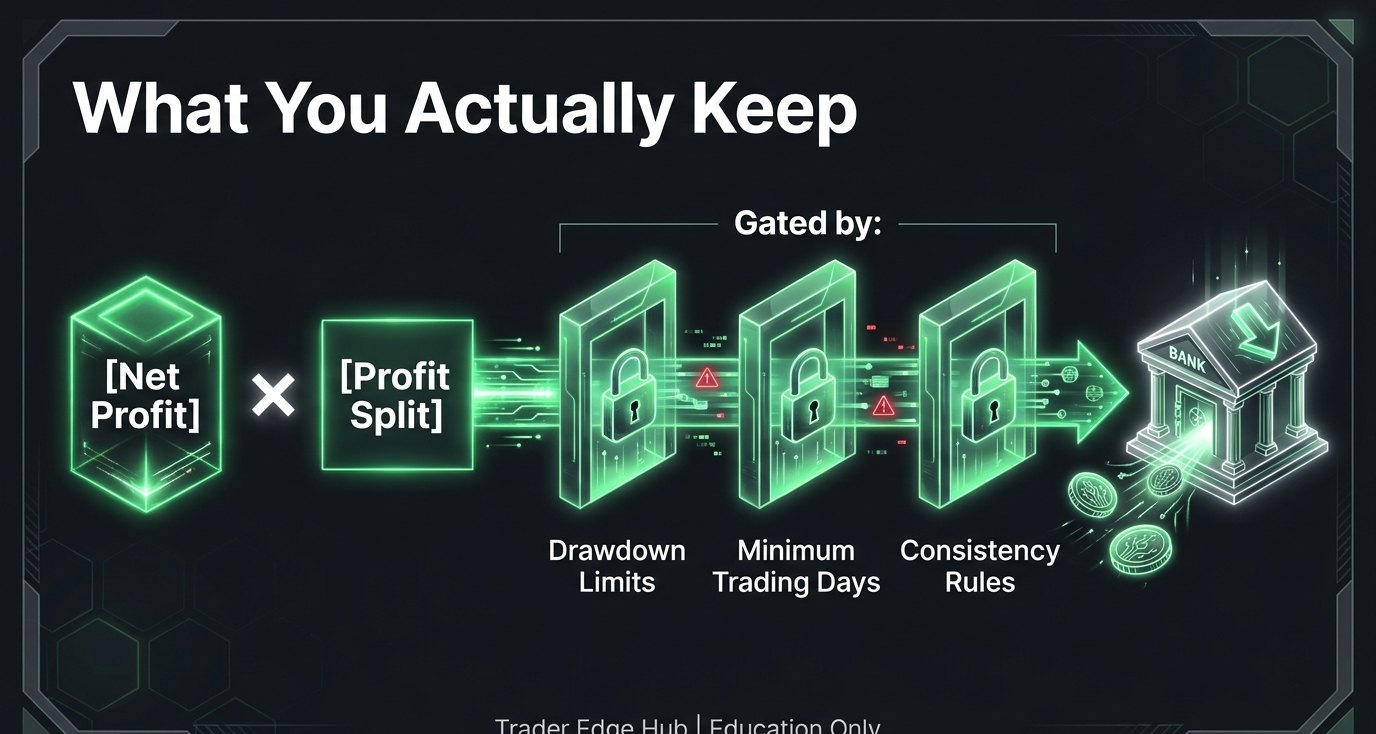
Quick answer: Payout terms determine how fast, how often, and how much performance revenue you can withdraw. Profit splits range from 70% to 90%, while drawdown structures (trailing, static, or end-of-day) and consistency gates govern your actual eligibility. Comparing these fine-print rules prevents unexpected withdrawal rejections.
What do payout terms actually mean at a prop firm?
Payout terms define the contractual conditions governing performance reward withdrawals. According to Myfxbook's payout guide, understanding each rule prevents surprise account forfeitures.
A profit split (the net profit percentage allocated to the trader) sets your baseline earning ratio. According to Blue Guardian's blog published on April 29, 2026, most firm splits range between 70% and 90% after deducting commissions.
Payout frequency (how often withdrawal requests are accepted) dictates your cash flow cadence. According to For Traders' FAQ, withdrawal schedules range from daily processing to bi-weekly or monthly windows.
First payout timing (the mandatory waiting period before your initial withdrawal) establishes your initial milestone. According to Lune Trading's guide published in 2026, initial payout gates range from day one to 30 calendar days.
Minimum payout amounts establish the floor required for processing withdrawal requests. According to TradersPost's comparison on September 16, 2026, withdrawal floors range from $50 up to $250 across major platforms.
Drawdown types (the mathematical tracking method used for loss limits) determine your account survival threshold. According to PropScorer's analysis, drawdowns track peak equity, end-of-day balance, or static capital limits.
Consistency rules (maximum percentage caps on single-day profit contributions) prevent single windfall trades from passing challenges. According to Capital Critic's tracker on October 1, 2026, consistency caps range from 30% to 55% across funded plans.
Pro tip: Never select a proprietary firm based solely on headline profit splits. An 80% split with a static drawdown often yields more accessible payouts than a 90% split paired with trailing intraday loss limits.
How do profit splits really differ between firms?
Headline profit splits vary based on account tiers, evaluation models, and scaling milestones. According to Topstep's payout policy, traders retain 90% of net gains after completing evaluation milestones.
Some firms offer tier scaling structures that raise your split over time. According to For Traders, profit splits begin at standard levels and scale up to 90% as traders achieve consistent profit targets.
Direct funding plans often feature slightly lower baseline splits in exchange for skipping evaluation phases. According to Instant Funding's Help Center, instant model splits start at 70% and scale up to 90% upon hitting growth metrics.
Other providers feature 100% initial split tiers up to specific earnings caps. According to Tradervana's Apex guide published in 2026, traders keep 100% of their first $25,000 in profits before moving to a 90% split.
Similarly, DayTraders.com provides a 100% profit split on Pro accounts, while Live funded accounts operate on an 80/20 split. According to DayTraders.com's documentation, higher split tiers reward consistent account growth over extended periods.
Passing evaluation challenges requires disciplined execution and strict risk management. According to Tradeify's performance disclosure updated on August 9, 2026, only 17.2% of evaluation accounts reach funded status. Furthermore, Tradeify's official statistics show that only 28.5% of funded participants receive a payout. Proprietary trading involves significant loss risks and is never easy money.
How does the drawdown type change what you can withdraw?
Drawdown structures directly control how much profit you can safely extract from your account. According to AudaCity Capital's analysis, understanding trailing versus static loss limits protects your funded balance.
Trailing drawdown (a loss limit that moves upward continuously with open equity peaks) tracks real-time unrealized gains. According to PropScorer's drawdown guide, if open equity reaches a new high, your loss threshold trails upward immediately, locking in higher equity floors.
End-of-day drawdown (a loss limit calculated strictly at market close balance) ignores intraday equity spikes. According to Tradeify's policy guide, end-of-day tracking allows intraday floating profits to fluctuate without raising your loss floor until session settlement.
Static drawdown (a fixed loss threshold anchored strictly to initial balance) never moves upward regardless of profit accumulated. According to AudaCity Capital, static limits provide maximum flexibility because withdrawing profit does not pull your loss limit higher.
Requesting payouts reduces your account equity and pulls your balance closer to the drawdown floor. According to Lune Trading's Apex guide published in 2026, traders must maintain safety buffer profits above trailing thresholds. This buffer prevents immediate account closure upon withdrawal.
Safety buffers act as mandatory equity cushions above starting balance limits. According to Take Profit Trader's PRO account rules, profits below the buffer threshold remain locked inside the account as equity support.
How do FTMO, Apex, For Traders and Instant Funding payout terms compare?
Evaluating proprietary platforms side-by-side reveals significant differences in operational rules and withdrawal conditions. According to Capital Critic's Fine Print tracker on October 1, 2026, firms updated over 150 fine-print terms across the industry.
Each firm strikes a distinct balance between split percentages, evaluation requirements, and loss parameters. Examining these metrics together provides a clear view of total operational conditions.
Comparing payout limits across platforms helps traders avoid unexpected hurdles. According to Myfxbook's guide, checking rules before signing up protects your trading capital.
The table below compares payout parameters across four major proprietary trading platforms. All data points reflect verified rules published in official firm documentation and user guides.
| Prop Firm Platform | Profit Split Ratio | Payout Cadence / First Payout | Drawdown Structure Type | Key Payout Gate Rule |
|---|---|---|---|---|
| FTMO | 80% to 90% (FTMO FAQ) | Bi-weekly / 14 days (Lune Guide 2026) | Max Daily & Max Loss (FTMO FAQ) | Flat positions at snapshot (FTMO FAQ) |
| Apex Trader Funding | 100% first $25k, then 90% (Tradervana 2026) | Twice monthly (Lune Apex 2026) | Trailing Intraday (Tradervana 2026) | 8 minimum trading days per cycle (Tradervana) |
| For Traders | Up to 90% (For Traders Rules 2026) | On-demand after 14 days (For Traders FAQ) | Static & Daily Max Loss (For Traders Rules) | $50 minimum payout floor (For Traders FAQ) |
| Instant Funding | 70% to 90% (Instant Funding Help Center) | Weekly / On-demand (Lune Instant 2026) | Smart Trailing & Static (Help Center) | Consistency rule on select plans (Lune 2026) |
How fast do prop firms actually pay out?
Payout processing speeds depend on internal compliance verification steps and chosen payment transfer rails. According to Blue Guardian's fast payout review published on April 29, 2026, withdrawal speeds vary significantly between platforms.
Cryptocurrency processing rails offer the fastest settlement times across major prop firms. According to Lune Trading's FundedNext review updated in 2026, crypto payouts process within 24 hours of approval.
Traditional bank wire transfers require longer processing intervals due to intermediary banking checks. According to For Traders' FAQ, bank wire payouts settle within 1 to 5 business days following risk review approval.
Direct payment processors like Rise or Deel offer flexible withdrawal options for global traders. According to Myfxbook's payout guide, digital processors settle approved transactions within 24 to 48 hours.
Fast processing policies reward disciplined traders who satisfy compliance checks promptly. According to Blue Guardian's 2026 report, completing identity verification in advance prevents processing delays.
Common mistake: Selecting cryptocurrency payout rails without double-checking wallet address network compatibility. Sending funds to an incorrect blockchain network results in permanent loss of your performance rewards.
How should you compare payout terms for your own trading style?
Matching payout parameters to your trading style requires evaluating execution frequency, holding times, and risk parameters. According to Myfxbook's payout guide, selecting incompatible rules increases account failure rates.
Before buying an evaluation account, review your strategy against the firm's fine print. Follow this five-step checklist to evaluate payout terms effectively:
- Identify drawdown tracking mechanics: Determine whether the firm uses trailing intraday drawdown, end-of-day balance tracking, or static loss limits.
- Calculate consistency requirements: Verify whether single-day profit caps or minimum winning day thresholds apply to withdrawal requests.
- Verify payout frequency and minimum floors: Check how often payouts process and ensure minimum withdrawal floors match your expected gains.
- Confirm position holding rules: Ensure the platform permits weekend position holds and news trading if your strategy requires overnight exposure.
- Review safety buffer rules: Check whether initial profits remain locked as equity support before withdrawals open.
Systematically checking these criteria ensures your strategy aligns with platform rules. According to For Traders' guidelines, choosing compatible terms improves long-term consistency.
What does a payout look like with a $5,000 account?
Examining a concrete trading record shows how position sizing, win rates, and profit splits determine take-home earnings. Proper risk management through Position Sizing: The 1% Rule Explained preserves capital during market drawdowns.
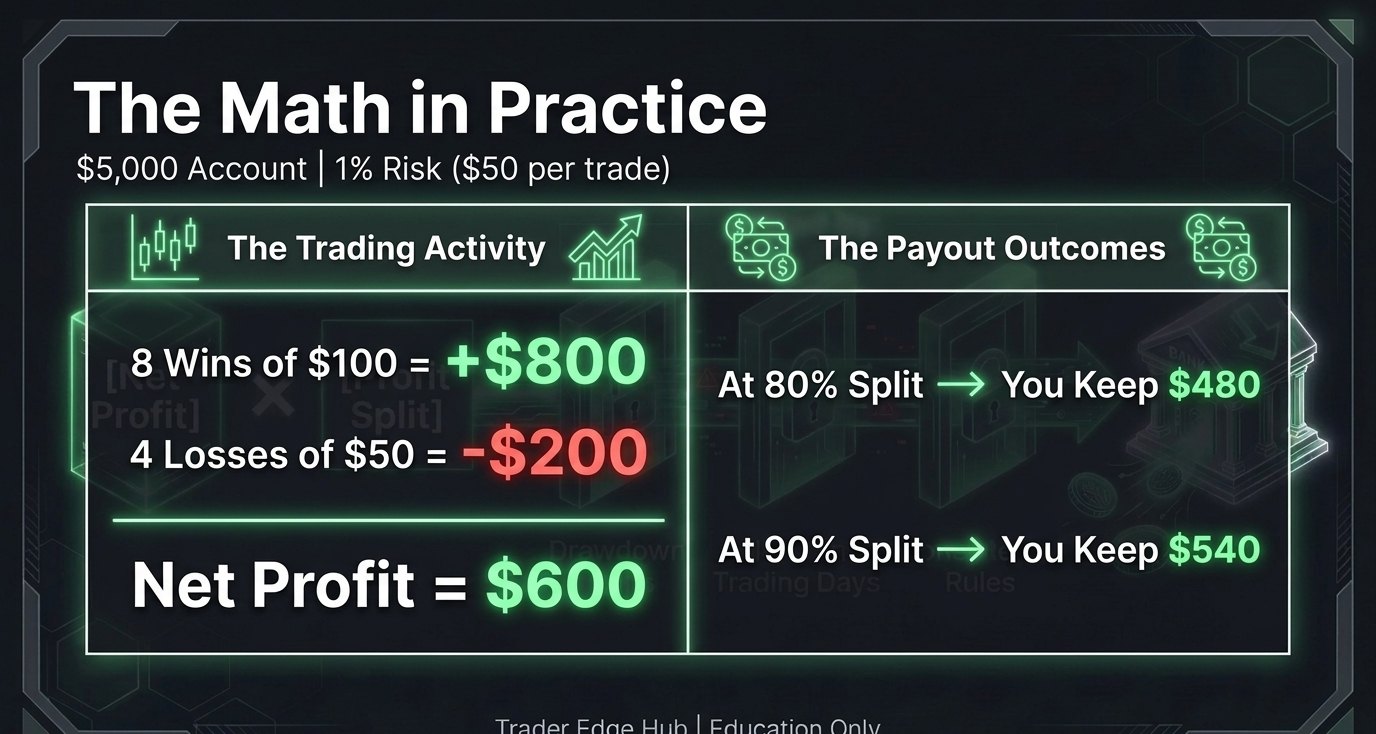
Consider a $5,000 evaluation account with 1% risk ($50 per trade). Over twelve trading sessions, you execute eight winning trades at $100 profit (2:1 reward ratio) and four losing trades at $50 loss.
Your gross profit totals $800 (eight wins at $100), while gross loss equals $200 (four losses at $50). Subtracting losses yields a net profit of $600 over the trading period.
Evaluating net profit across different split tiers highlights the financial impact of profit splits. The table below details the exact payout calculations for this $5,000 account scenario.
| Account Parameter / Metric | Calculation Details | Resulting Value |
|---|---|---|
| Starting Account Capital | Initial evaluation account balance | $5,000 |
| Risk Per Trade (1%) | $5,000 multiplied by 0.01 | $50 |
| Winning Trades (8 trades) | 8 wins multiplied by $100 profit | +$800 gross profit |
| Losing Trades (4 trades) | 4 losses multiplied by $50 loss | -$200 gross loss |
| Net Accumulated Profit | $800 gross profit minus $200 gross loss | $600 net profit |
| Trader Share at 80% Split | $600 net profit multiplied by 0.80 | $480 payout to trader |
| Firm Share at 80% Split | $600 net profit multiplied by 0.20 | $120 retained by firm |
| Trader Share at 90% Split | $600 net profit multiplied by 0.90 | $540 payout to trader |
| Firm Share at 90% Split | $600 net profit multiplied by 0.10 | $60 retained by firm |
What are the 6 most common payout mistakes?
Payout rejections occur primarily from administrative oversights. According to Blue Guardian's payout guide published on April 29, 2026, avoiding six common errors protects your earned capital.
First, failing to flatten open trades before requesting withdrawals triggers immediate rejection. According to For Traders' FAQ, all open positions must be closed before cycle snapshots.
Second, breaching daily loss parameters forfeits accumulated earnings automatically. Managing risks covered in Daily Loss Limits and Max Drawdown prevents unexpected account terminations.
Third, miscalculating consistency caps blocks withdrawal processing. According to PropScorer's guide, one oversized winning day forces traders to complete additional sessions to dilute their percentage ratio.
Fourth, requesting withdrawals below minimum payout thresholds causes administrative rejections. According to TradersPost's comparison, submitting requests under required floors stalls processing schedules.
Fifth, withdrawing profits without maintaining mandatory safety buffers pulls equity into drawdown zones. According to Take Profit Trader's rules, buffer balances must remain untouched.
Sixth, trading prohibited high-impact news events invalidates session profits. According to FTMO's FAQ, executing orders inside restricted news windows results in profit forfeitures.
Which tools help you track prop firm payout terms?
Monitoring complex evaluation metrics requires structured tracking platforms. Tracking daily equity curves prevents accidental rule breaches across active cycles.
Using TradingView enables precise daily P&L charting and technical analysis. Linking chart logs with How to Keep a Trading Journal maintains accurate execution records.
Selecting platforms with transparent rule engines simplifies compliance management. Evaluating direct plans at Instant Funding or structured challenges at For Traders helps align your strategy with clear rules.
Remember that proprietary trading involves substantial risk, and most evaluation accounts fail to pass. According to Tradeify's performance disclosure, over 82% of evaluation attempts fail before reaching funded status.
Test yourself: 5 questions on prop firm payout terms
Test your understanding of profit splits, drawdown mechanics, and payout gates with this five-question quiz. Evaluate each question carefully to confirm your operational readiness.
1. What happens when you submit a payout request while holding open trades?
A) The prop firm automatically closes your trades at market price.
B) Your payout request is rejected immediately by compliance.
C) The payout processes normally while trades remain open.
D) Your account balance doubles automatically.
Answer: B. Most prop firms require all open positions to be flattened before approving payout requests.
2. On a $5,000 account with $600 net profit and an 80% split, how much does the trader receive?
A) $600
B) $540
C) $480
D) $120
Answer: C. An 80% split on $600 net profit yields $480 to the trader ($600 multiplied by 0.80).
3. How does a trailing intraday drawdown behave as your account equity rises?
A) It remains fixed at your starting account capital.
B) It trails your highest unrealized equity peak upward in real time.
C) It resets to zero at the end of every trading week.
D) It decreases by 1% after every winning trade.
Answer: B. Trailing intraday drawdowns follow unrealized equity highs upward, raising your loss threshold continuously.
4. What is the main purpose of a prop firm safety buffer?
A) To cover monthly platform subscription fees.
B) To protect the firm from immediate drawdown losses after payouts.
C) To prevent traders from accessing leverage.
D) To limit total trading hours per week.
Answer: B. Safety buffers preserve an equity cushion above starting balance to absorb future trading losses.
5. According to Tradeify's performance disclosure, what percentage of evaluation accounts reach funded status?
A) 50.0%
B) 28.5%
C) 17.2%
D) 90.0%
Answer: C. Tradeify's official statistics confirm that only 17.2% of evaluation accounts successfully pass to funded status.
FAQ
How long does a prop firm payout take to settle?
Payout processing speed depends on compliance verification and transfer rails. According to Blue Guardian's 2026 report, crypto payouts settle within 24 hours, while bank wires require 1 to 5 business days.
Do you have to pay taxes on prop firm payouts?
Performance rewards from proprietary trading are treated as taxable self-employment income in most jurisdictions. According to For Traders' FAQ, traders receive gross distributions and must file local taxes independently.
What is the difference between static and trailing drawdown?
Static drawdown stays anchored to your initial balance, whereas trailing drawdown moves upward with equity peaks. According to AudaCity Capital's guide, static limits offer greater operational flexibility for traders.
Does a payout request reduce your available drawdown cushion?
Withdrawing profits reduces account equity and brings your balance closer to trailing drawdown thresholds. According to Topstep's payout documentation, maintaining equity above loss limits prevents account closure.
Are evaluation challenge fees refunded upon your first payout?
Many proprietary platforms refund initial challenge fees alongside your first approved withdrawal. According to Blue Guardian's 2026 review, fee refunds lower total amortized costs for successful traders.
What happens if you experience a drawdown losing streak after a payout?
Navigating drawdown requires strict risk management to prevent account termination. Reviewing techniques in Losing Streaks in Trading helps preserve remaining equity support.
The verdict
Prop firm payout terms reward disciplined position sizing, systematic risk management, and rule adherence. Understanding how profit splits, drawdown types, and consistency gates interact ensures your gains reach your bank account.
Calculating long-term probabilities through How Prop Firm Payouts Work: Profit Splits, Consistency Rules and the Math improves performance consistency. Evaluating execution parameters ensures sustainable account growth over time.
Your immediate next step is to review your firm's exact drawdown tracking model and consistency formulas before opening your next trade. Verifying fine-print rules protects your earned profits effectively.
Sources: FTMO FAQ, For Traders Rules (August 2026), Tradeify Policy, and Bold Funded Rules (October 2026). Additional sources include Blue Guardian (April 2026), Capital Critic (October 2026), TradersPost (September 2026), PropScorer (2026), and AudaCity Capital.
Trading involves substantial risk of loss, and most retail traders lose money. This article is education, not financial advice.
