

- What is a prop firm payout and where does the money come from?
- How does a profit split work?
- What is a consistency rule and how is it calculated?
- What are minimum trading days, payout frequency and minimum payout amounts?
- How do drawdown and buffer rules limit what you can withdraw?
- Why do prop firm payouts get denied?
- How do payout terms differ between prop firms?
- How does the math work on a $5,000 account example?
- Which 6 common mistakes block prop firm payouts?
- Which tools help you track prop firm payout rules?
- Test yourself: 5 questions on prop firm payouts
- What are frequently asked questions about prop firm payouts?
- How long does a prop firm payout take to settle?
- Do you have to pay taxes on prop firm payouts?
- Can you withdraw funds while holding open trades?
- What is the difference between a soft breach and a hard breach?
- Does the consistency calculation reset after a payout?
- Are challenge fees refunded with your first payout?
- What is the final verdict on prop firm payouts?
Trading involves substantial risk of loss, and most retail traders lose money. This article is education, not financial advice.
Disclosure: this article contains affiliate links. If you sign up through them, Trader Edge Hub may earn a commission at no extra cost to you. We only mention tools we think fit the topic.
Understanding prop firm payouts [performance reward withdrawals from proprietary trading accounts] requires looking past advertised split numbers. At Trader Edge Hub, we examine the mathematical rules that dictate when virtual profits become real capital.
Proprietary trading firms set strict risk parameters to protect their shared capital pool. Navigating these rules determines whether you actually receive your requested withdrawals.
Quick answer: A prop firm payout is a performance reward drawn from simulated trading gains. You must pass evaluation checks, satisfy consistency caps, and observe minimum trading day thresholds to withdraw funds. Splits of 70% to 90% of net profit are common, but the rules decide whether you get paid at all.
What is a prop firm payout and where does the money come from?
A prop firm payout represents the transfer of your performance reward to your bank account or crypto wallet. According to For Traders, payouts move through dashboard requests, rule compliance checks, identity verification, and payment settlement.
Most modern proprietary firms evaluate traders inside simulated demo environments using virtual capital [notional funds provided for market assessment]. According to FTMO's FAQ, all trading accounts operate in a virtual environment to evaluate trader discipline.
When you meet performance conditions on a Master Account, the firm pays your performance reward from its corporate revenue pool. According to Myfxbook's payout guide, proprietary firms monetize simulation data and challenge fees to distribute real rewards to successful traders.
Securing a payout requires disciplined execution rather than aggressive gambling. According to Tradeify's performance statistics calculated as of August 9, 2026, only 17.2% of initiated evaluation accounts advance to funded status. Furthermore, Tradeify's official performance disclosure confirms that only 28.5% of funded participants actually receive a payout. Proprietary trading requires strict risk control and is never easy money.
How does a profit split work?
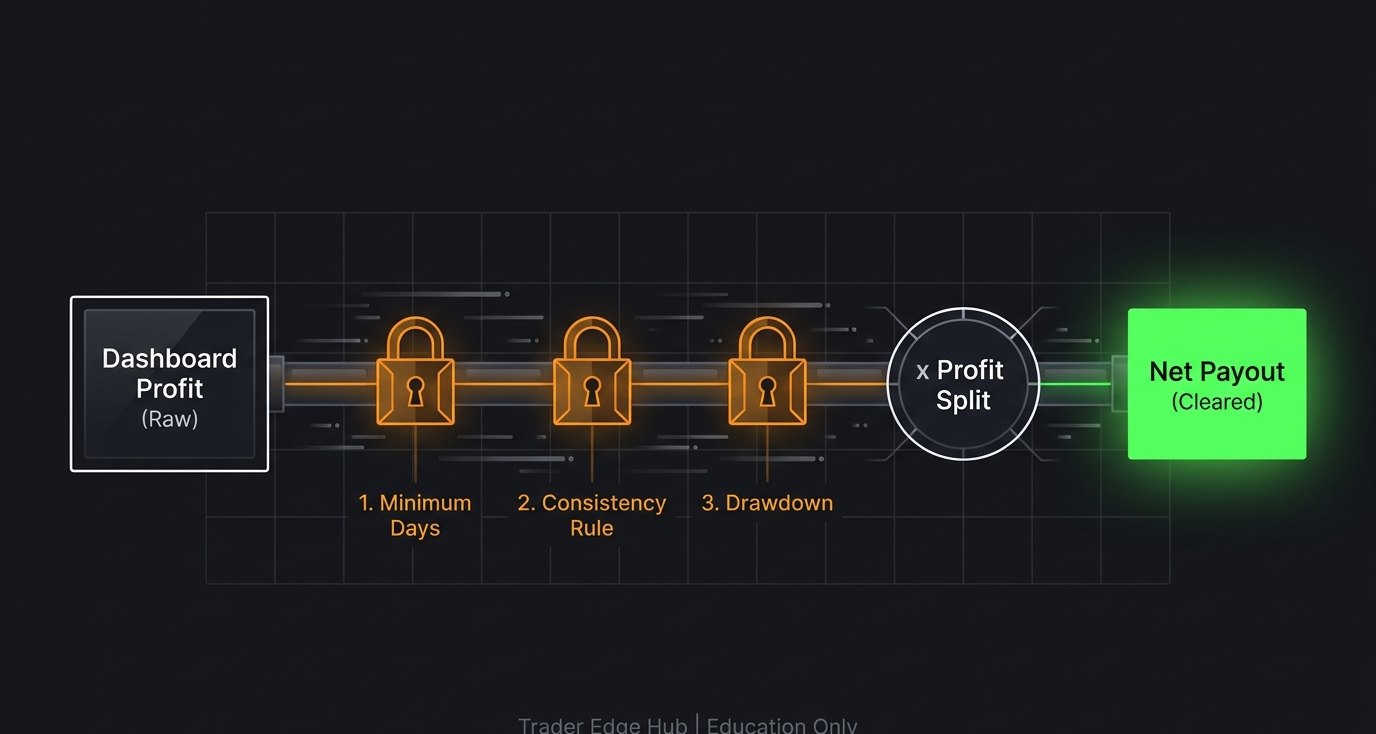
A profit split [the percentage ratio of net gains kept by the trader versus the firm] determines your share of generated earnings. According to Blue Guardian's blog published on April 29, 2026, profit splits apply strictly to net profit after deducting commissions and transaction fees.
Standard industry profit splits range from 70% to 90% in favor of the trader. According to DayTraders.com, Pro accounts offer a 100% split, while Live funded accounts operate on an 80/20 split disbursing 80% to the trader.
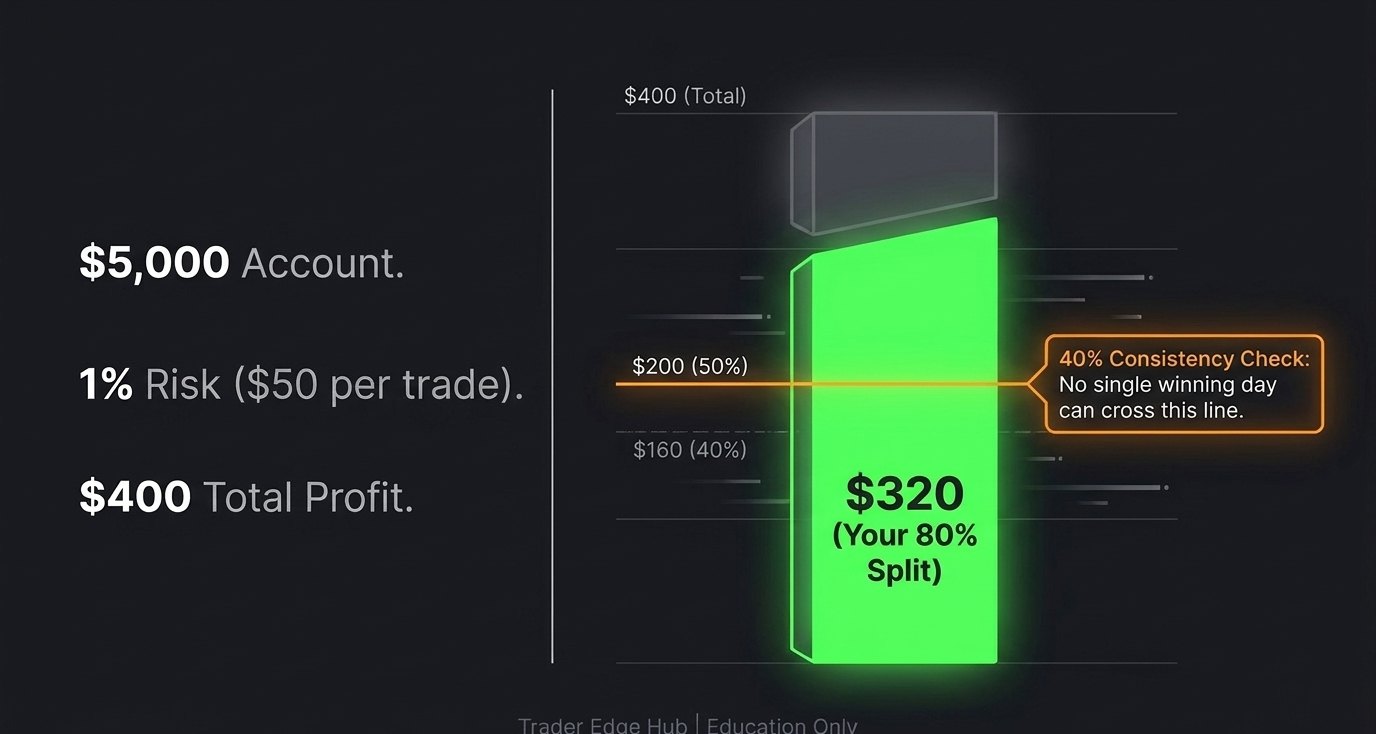
Consider a worked example on a $5,000 funded account with 1% risk ($50 per trade). Over a trading cycle, you generate $400 in net profit. On an 80/20 split, you receive $320 while the firm retains $80. According to Blue Guardian's guide from April 29, 2026, higher splits like 90% yield $360 on $400 net gains.
Some firms utilize performance scaling plans where your split percentage increases as you hit profit milestones. According to For Traders' guide published on August 21, 2026, scaling structures increase your account capital allocation and split percentage over consecutive profitable cycles.
Pro tip: Always calculate your effective take-home pay after accounting for commissions, rail processing fees, and mandatory safety buffers. A clean 80% split with immediate withdrawals often yields more net cash than a 90% split locked behind complex ladders.
What is a consistency rule and how is it calculated?
A consistency rule [a cap on the maximum profit percentage allowed from one session] prevents single-day windfalls from passing evaluations. According to Bold Funded's risk guide checked on October 13, 2026, the rule filters out single-bet passes to reward repeatable trading habits.
The mathematical formula for the consistency metric is straightforward. Consistency Percentage equals best single day profit divided by total accumulated profit, multiplied by 100. According to Phidias Propfirm's education guide from October 2026, your ratio must remain at or below the firm's threshold.
Let us examine a worked example on a $5,000 account. Suppose you accumulate $400 in total profit over a trading period under a 40% consistency rule. Your largest single trading day must be $160 or less [$400 multiplied by 0.40].
If your best day reaches $200 on $400 total profit, your consistency ratio equals 50% [$200 divided by $400]. Under a 40% rule, this creates a soft breach [a temporary restriction that delays payout requests without closing the account].
To calculate the total profit required to clear this soft breach, divide your best day by the cap percentage. In this scenario, $200 divided by 0.40 equals $500 total profit. You must make $100 in additional profit on smaller trading days to dilute the ratio back to 40%.
Cap percentages vary significantly across platforms. According to Capital Critic's Fine Print tracker on October 1, 2026, Topstep enforces a 55% consistency target in its Combine. Meanwhile, Tradeify applies a 35% consistency rule on Growth funded accounts.
| Prop Firm & Program | Consistency Cap % | Stage Applied | Max Day on $3,000 Gain |
|---|---|---|---|
| Phidias Fundamental (CASH) | 30% | Funded Account | $900 |
| Tradeify Growth Funded | 35% | Funded Account | $1,050 |
| Topstep XFA Consistency | 40% | Funded Account | $1,200 |
| MyFundedFutures Builder | 50% | Funded Account | $1,500 |
| Topstep Combine | 55% | Evaluation Phase | $1,650 |
| Instant Funding / Tradeify Select | None | Funded Account | No dollar limit |
What are minimum trading days, payout frequency and minimum payout amounts?
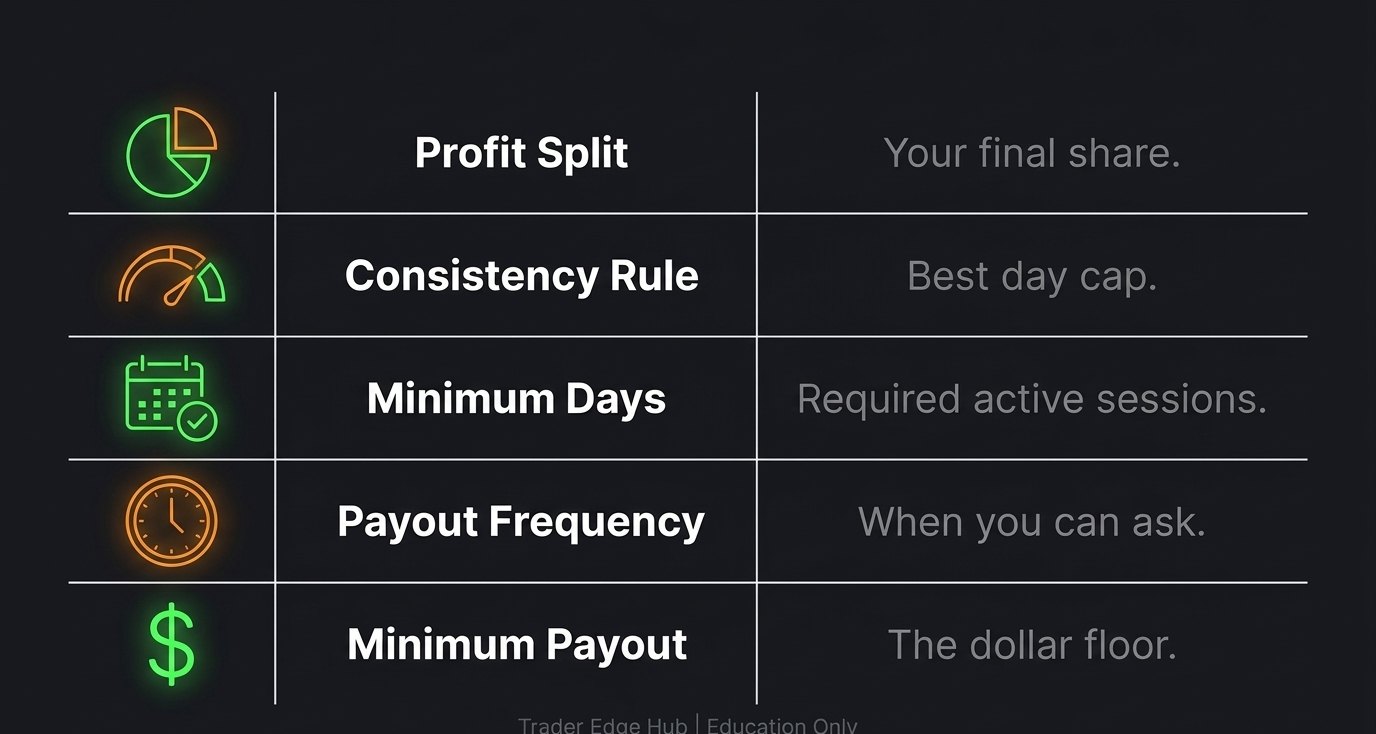
Minimum trading days [mandatory session counts with open and closed trades] determine when payouts unlock. According to Bold Funded's rules checked on October 13, 2026, holding positions across multiple days counts as one single trading day when closed.
Payout frequency dictates how often you can submit withdrawal requests. According to Blue Guardian's review published on April 29, 2026, payout schedules range from daily requests to bi-weekly cycles [14 days] or monthly intervals.
Minimum payout amounts establish the lowest withdrawal floor allowed per request. According to TradersPost's comparison on September 16, 2026, minimum floors vary widely across firms.
For Traders sets a low $50 minimum payout threshold, while Topstep sets a $125 minimum. According to TradeDay's pricing guide, their platform sets a $250 minimum withdrawal floor across all account tiers.
| Prop Firm | Minimum Trading Days | Payout Cadence | Minimum Payout Floor |
|---|---|---|---|
| For Traders | None on funded sim | On-demand after 14 days | $50 |
| FTMO | None on standard funded | Bi-weekly / On-demand | None stated |
| Topstep XFA | 3 days [or 5 winning days] | Twice monthly | $125 |
| TradeDay Quick Pay | 1 day | Daily | $250 |
| Bold Funded (Bold Plan) | 5 qualifying days [$250+ win] | Every 5 days | $500 |
How do drawdown and buffer rules limit what you can withdraw?
Drawdown limits [the maximum loss threshold allowed before account termination] sit directly alongside payout rules. According to Tradeify's risk policy, trailing drawdowns track your highest balance and move your loss floor upward.
A safety buffer [a mandatory profit cushion required above starting equity] further restricts initial withdrawals. According to Tradeify's Select Daily plan, a $50,000 account requires a $2,100 buffer before daily withdrawals open.
This buffer protects the firm from immediate losses after distributing capital. According to Take Profit Trader's PRO account rules, profits below the buffer threshold remain locked inside the account as equity support.
Requesting payouts reduces your account equity and pulls your balance closer to the drawdown floor. According to Topstep's payout documentation, maintaining equity above your Maximum Loss Limit ensures you can continue trading safely after withdrawing profits.
Why do prop firm payouts get denied?
Payout denials stem primarily from operational oversights rather than performance failures. According to Blue Guardian's payout guide published on April 29, 2026, leaving open positions at request time triggers immediate rejection.
Breaching daily loss limits or maximum trailing drawdowns automatically terminates the account and forfeits unrequested gains. According to For Traders' rules from August 21, 2026, risk limit violations void all pending performance rewards instantly.
Exceeding consistency percentage caps blocks withdrawal approval until you dilute the oversized single-day gain. According to Thor Trade Copier's guide published on June 15, 2026, consistency breaches act as payout gates rather than account failures.
Violating trading conduct guidelines also leads to denied withdrawals. According to FTMO's FAQ, using unauthorized automated trading algorithms or trading through restricted news windows invalidates generated profits.
Common mistake: Submitting a withdrawal request while holding open trades or before completing identity verification. Always flatten all positions, confirm your consistency calculation, and complete identity documentation before requesting your payout.
How do payout terms differ between prop firms?
Comparing payout terms requires evaluating profit splits, consistency caps, minimum trading days, and withdrawal cadences together. According to TradersPost's comparison on September 16, 2026, headline splits mean little if restrictive rules block your funds.
Proprietary trading firms set varied parameters across account models. According to Capital Critic's Fine Print tracker on October 1, 2026, terms update frequently without public announcements.
The table below compares major proprietary platforms using verified source data. Figures come from the sources named in this article. Firms change terms often, so check each firm's current terms page before you buy.
| Prop Firm & Model | Profit Split | Consistency Rule | Minimum Trading Days | Payout Cadence |
|---|---|---|---|---|
| FTMO (Standard) | 80% to 90% | None on standard accounts | None on standard funded | Bi-weekly / On-demand |
| Instant Funding | 70% to 90% | None on One-Phase | None [funded day one] | Weekly / On-demand |
| For Traders | Up to 90% | No hard cap, soft guidance | None on funded sim | On-demand after 14 days |
| Apex Trader Funding | 100% first $25k, then 90% | Trading day minimums | 8 trading days per cycle | Twice monthly |
| Topstep XFA Consistency | 90% | 40% consistency cap | 3 trading days | Twice monthly |
| Tradeify Select Flex | 90% | None once funded | 5 winning days | On-demand after 5 winning days |
| Take Profit Trader PRO | 80% [100% first $10k] | None above buffer | None above buffer | Twice monthly / Daily |
| TradeDay Quick Pay | 80% to 90% | None in funded sim | 1 day | Daily |
| Bold Funded (Bold Plan) | 90% to 95% | None once funded | 5 qualifying days [$250+ win] | Every 5 days |
How does the math work on a $5,000 account example?
Understanding payout calculations requires evaluating account equity, position sizing, net profit, profit splits, and consistency limits together. Proper risk controls ensure accounts stay compliant through all market conditions.
Following strict rules like Position Sizing: The 1% Rule keeps your loss limits safe during drawdown cycles. Managing your risk per trade protects your account capital effectively.
Let us analyze a $5,000 account with 1% risk [$50 per trade] over five sessions. The table below details two trading records: Case A passes the 40% consistency rule, while Case B fails.
| Metric / Trading Session | Case A (Passing Record) | Case B (Failing / Soft Breach) |
|---|---|---|
| Starting Account Equity | $5,000 | $5,000 |
| Risk Per Trade [1%] | $50 | $50 |
| Session 1 Net P&L | +$100 | +$220 [Largest Day] |
| Session 2 Net P&L | +$150 [Largest Day] | +$50 |
| Session 3 Net P&L | +$75 | +$60 |
| Session 4 Net P&L | +$50 | +$40 |
| Session 5 Net P&L | +$25 | +$30 |
| Total Accumulated Net Profit | $400 | $400 |
| Max Allowed Day [40% Cap] | $160 [$400 x 0.40] | $160 [$400 x 0.40] |
| Consistency Ratio Check | 37.5% [$150 / $400] - PASS | 55.0% [$220 / $400] - FAIL |
| 80% Trader Profit Split | $320 [$400 x 0.80] | Gated [$0 until diluted] |
| Action Required to Clear | Submit payout request | Earn $150 extra [Total $550] |
Which 6 common mistakes block prop firm payouts?
Payout rejections occur primarily from administrative oversights and procedural errors. According to Blue Guardian's guide from April 29, 2026, avoiding these six pitfalls protects your earned capital.
First, holding open trades when submitting a withdrawal request triggers an automatic rejection. According to For Traders' guidelines, all open positions must be flattened at cycle snapshot time.
Second, failing to calculate your consistency ratio leads to gated withdrawals. According to Phidias Propfirm's education guide, one oversized day forces extra trading sessions to dilute the percentage.
Third, violating daily drawdown parameters during active cycles terminates your account instantly. Keeping firm control over your daily loss limit and max drawdown prevents sudden forfeitures.
Fourth, submitting withdrawal requests before clearing minimum qualifying trading days creates processing delays. According to Bold Funded's rules, trades must open and close on qualifying sessions.
Fifth, requesting payouts below the required safety buffer floor locks your withdrawal options. According to Tradeify's policy, profit below mandatory buffers must remain as account equity.
Sixth, trading restricted high-impact news windows invalidates generated profits. According to FTMO's FAQ, executing trades inside prohibited news windows forfeits session gains.
Which tools help you track prop firm payout rules?
Managing multiple evaluation metrics requires reliable tracking platforms and analytics tools. Maintaining a structured journal allows you to monitor daily P&L, consistency percentages, and drawdown buffers.
Using TradingView enables precise daily P&L charting and trade logging. Pair your charts with a simple trading journal so you can track each payout cycle.
Choosing platforms with clear rule engines simplifies compliance management. Exploring flexible evaluation plans at Instant Funding or structured challenges at For Traders helps align your strategy with clear rules.
Test yourself: 5 questions on prop firm payouts
Test your understanding of profit splits, consistency caps, and payout mechanics with this five-question quiz. Answer each question carefully to evaluate your readiness for real funded withdrawals.
Q1: What happens if your single best trading day exceeds a 40% consistency rule?
A) Your account is failed and closed immediately.
B) Your payout is delayed until you dilute the ratio with more profit.
C) The prop firm forfeits your account balance.
D) You receive a 10% penalty fee.
Answer: B. Exceeding a consistency cap results in a soft breach that delays payouts until total profit increases.
Q2: On a $50,000 account with an 80% split and $400 net profit, how much do you receive?
A) $400
B) $360
C) $320
D) $280
Answer: C. An 80% split on $400 net profit yields $320 to the trader [$400 multiplied by 0.80].
Q3: According to Bold Funded, what constitutes a valid trading day?
A) Placing a pending limit order.
B) Holding an open trade overnight without closing.
C) Opening and closing at least one trade during the session.
D) Logging into the trading platform.
Answer: C. A valid trading day requires at least one trade to be both opened and closed within the session.
Q4: Why do prop firms enforce safety buffers on funded accounts?
A) To charge hidden monthly platform fees.
B) To protect the firm from immediate drawdown losses post-payout.
C) To restrict traders from ever withdrawing profits.
D) To reduce available leverage to 1:1.
Answer: B. Safety buffers preserve equity cushions above starting balance to absorb future trading drawdowns.
Q5: How does a trailing drawdown differ from a static drawdown?
A) A trailing drawdown never moves from starting capital.
B) A trailing drawdown follows equity peaks upward, whereas static drawdown stays fixed.
C) A static drawdown increases after every winning trade.
D) A trailing drawdown only updates once per year.
Answer: B. Trailing drawdowns move upward with account highs, while static drawdowns remain anchored at fixed levels.
What are frequently asked questions about prop firm payouts?
How long does a prop firm payout take to settle?
Payout settlement speed depends on the chosen payment rail and firm compliance checks. According to Blue Guardian's 2026 review, crypto withdrawals process within hours, while bank wires require 1 to 5 business days.
Do you have to pay taxes on prop firm payouts?
Performance rewards from proprietary trading are treated as taxable income in your local jurisdiction. According to For Traders' FAQ, traders receive gross rewards and must manage local tax filings independently.
Can you withdraw funds while holding open trades?
Most proprietary trading firms require all open positions to be flattened before submitting payout requests. According to Blue Guardian's rules, open trades cause immediate withdrawal rejection.
What is the difference between a soft breach and a hard breach?
A soft breach delays payout eligibility without terminating your account balance or evaluation status. According to Thor Trade Copier's guide, a hard breach [hitting daily loss limits] closes the account permanently.
Does the consistency calculation reset after a payout?
Reset rules vary by platform after receiving an approved withdrawal. According to Phidias Propfirm's rules guide from October 2026, firms like Lucid reset consistency calculations to zero for the next payout cycle.
Are challenge fees refunded with your first payout?
Many evaluation-based proprietary firms refund initial challenge fees alongside your first approved reward. According to Blue Guardian's guide, fee refunds lower amortized costs for disciplined traders.
What is the final verdict on prop firm payouts?
Prop firm payouts reward steady execution, disciplined position sizing, and systematic risk management. Understanding rule mechanics ensures your trading gains convert into real take-home capital.
If you trade a small account, our guide to what replaced the PDT rule covers other routes. Our AI backtesting guide shows how to test a strategy before you pay a challenge fee.
Your immediate next step is to review your current firm's exact consistency formula, drawdown buffer, and payout cadence before opening your next trade. Taking time to verify these terms protects your earned profits.
Sources: FTMO FAQ, For Traders Payout Rules (August 2026), Tradeify Payout Policy, Bold Funded Rules (October 2026), Blue Guardian Fast Payouts (April 2026), Capital Critic Fine Print Tracker (October 2026), TradersPost Payout Comparison (September 2026), Phidias Propfirm Consistency Guide (October 2026), DayTraders.com Profit Split Guide.
Trading involves substantial risk of loss, and most retail traders lose money. This article is education, not financial advice.