
- What is position sizing?
- What is the 1% rule and why do traders use it?
- Why drawdowns hurt more than they look
- How do you calculate position size?
- Example 1: a $5,000 stock account
- Example 2: a $10,000 forex account (pips and lots)
- Example 3: a $50,000 prop-firm or futures account
- Should you risk 1% or less?
- How does position sizing work with risk-reward and R-multiples?
- How do you handle a losing streak?
- Common position sizing mistakes
- Tools that help
- FAQ
- How do you calculate position size for a small account?
- What is the difference between position size and leverage?
- Is 2% risk per trade safe for day trading?
- What if my position size is smaller than the broker's minimum order?
- What is risk of ruin in trading?
- The verdict
Trading involves substantial risk of loss. This article is education, not financial advice.
Disclosure: this article contains affiliate links. If you sign up through them, Trader Edge Hub may earn a commission at no extra cost to you. We only mention tools we think fit the topic.
Most traders spend hundreds of hours hunting for the perfect chart setup, then blow up their accounts anyway because they never controlled their risk. When you enter a trade without knowing your exact downside, one bad trade can wipe out weeks of gains. This guide shows you how to calculate your exact trade size for stocks, forex and futures before you place an order. By the end, you'll know how much to risk, how to size every position, and how to keep your account alive through a losing streak.
Quick answer: Position sizing decides how many shares, lots or contracts you trade, based on your account size and your stop loss distance. The 1% rule caps your loss on any single trade at 1% of your account. To size a trade, divide your dollar risk (1% of your balance) by your risk per share, pip or point.
What is position sizing?
Position sizing (calculating how many shares, contracts or lots to trade based on your account and your risk limit) is what keeps traders in the game. Many beginners believe success comes down to entry signals and indicators. Trading author Van Tharp argued the opposite: entries matter far less than most people think, and position sizing drives most of a system's results.
Size also changes how you trade. When a position is too big for your account, the loss feels threatening, and fear takes over your decisions. That's when traders move their stop loss (a pre-set order that exits a trade at a chosen price to limit the loss), hesitate on valid setups, or cut winners early.
Keeping each trade small removes most of that pressure. When one trade is a small slice of your account, a loss stops feeling personal. You stay calm enough to follow your rules and let your edge play out over many trades.
What is the 1% rule and why do traders use it?
The 1% rule means you risk no more than 1% of your account on any single trade. If the trade hits your stop, you lose at most $1 for every $100 in your account. It's a common benchmark among professional risk managers because staying in the game comes before growing the account.
The main reason is to keep your risk of ruin (the probability of losing so much that you can't keep trading) as close to zero as possible. Trading author Brent Penfold makes the point bluntly: any approach with a risk of ruin above zero will eventually fail. Risk 25% per trade and four straight losses can wipe out most or all of your account. Risk 1% and you can take dozens of losses in a row and still be trading.
Why drawdowns hurt more than they look
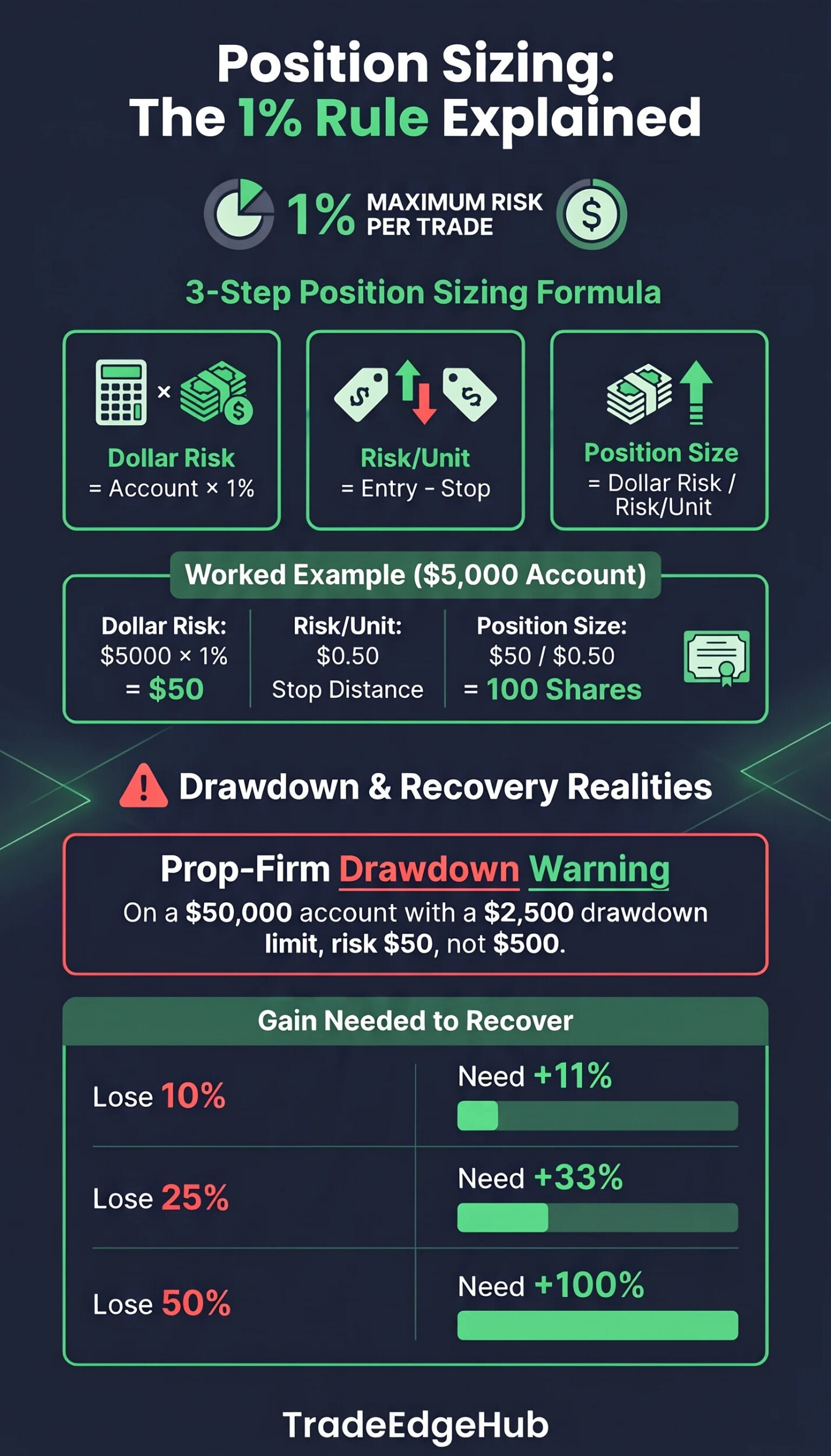
A drawdown (the fall from your account's peak to its low point) is harder to recover from than it sounds. After a loss, you're growing a smaller balance, so you need a bigger percentage gain just to get back to even:
| If you lose | You need to gain |
|---|---|
| 10% | 11.1% |
| 25% | 33.3% |
| 50% | 100% |
That last row is the one to remember: halve your account and you have to double it to break even.
Risking a fixed 1% also works in your favour automatically. As your balance grows, 1% becomes a larger dollar amount, so your position sizes scale up. During a losing streak, 1% becomes a smaller dollar amount, so your losses slow down when you most need them to.
How do you calculate position size?
You need three numbers: your account balance, your risk percentage, and the distance from your entry to your stop loss.
- Dollar risk = account balance × risk percentage (0.01 for 1%)
- Risk per unit = entry price − stop loss price
- Position size = dollar risk ÷ risk per unit
Always run this calculation before you enter, never after.
Example 1: a $5,000 stock account
- Dollar risk: $5,000 × 1% = $50
- Say a stock trades at $10.00 and the nearest support level puts your stop at $9.50. Risk per share: $10.00 − $9.50 = $0.50
- Position size: $50 ÷ $0.50 = 100 shares
Those 100 shares cost $1,000, but if the stop at $9.50 is hit, your loss is capped at about $50 (slippage aside).
Example 2: a $10,000 forex account (pips and lots)
Forex prices move in pips (the fourth decimal place on most currency pairs) and trades are sized in lots. On pairs quoted in US dollars, such as EUR/USD:
| Lot | Units | Value per pip |
|---|---|---|
| Standard | 100,000 | $10 |
| Mini | 10,000 | $1 |
| Micro | 1,000 | $0.10 |
- Dollar risk: $10,000 × 1% = $100
- Say you buy EUR/USD with a stop 50 pips away. Risk per pip: $100 ÷ 50 = $2 per pip
- At $1 per pip per mini lot, that's 2 mini lots (0.20 lots, 20,000 units)
If price drops 50 pips and hits your stop, you lose about $100. Your broker's leverage (borrowed buying power) lets you open the position, but it doesn't change your risk. Your stop and your size do.
Example 3: a $50,000 prop-firm or futures account
A prop firm (a company that funds traders who pass an evaluation) changes the maths. The account may say $50,000, but the firm sets a maximum drawdown, often in the region of $2,000 to $2,500 on a $50,000 account. Check your own firm's rules, because they vary. Whichever firm you use, for example Instant Funding or ForTraders, find the maximum and daily drawdown in its current rules and size your trades from those numbers.
If you take 1% of the $50,000 headline balance, you risk $500 a trade. Against a $2,500 limit, four or five losses in a row ends your account. On a prop account, 1% of the headline balance is aggressive, not conservative.
Many experienced prop traders size from the drawdown allowance instead, or risk around 0.1% of the headline balance: $50 a trade. That gives you about 50 losing trades of room before you hit a $2,500 limit, and the calm to trade the evaluation properly.
Pro tip: Never place the order first and work out the size later. Measure your stop on the chart, run the numbers through a position size calculator, then enter. It prevents accidental over-leverage and costly typos.
Should you risk 1% or less?
The 1% rule is a benchmark, not a law. The right number depends on how often you trade, your experience, and the type of account.
| Risk per trade | Who it suits | What 10 straight losses costs |
|---|---|---|
| 2% | Experienced swing traders taking few trades; generally treated as the ceiling | About 18% |
| 1% | Most traders with a tested strategy | About 10% |
| 0.5% | Active day traders and anyone still building consistency | About 5% |
| 0.1–0.25% | Prop-firm evaluations, or traders coming back from a blown account | 1–2.5% |
How often you trade matters. If you take three trades a day at 1% risk, a 20-trade losing streak can arrive within a couple of weeks and cost you about 18% of your account. That's why many day traders drop to 0.5% or lower.
How does position sizing work with risk-reward and R-multiples?
Position sizing works together with your risk-reward ratio. Van Tharp popularised R (the amount you risk on a trade) as a way to compare trades of any size. Risk $100 and your loss at the stop is 1R. If the trade makes $300, that's a 3R win.
Measuring trades in R lets you work out your expectancy (how many R your system makes or loses on average per trade). It also shows why win rate (the share of trades that make money) can mislead you.
Compare two systems over 10 trades:
| System A | System B | |
|---|---|---|
| Win rate | 70% | 40% |
| Risk per trade | $300 | 1R |
| Reward per win | $100 | 2R |
| Result | 7 × $100 − 3 × $300 = −$200 | 4 × 2R − 6 × 1R = +2R |
System A wins most of the time and still loses money. System B loses more often than it wins and makes money. Combine sensible sizing with a positive-expectancy system and no single trade matters much; the edge shows up over hundreds of trades.
How do you handle a losing streak?
Every trader hits losing streaks. To get through them:
- Set a daily loss limit. Pick a maximum loss for the day, for example 2–3% of your account. Hit it and you stop trading until tomorrow.
- Cut your size during a drawdown. Fixed-percentage risk already shrinks your dollar risk as the balance falls. You can go further and drop from 1% to 0.5% or 0.25% until your trading is consistent again.
If you've already blown an account, recover with a plan rather than revenge trades:
- Leave it behind. You can't win the money back by forcing trades.
- Find the cause. Was it the strategy, the risk management, or your execution (how you actually enter and manage trades)?
- Write explicit rules for size, entries and exits, not vague promises to "be more disciplined".
- Get feedback from experienced traders or a structured course.
- Set a hard stop for the account, such as pausing live trading if it falls 10%.
Common position sizing mistakes
- Sizing by gut feel: picking a size because you feel confident, not from your stop distance.
- Moving the stop further away when price gets close, because taking the loss hurts.
- Ignoring leverage and margin: opening lot sizes your account can't absorb.
- Using 1% of a prop account's headline balance instead of sizing from the drawdown limit.
- Adding to losing trades to "average down", which multiplies your risk.
- Keeping full size during a losing streak, which speeds up the damage.
Common mistake: Moving your stop loss wider during a trade is the fastest route to a blown account. It turns a controlled 1% loss into an open-ended one.
Tools that help
You don't need to do this maths in your head every time.
- A position size calculator. Enter your balance, risk percentage and stop distance, and it returns the shares, contracts or lots to trade.
- TradingView's Long/Short Position tool. Draw your entry, stop and target on the chart and see your risk-reward ratio, dollar risk and quantity update as you drag.
- A trading journal, such as Edgewonk. Logging every trade's R-multiple, win rate and drawdown shows you whether your sizing and your strategy actually work.
FAQ
How do you calculate position size for a small account?
Multiply your balance by your risk percentage (1% of $1,000 is $10). Measure the distance from entry to stop in dollars or pips. Divide your dollar risk by that distance to get your share count or lot size.
What is the difference between position size and leverage?
Position size is how much of the asset you control. Leverage is borrowed buying power from your broker that lets you control that position with less cash. Your size and stop decide your risk; leverage decides how much margin your broker holds.
Is 2% risk per trade safe for day trading?
It's high for anyone taking several trades a day. Five or six losses in a row at 2% costs roughly 10–11% of your account, potentially in one session. Many day traders cap risk at 0.5% or less.
What if my position size is smaller than the broker's minimum order?
Skip the trade, or find a setup with a tighter stop. Trading a bigger size than your rules allow breaks the whole point of the rule.
What is risk of ruin in trading?
It's the probability that a run of losses empties your account. It depends on your win rate, your risk-reward ratio and how much you risk per trade. Good risk management keeps it as close to zero as possible.
The verdict
Position sizing is what connects a strategy to long-term survival. Risk 1% or less per trade, calculate your size before every entry, and measure your results in R. Do that and losing streaks become survivable, emotions stay manageable, and your edge gets the time it needs to work.
Your next step: before your next trade, open a position size calculator or TradingView's Long/Short Position tool and size the trade from your stop, not your gut.
Trading involves substantial risk of loss. This article is education, not financial advice.
Further reading: Van Tharp's Trade Your Way to Financial Freedom is one of the best-known books on position sizing, with whole chapters on sizing models and thinking about risk in multiples of what you risk per trade. Check the current price on Amazon.
As an Amazon Associate, Trader Edge Hub earns from qualifying purchases.
