

- What was the pattern day trader rule?
- What replaced it and when did it take effect?
- What does the new intraday margin framework require?
- What does this change for a small account?
- What did not change?
- Risks and traps for small accounts
- How to prepare: a 5-step checklist
- FAQ
- Is the PDT rule gone for everyone?
- Do I need $25,000 now?
- Does this apply to cash accounts?
- Can my broker still restrict me?
- The verdict
Trading involves substantial risk of loss. This article is education, not financial advice.
Disclosure: this article contains affiliate links. If you sign up through them, Trader Edge Hub may earn a commission at no extra cost to you. We only mention tools we think fit the topic.
For more than two decades, a small account meant a speed limit. Make four day trades in five business days without $25,000 in your margin account and your broker flagged you and shut the door. In 2026 that rule was replaced. This guide explains exactly what changed, what the new rules require, and what you should do before you change how often you trade.
Quick answer: FINRA retired the pattern day trader rule, including the four-trade count and the $25,000 minimum, effective 4 June 2026. In its place, Rule 4210 now measures your intraday margin deficit based on the positions you actually hold. Brokers have until 20 October 2027 to phase it in, and your broker can still set stricter house rules.
What was the pattern day trader rule?
The pattern day trader rule (PDT: a rule from 2001 that limited frequent day trading in margin accounts unless you kept a high balance) was created after the dot-com crash. Regulators wanted to protect retail investors from fast losses, heavy commissions and too much leverage.
Under the old framework, a day trade meant buying and selling, or selling and buying, the same security on the same day in a margin account. If you made four or more day trades within five business days, your broker designated you a pattern day trader. The one exception was when your day trades were six percent or less of your total trades in that window.
Once flagged, you had to keep minimum equity (the account value required before you could keep day trading) of $25,000. If your equity fell below that, your broker had to block further day trades. Your day trading was also capped by day trade buying power (the most you could day trade, set at four times your maintenance margin excess from the previous close).
Going over that limit triggered a day trade margin call (a demand to deposit more cash or securities within five business days). Miss it and your account was restricted to trading on a cash-available basis for 90 calendar days. Money you deposited to meet the minimum was also locked for at least two business days.
The rule shielded some beginners from themselves. But with zero-commission trading and faster settlement, a flat $25,000 line looked outdated. It treated a careful trader with two quick trades the same as a reckless one with ten, and it said nothing about how much risk a position actually carried.
What replaced it and when did it take effect?
The change came out of a long review of the old rules that started with FINRA Regulatory Notice 24-13. The SEC approved FINRA's amendments to Rule 4210 on 14 April 2026. FINRA then published Regulatory Notice 26-10 on 20 April 2026, announcing the new standards.
FINRA followed with Regulatory Notice 26-11 on 19 May 2026, which updated its interpretive guidance and removed the outdated PDT material. The amendments took effect on 4 June 2026, 45 days after the first notice was published. Firms that needed more time to update their systems may phase the changes in over 18 months, until 20 October 2027.
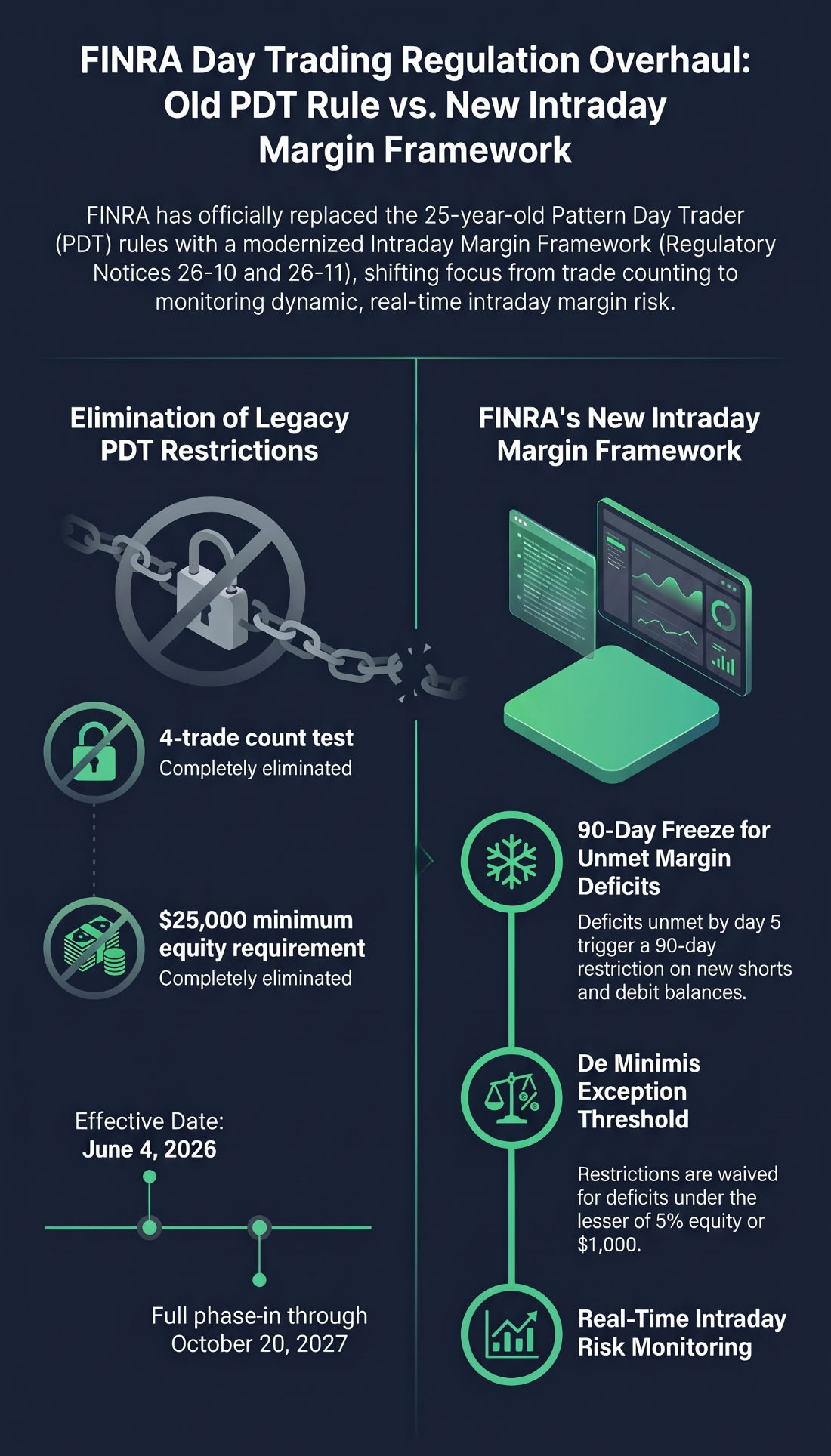
The new standards replace the old day trading margin requirements in their entirety. That means no more pattern day trader designation, no day trade count test and no $25,000 pattern day trader minimum. What replaced them is the intraday margin framework (a standard that tracks the risk you carry during the trading day instead of how many trades you make).
What does the new intraday margin framework require?
The core rules sit in paragraph (d)(2) of FINRA Rule 4210. They apply to customer margin accounts. Good faith accounts and portfolio margin accounts are treated separately. The new rule supplements the regular maintenance margin requirements without replacing them.
On any day you make a trade that increases your exposure, your broker must work out your intraday margin deficit (the largest gap between the margin your positions require and the equity in your account during the day). Your broker tracks this with your intraday margin level (a running figure updated through the day from asset prices, open positions and unrealized profit or loss).
Brokers can do this in real time and reject orders that would create a deficit. They can also run a single end-of-day calculation like a traditional maintenance margin review. They may use updated intraday prices, count same-day cash deposits and withdrawals, and treat multi-leg option strategies entered together as one event. If a broker cannot show the exact order of your trades, it has to assume the order that produces the biggest possible deficit.
If you do end up with a deficit, your broker must demand that it be satisfied as promptly as possible. You can fix it by depositing cash, transferring eligible securities, or realizing gains that lift your intraday margin level. A deficit stays on the books until it is satisfied or expires at the close of business on the 15th business day after the trade date.
The penalty is aimed at a practice, not a single slip. If you make a practice of not satisfying deficits promptly and a deficit is still open at the close of business on the fifth business day, your broker must stop you from creating or increasing short positions or debit balances (borrowed money in your account). You can still close positions. The restriction lasts 90 calendar days after that fifth business day, or until the deficit is satisfied.
Small mistakes are protected. A deficit that does not exceed the lesser of 5% of the equity in the margin account or $1,000 does not count toward that practice. A broker can also excuse a deficit it reasonably judges arose under extraordinary circumstances.
Portfolio margin accounts get extra oversight. Firms must update their written risk methodologies to watch intraday exposure, and accounts with less than $5 million in equity must hold intraday requirements substantially similar to their end-of-day requirements.
What does this change for a small account?
The big shift is that the number of trades no longer decides whether you can trade. Your risk does. If you have less than $25,000, you are no longer locked out of active intraday trading by a trade counter. Instead your broker measures the exposure you are carrying and the deficit it creates.
| Old PDT rule | New intraday margin framework | |
|---|---|---|
| Trade count | Flagged after 4 or more day trades in 5 business days | No trade count and no PDT designation |
| Minimum equity | $25,000 for pattern day traders | No $25,000 pattern day trader minimum |
| Intraday limit | Day trade buying power (4x the prior close's maintenance margin excess) | Intraday margin deficit measured against your positions |
| If you break it | Day trade margin call, then 90 days cash-only if unmet in 5 days | Deficit must be met promptly; 90-day restriction on new shorts and debit balances if a practice and unmet by day 5 |
| Small slips | No equivalent | Deficits up to the lesser of 5% of equity or $1,000 are excepted |
Remember the phase-in. FINRA's rule is a floor, not a ceiling. Your broker can have house rules (its own stricter requirements, such as a higher minimum balance or tighter leverage limits). Some firms will switch to the new framework quickly, and some will take until October 2027. Check what your broker actually offers today. FINRA's notice sets the rule; it does not promise any particular buying power to you.
What did not change?
Quite a lot. The new rule supplements your broker's regular maintenance margin requirements (the equity you must keep against open positions). It does not remove them. Losses still count the same, and a position that moves against you can still push your account into a margin call.
The rule also does not tell you how to trade. A day trade is still a trade that has to make money after costs, slippage and your own mistakes. What changed is the paperwork around it, not the math of whether your strategy has an edge.
If you have been avoiding day trading only because of the $25,000 line, treat the change as permission to practice, not a reason to scale up. Start with a demo account or small size, track every trade, and compare your results with a slower approach before you increase your activity. Your journal will tell you whether more trades are helping.
Risks and traps for small accounts
Removing the $25,000 wall gives small accounts more freedom. It also removes a speed bump that was keeping some traders from overtrading. The trap is assuming that because you can trade more, you should.
Leverage (borrowed money from your broker that lets you hold more than your cash) cuts both ways. A position that is too big for your balance can create an intraday margin deficit in a single trade. If your broker uses pre-trade controls, it may simply reject your next order. If a deficit stays open, you risk the 90-day restriction.
More trades also means more chances for mistakes, slippage (getting a worse price than you expected) and emotional decisions. A rule change does not give you an edge. If your strategy loses money on 3 trades a week, it will lose money faster on 30.
Common mistake: Treating "no trade limit" as "no risk limit." Without the PDT rule, the only brake left is the one you build yourself: position size, a daily loss limit and a maximum number of trades you set in advance.
If you have not already, read our guide to position sizing and the 1% rule. It is the fastest way to keep a single trade from becoming a margin problem.
How to prepare: a 5-step checklist
- Check your account type. The framework covers margin accounts. Confirm with your broker whether yours is one, and what your broker requires.
- Find out your broker's timeline. Ask whether it has adopted the new framework or is using the phase-in, which runs until 20 October 2027.
- Read the house rules. Look for the minimum balance, the intraday leverage limit and how orders are rejected when a deficit would occur.
- Set your own loss limit. Pick a daily loss limit, such as 2% of your account, and stop trading when you hit it.
- Set a trade limit and keep a journal. Decide in advance how many trades you will take, and log each one so you can see whether extra trades help or hurt.
If you are comparing brokers, Robinhood is one that traders look at. Check its current margin and day trading policy before you rely on it, because the details can change.
FAQ
Is the PDT rule gone for everyone?
FINRA retired it for member firms, effective 4 June 2026. Firms may phase in the new standards until 20 October 2027, so how and when you feel the change depends on your broker.
Do I need $25,000 now?
The $25,000 pattern day trader minimum no longer applies. Your broker can still set its own minimum balance and margin requirements, so check with your firm.
Does this apply to cash accounts?
The intraday margin framework is written for margin accounts. Cash accounts follow settlement and free-riding rules instead. The FINRA notice does not give a full explanation of cash account treatment, so check with your broker.
Can my broker still restrict me?
Yes. Your broker can enforce stricter house rules. And if you make a practice of leaving an intraday margin deficit unmet past the fifth business day, FINRA requires a 90-day restriction on new short positions and debit balances.
The verdict
The pattern day trader rule did one thing well: it forced small accounts to slow down. Now that it has been replaced with a risk-based test, the discipline has to come from you. Your next step is simple: log in, find your broker's margin and day trading rules, and write down your daily loss limit before you place another trade.
Sources: FINRA Regulatory Notice 26-10 and Regulatory Notice 26-11 (finra.org).
Trading involves substantial risk of loss. This article is education, not financial advice.
