- What is backtesting and why do traders use it?
- What can AI actually do in a backtest?
- What can't AI do when you backtest a strategy?
- What are overfitting and look-ahead bias?
- How do you run a careful AI-assisted backtest step by step?
- Manual, TradingView Strategy Tester or AI-written Python: which backtest method fits you?
- What does a careful AI backtest look like with a $5,000 account?
- What are the 6 most common AI backtesting mistakes?
- Which tools help you run AI backtests?
- Test yourself
- FAQ
- Can ChatGPT run a backtest directly in chat?
- What is the difference between in-sample and out-of-sample data?
- Why do backtested strategies fail in live trading?
- How much historical data should you use for backtesting?
- What is walk-forward optimization?
- Is AI backtesting suitable for complete beginners?
- The verdict
Trading involves substantial risk of loss, and most retail traders lose money. This article is education, not financial advice.
Disclosure: this article contains affiliate links. If you sign up through them, Trader Edge Hub may earn a commission at no extra cost to you. We only mention tools we think fit the topic.
Many retail traders want to know if AI backtesting can create profitable trading systems automatically. Testing a strategy requires converting exact entry and exit rules into computer code and historical data simulations. We at Trader Edge Hub evaluate how language models assist traders without replacing core backtesting engines. This guide explains how you can use artificial intelligence carefully to refine your trading workflow.
Quick answer: Artificial intelligence cannot perform backtests on its own because backtesting is deterministic calculation on historical price bars. AI excels at writing strategy code, generating script logic, and diagnosing performance metrics produced by platform backtesting engines. To avoid costly errors, you must combine AI coding assistance with strict out-of-sample data splitting and walk-forward validation.
What is backtesting and why do traders use it?
Backtesting [simulating trades on historical price data] measures how a trading strategy would have performed in past markets. It allows you to evaluate entry rules, exit conditions, and risk management parameters before risking real capital. By analyzing historical trade sequences, traders evaluate whether a system possesses a statistical edge.
According to Alturoi's December 2025 backtesting guide, systematic testing establishes rule-based discipline and eliminates emotional guesswork. TradingView's documentation notes that backtesting recreates strategy performance across historical bars directly on active price charts. CME Group research by Campbell Harvey and Yan Liu from July 2015 highlights evaluating Sharpe ratios [a measure of risk-adjusted return] through historical data.
In a Glucksman Fellowship study at NYU Stern, Niko Lahanis, Alice Liu, and Zhengyuan Zhou built a Python backtesting framework. Their research evaluates risk-adjusted metrics like cumulative wealth and maximum drawdown [peak-to-trough account decline]. TradingView strategies use functions like strategy.entry and strategy.exit to simulate historical orders.
However, strong historical results do not assure future live trading success. A 2025 CFA Institute study cited by ClearEdge Trading shows that over 90% of backtested strategies with strong in-sample results fail in live trading. We at Trader Edge Hub emphasize backtesting to discard flawed concepts early before capital is lost.
What can AI actually do in a backtest?
AI acts as a code generator, logic translator, and performance diagnostic assistant during strategy development. Language models can quickly convert plain English trading rules into executable code for charting platforms. They can also analyze complex performance reports to identify why a strategy struggled in specific market environments.
According to NovaTrader's documentation, AI excels at writing Pine Script [TradingView's programming language] v6 strategy scripts from written descriptions. NovaTrader notes that AI can inspect backtest metrics to explain regime failure. For example, AI interprets a profit factor [gross profit divided by gross loss] of 0.949. In a 2024 Imperial College thesis, Alireza Kargarzadeh used GPT-4o [Generative Pre-trained Transformer 4o] to analyze news sentiment for stock filtration.
In addition, platforms like Kavout use AI agents to combine factor strategies like Greenblatt, Lynch, and Piotroski quality scores across global markets. A July 2026 study by Xavier Fonseca on temporal non-interference demonstrates how AI tools assist traders in reviewing code logic. Research by Mostapha Benhenda from June 2026 emphasizes using standardized benchmarks to evaluate point-in-time AI trading pipelines.
AI accelerates development speed, but human oversight remains essential for checking code correctness. Language models can generate trading scripts in seconds, saving hours of manual coding effort. You must still verify that the generated code accurately reflects your intended risk management parameters.
What can't AI do when you backtest a strategy?
AI cannot run backtest calculations, verify data integrity, or assure future trading performance. Backtesting is deterministic arithmetic executed across historical price bars by dedicated platform strategy testers. Language models cannot replace historical data feeds or calculate trade executions independently.
NovaTrader emphasizes that tools claiming to backtest strategies entirely inside language models should be distrusted. In a January 2024 investor alert, FINRA [Financial Industry Regulatory Authority] warned investors against AI washing [deceptive marketing claims about artificial intelligence]. Furthermore, a July 2025 FINRA alert highlighted unregistered entities falsely claiming AI systems can deliver 10% monthly returns.
Pro tip: Always limit your strategy to two or three adjustable parameters. Research by Robert Pardo in 2008 shows that adding excessive parameters increases the probability of fitting historical noise rather than genuine market edge.
Pineify's 2026 documentation notes that AI models cannot detect look-ahead bias [using future data during past calculations] without explicit availability logs. AI cannot predict changing market volatility or account for sudden liquidity shocks. You must rely on platform strategy testers for verified transaction arithmetic.
What are overfitting and look-ahead bias?
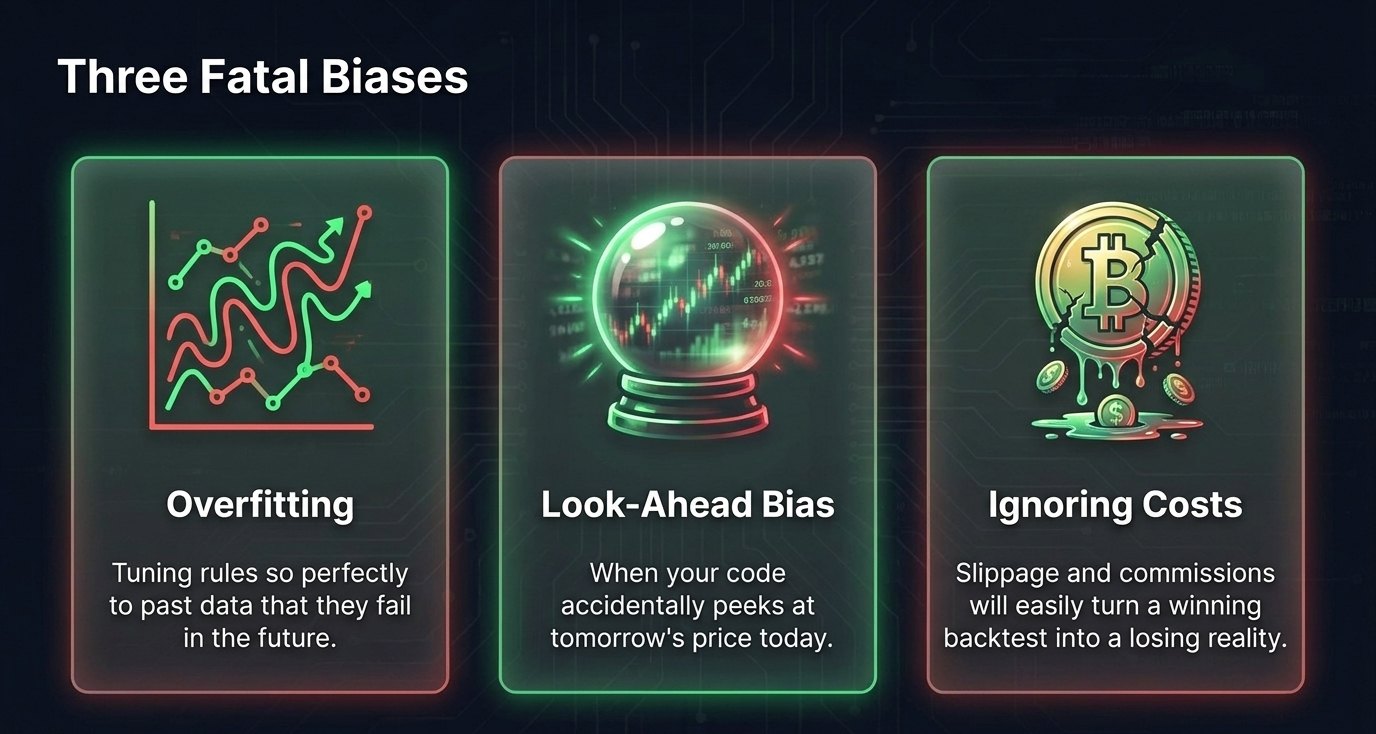
Overfitting is tailoring strategy parameters too closely to historical noise, while look-ahead bias is accidentally leaking future price data into past trade decisions. Both flaws create inflated backtest results that collapse when traded in live market conditions. Understanding these two hazards is critical for building durable trading systems.
Marcos López de Prado's 2018 research defines overfitting as monetizing random historical patterns rather than persistent market structure. In a January 2026 MDPI study, Alexander Pearson Sheppert evaluated the GT-Score [Golden Ticket Score]. He tested 50 S&P 500 stocks across data from 2010 to 2024. In Sheppert's 9,000 Monte Carlo trials, profit-maximized strategies lost over 70% of their return in out-of-sample testing.
Pineify's 2026 guide explains that look-ahead bias occurs when a historical trade decision uses information that was unavailable at that moment. TradingView's documentation warns that referencing unconfirmed higher-timeframe bars or future session highs creates misleading results. Eliminating look-ahead bias requires strict point-in-time data verification across all inputs.
Research by Marcos López de Prado and David Bailey introduces the Deflated Sharpe Ratio. It corrects for selection bias [choosing top performers from many trials]. In a June 2026 paper on the TradeQuant platform, researchers noted that zero-cost backtest assumptions produce systematic optimism bias. Testing strategies with realistic transaction costs and out-of-sample data prevents costly deployment failures.
How do you run a careful AI-assisted backtest step by step?
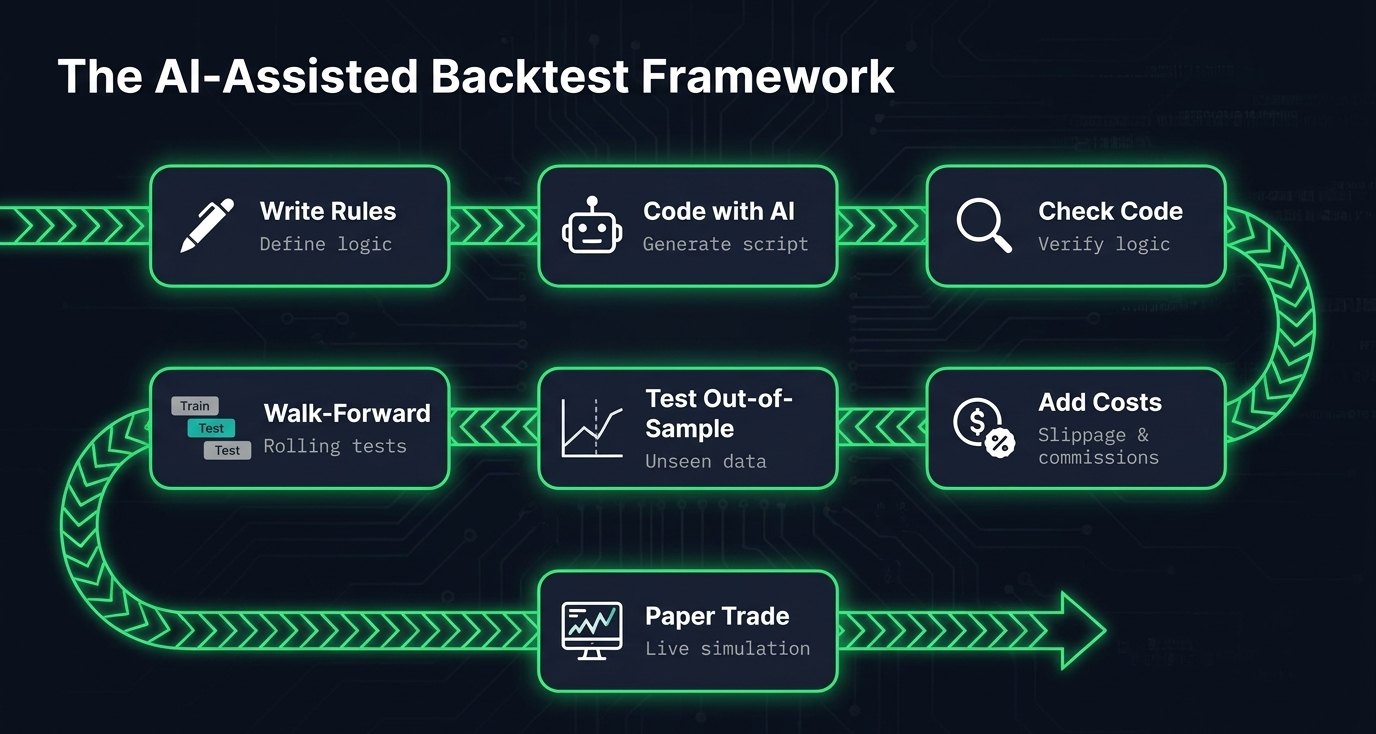
Running a careful AI-assisted backtest requires following a disciplined, multi-stage validation pipeline. Combining artificial intelligence with strict statistical controls prevents curve-fitted results from reaching live deployment. We at Trader Edge Hub recommend executing the seven steps outlined below.
- Write exact rules: Define your trading hypothesis, entry triggers, stop-loss levels, and session filters in plain text before generating code. Clear rules prevent discretionary bias during testing.
- Let AI draft the code: Use language models to translate your written rules into Pine Script or Python strategy code. Review the generated code to ensure all logic statements match your plan.
- Read and check the code: Verify that the script compiles cleanly without syntax errors or unintended loop behavior. Confirm that order execution functions match your intended entry and exit timing.
- Add commissions and slippage: Configure realistic transaction costs, broker commissions, and execution slippage [price difference between order placement and fill]. TradeQuant research from June 2026 shows that ignoring costs creates severe optimism bias on lower timeframes.
- Split in-sample and out-of-sample data: Divide your historical dataset into IS [in-sample, training data] and OOS [out-of-sample, test data] segments. A standard 70/30 split reserves unseen data to verify strategy generalizability.
- Walk-forward test: Perform walk-forward optimization [WFO, re-optimizing parameters on rolling historical windows]. ClearEdge Trading notes that an efficiency ratio [OOS performance divided by IS performance] above 0.5 indicates robust performance.
- Paper trade: Execute your strategy in real-time using paper trading [simulated execution on live data streams] for several weeks. Forward testing confirms that order execution, alerts, and live data feeds function as expected.
Common mistake: Re-tuning your strategy parameters after looking at out-of-sample results destroys data blindness. Once out-of-sample data is used for tuning, it becomes in-sample data and loses its validation value.
Manual, TradingView Strategy Tester or AI-written Python: which backtest method fits you?
Selecting the right backtesting method depends on your programming skills and trading goals. Traders choose between manual spreadsheet logging, automated platform strategy testers, and custom AI-written Python scripts. We at Trader Edge Hub evaluate how these three approaches compare across speed and accuracy.
Manual backtesting requires reviewing historical charts bar by bar and logging entries. According to Alturoi's December 2025 guide, manual testing builds visual intuition but suffers from human fatigue and selection bias. Learn more about systematic logging in our guide to How to Keep a Trading Journal.
Automated testing on TradingView uses built-in strategy engines to execute scripts automatically. TradingView documentation notes that automated strategy testing evaluates thousands of historical bars in seconds. AI-written Python scripts offer maximum customization for advanced multi-asset quantitative modeling, as demonstrated in TradeQuant's June 2026 research paper.
The comparison table below outlines core differences, setup speeds, and major limitations across all three methods. Reviewing these trade-offs helps you choose the method that aligns with your technical capabilities.
| Backtest Method | Execution Speed | Technical Requirements | Primary Limitation |
|---|---|---|---|
| Manual Chart Logging | Slow (hours to days for 100 trades) | No coding required; uses spreadsheets | High human fatigue and selection bias |
| TradingView Strategy Tester | Fast (seconds per historical backtest) | Requires basic Pine Script knowledge or AI prompts | Limited to platform chart resolution limits |
| AI-Written Python Engine | Instant execution after script generation | Requires Python environment setup and API feeds | Requires debugging AI code for logic bugs |
What does a careful AI backtest look like with a $5,000 account?
To understand how transaction costs and out-of-sample testing impact performance, let us examine a worked quantitative example. We evaluate a hypothetical $5,000 trading account using a strict 1% account risk limit ($50 risk per trade). Read our guide on Position Sizing: The 1% Rule Explained for risk formulas.
In this baseline test across 100 in-sample trades, the strategy wins 45 trades (45% win rate) and loses 55 trades. Winning trades yield a 2R reward ($100 profit), while losing trades cost 1R ($50 loss). Review our explanation in Risk-Reward Ratio Explained to structure trade setups.
Gross trade expectancy [average dollar gain per trade] equals $17.50 before factoring in transaction friction [0.45 x $100 - 0.55 x $50]. Subtracting $5.00 per trade in broker commissions and slippage reduces net expectancy to $12.50 per trade. Detailed mathematical formulas appear in our post on Trading Expectancy: The Formula That Combines Win Rate and Risk-Reward.
When tested on unseen out-of-sample data, market shifts lower the win rate to 40%. The net out-of-sample expectancy drops to $5.00 per trade [0.40 x $100 - 0.60 x $50 - $5.00]. Total net profits fall from $1,250 in-sample to $500 out-of-sample over 100 trades.
| Performance Metric | In-Sample (Gross) | In-Sample (Net of $5 Costs) | Out-of-Sample (Net of $5 Costs) |
|---|---|---|---|
| Sample Trade Count | 100 trades | 100 trades | 100 trades |
| Strategy Win Rate | 45% (45 wins / 55 losses) | 45% (45 wins / 55 losses) | 40% (40 wins / 60 losses) |
| Average Win / Loss Size | +$100 win / -$50 loss | +$95 net win / -$55 net loss | +$95 net win / -$55 net loss |
| Trade Expectancy | +$17.50 per trade | +$12.50 per trade | +$5.00 per trade |
| Total Account Return | +$1,750.00 (+35.0%) | +$1,250.00 (+25.0%) | +$500.00 (+10.0%) |
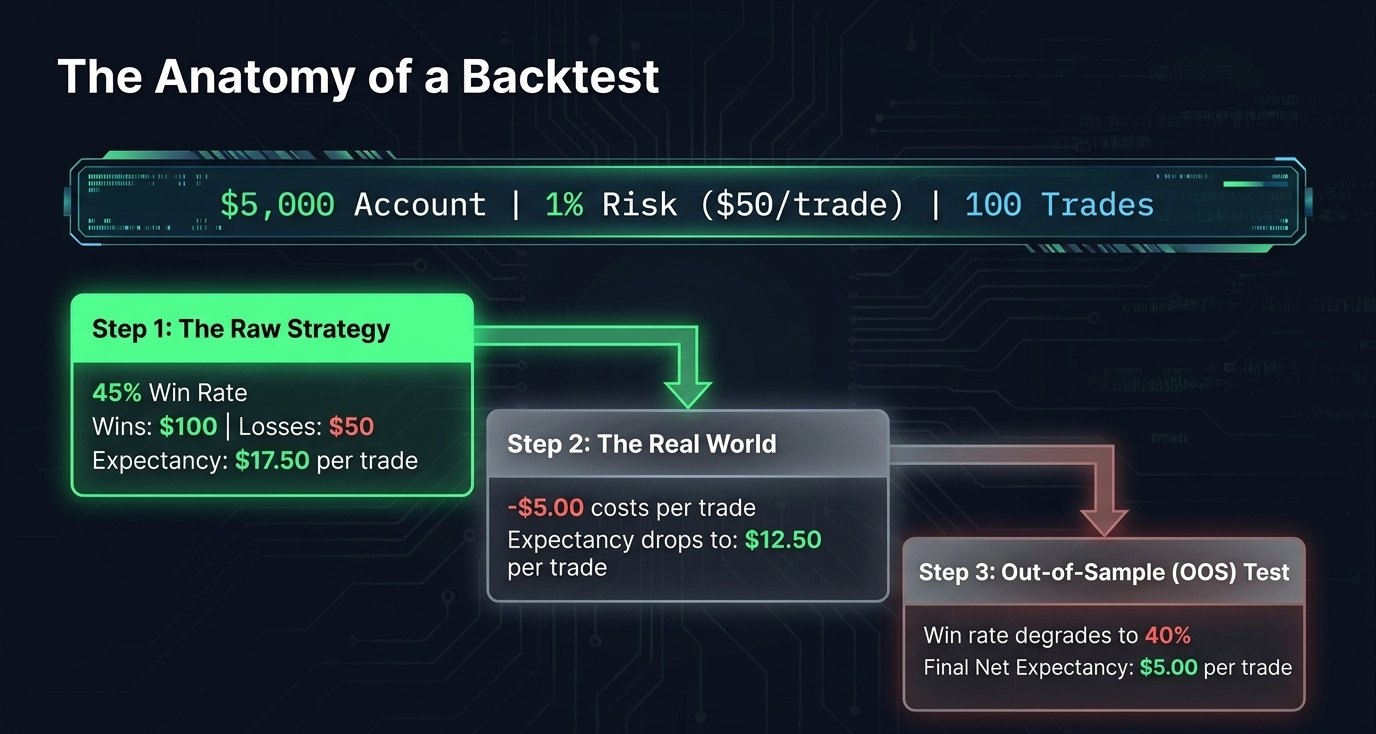
This worked example demonstrates why unadjusted backtest results deceive inexperienced traders. Factoring in $500 total transaction costs reduces net in-sample profit by about 28.6% ($500 of $1,750). Performance decay during out-of-sample testing is normal when markets transition into higher volatility regimes.
Even with a reduced 40% win rate, the strategy remains positive due to its 2R reward structure. Expect losing streaks along the way, even when the long-run expectancy is positive.
What are the 6 most common AI backtesting mistakes?
Traders frequently stumble when integrating artificial intelligence into their strategy development workflows. We at Trader Edge Hub identified six common mistakes that cause backtest failure:
- Over-optimizing parameters: Adjusting indicators to fit historical noise creates fragile rules that fail in live trading.
- Ignoring commissions and slippage: Assuming zero transaction costs inflates performance metrics on lower timeframes.
- Leaking future price data: Referencing unconfirmed bars creates look-ahead bias that distorts historical entry signals.
- Skipping out-of-sample testing: Evaluating strategies exclusively on training data often leads to curve-fitted deployment failures.
- Trusting AI code blindly: Deploying generated scripts without inspecting logic statements introduces severe execution errors.
- Changing rules after OOS tests: Re-tuning parameters after viewing out-of-sample data invalidates statistical testing controls.
Which tools help you run AI backtests?
Modern charting platforms provide tools for strategy simulation and factor analysis. We at Trader Edge Hub recommend leveraging professional software to run verified backtesting routines. Read our guide to TradingView AI Features in 2026.
To write and test strategy scripts directly on interactive price charts, use TradingView. TradingView provides built-in Pine Script strategy testers, deep historical data feeds, and automated alert execution.
For quantitative equity research and factor analysis, consider evaluating Kavout. Kavout offers AI-driven stock ratings, fundamental screening metrics, and multi-factor portfolio analytics.
Test yourself
Test your understanding of AI backtesting concepts, statistical validation, and risk parameters. Select the correct answer for each question below to verify your technical knowledge.
1. What is the primary role of AI in a strategy backtest?
A) Executing deterministic transaction calculations on historical price feeds.
B) Translating trading rules into strategy code and assisting with performance diagnostics.
C) Eliminating market risk and assuring consistent live trading profits.
D) Replacing platform strategy engines with neural network simulations.
Answer: B. AI acts as a coding assistant and diagnostic interpreter, while platform strategy engines handle deterministic calculations.
2. What causes look-ahead bias in a historical backtest?
A) Including realistic broker commissions and slippage in strategy settings.
B) Using future price data or unconfirmed bars during past trade calculations.
C) Testing a strategy across multiple market regimes on daily charts.
D) Reserving 30% of historical data for out-of-sample validation.
Answer: B. Look-ahead bias occurs when a backtest references future price information unavailable at the historical execution bar.
3. Why is out-of-sample (OOS) data testing necessary?
A) It increases the strategy win rate by 20% automatically.
B) It verifies whether a strategy generalizes to unseen historical data without curve fitting.
C) It allows traders to re-tune indicator parameters continuously.
D) It eliminates the need for broker execution commissions.
Answer: B. Out-of-sample testing evaluates strategy robustness on unseen data to ensure the system did not overfit historical noise.
4. How do execution costs affect quantitative trade expectancy?
A) Costs reduce net dollar expectancy per trade and lower total cumulative returns.
B) Costs increase trade expectancy by improving position execution speed.
C) Costs have zero impact on backtest performance on lower timeframes.
D) Costs only affect losing trades while leaving winning trades untouched.
Answer: A. Commissions and execution slippage drag down net profit per trade, reducing total strategy performance.
5. What does an efficiency ratio above 0.5 indicate in walk-forward optimization?
A) The strategy is expected to double account capital within 30 days.
B) Out-of-sample performance retained at least half of its in-sample profitability.
C) The strategy suffered zero losing trades during historical testing.
D) All technical indicators were removed from the trading script.
Answer: B. An efficiency ratio above 0.5 shows that out-of-sample results maintained acceptable consistency relative to training data.
FAQ
Can ChatGPT run a backtest directly in chat?
No, ChatGPT cannot execute a backtest directly inside its chat interface. Language models generate code, but you must run the script inside a platform strategy engine like TradingView or Python.
What is the difference between in-sample and out-of-sample data?
In-sample data is historical price data used to build and optimize strategy rules. Out-of-sample data is reserved historical data used to verify whether the strategy performs on unseen market conditions.
Why do backtested strategies fail in live trading?
Strategies fail when they suffer from curve fitting, look-ahead bias, or unmodeled transaction friction. ClearEdge Trading notes that over 90% of over-optimized in-sample strategies fail in live markets.
How much historical data should you use for backtesting?
You should test across multiple market regimes, including trending, ranging, and high-volatility years. CME Group research recommends testing across several years of data to capture varying market cycles.
What is walk-forward optimization?
Walk-forward optimization re-optimizes strategy parameters on rolling historical windows and tests them on subsequent periods. This process simulates how a systematic strategy adapts to live market shifts over time.
Is AI backtesting suitable for complete beginners?
AI assists beginners with code generation, but understanding risk management remains essential. Beginners must learn core statistical principles like expectancy, drawdown, and position sizing before deploying code.
The verdict
AI backtesting provides powerful coding assistance, enabling traders to prototype systematic ideas rapidly. However, artificial intelligence cannot replace deterministic calculation engine math or rigorous statistical controls. Combining AI code generation with strict out-of-sample testing protects your capital from overfitted strategies.
Your immediate next step is to open TradingView and prompt an AI model for a Pine Script strategy. Apply your script with realistic commission settings to build visual intuition.
Sources: TradingView Documentation (Strategy Tester, Pine Script v6), Alturoi Backtesting Guide (Dec 2025), CME Group Backtesting Research (Harvey & Liu, July 2015), NYU Stern Glucksman Fellowship (Lahanis et al.), NovaTrader AI Backtesting Guide, Imperial College London Thesis (Kargarzadeh, 2024), Pineify Look-Ahead Bias Guide (2026), Marcos López de Prado Research (2018), MDPI GT-Score Study (Sheppert, Jan 2026), TradeQuant Platform Paper (June 2026), ClearEdge Trading Walk-Forward Optimization Guide (2025), FINRA Investor Alerts (Jan 2024, July 2025).
Trading involves substantial risk of loss, and most retail traders lose money. This article is education, not financial advice.
