
- What is a daily loss limit?
- How to set your daily loss limit
- Method 1: three times your risk per trade (good for beginners)
- Method 2: use your own daily results (good once you have data)
- Worked example with a $10,000 account
- What to do when you hit the limit
- Maximum drawdown: definition and math
- Why recovering from a drawdown is harder than losing
- Weekly and monthly limits
- Hard limits vs soft limits
- Prop firm daily loss rules
- Common daily loss limit mistakes
- Put it in your trading plan
- FAQ
- What is a good daily loss limit?
- Should the limit use closed trades or open losses too?
- What is a safe maximum drawdown?
- What should I do right after hitting the limit?
- The verdict
Trading involves substantial risk of loss. This article is education, not financial advice.
Disclosure: this article contains affiliate links. If you sign up through them, Trader Edge Hub may earn a commission at no extra cost to you. We only mention tools we think fit the topic.
One bad morning should never become a ruined account. Yet that is how many accounts end: a first loss, a bigger second trade to win it back, and a third that was never in the plan. A daily loss limit and a maximum drawdown rule are the circuit breakers that stop that chain. This guide shows how to set both, with worked numbers for a $10,000 account, what to do the moment you hit the limit, and why recovering from a deep drawdown takes a far bigger gain than the loss.
Quick answer: A daily loss limit (a preset maximum loss for one trading session, after which you stop) caps the damage from a bad day. A common beginner rule is 3 times your risk per trade, so risking 1% of a $10,000 account gives a $300 daily limit. A maximum drawdown limit (the largest peak-to-trough fall in account equity you will accept before pausing to reassess) protects you from slow, multi-day slides.
What is a daily loss limit?
A daily loss limit is the most money you allow yourself to lose in one session. When realized losses, or open plus closed losses if you track them together, reach that number, the session is over. No "one more trade," no bigger size to make it back. You close positions, step away and review.
The limit exists because losses tend to snowball when emotions take over. Three patterns show up again and again:
- The revenge spiral. A loss stings, so you increase size to win it back quickly, lose again, and repeat.
- Overtrading. Frustration or fear of missing out pushes you into lower-quality setups outside your plan, and commissions and spreads pile up.
- The giveback day. You are up in the morning, relax your rules, and hand all of it back by the afternoon.
A fixed limit breaks that chain before it starts. Even your worst day stays at a level you can recover from over the next few normal sessions.
How to set your daily loss limit
A good limit balances two things. It should be wide enough to survive the normal ups and downs of your strategy, and tight enough that a max-loss day does not take weeks to repair. The sources describe two practical approaches.
Method 1: three times your risk per trade (good for beginners)
If you do not have much trading history yet, set the limit at 3R, meaning three times your planned risk per trade. R (the amount you risk on one trade) is the unit most traders use to measure results. Risk 1% per trade and three full losses in a row equal a 3% day, which is when you stop.
Method 2: use your own daily results (good once you have data)
Once you have a few months of journal data (a log of each trade and day), you can base the limit on your history. One approach described in the sources takes the midpoint between your average winning day and your best winning day, so that a full loss day can be recovered in one or two above-average winning sessions. Treat it as a starting point, then adjust to your own results.
Worked example with a $10,000 account
| Item | Calculation | Result |
|---|---|---|
| Risk per trade (1R) | $10,000 × 1% | $100 |
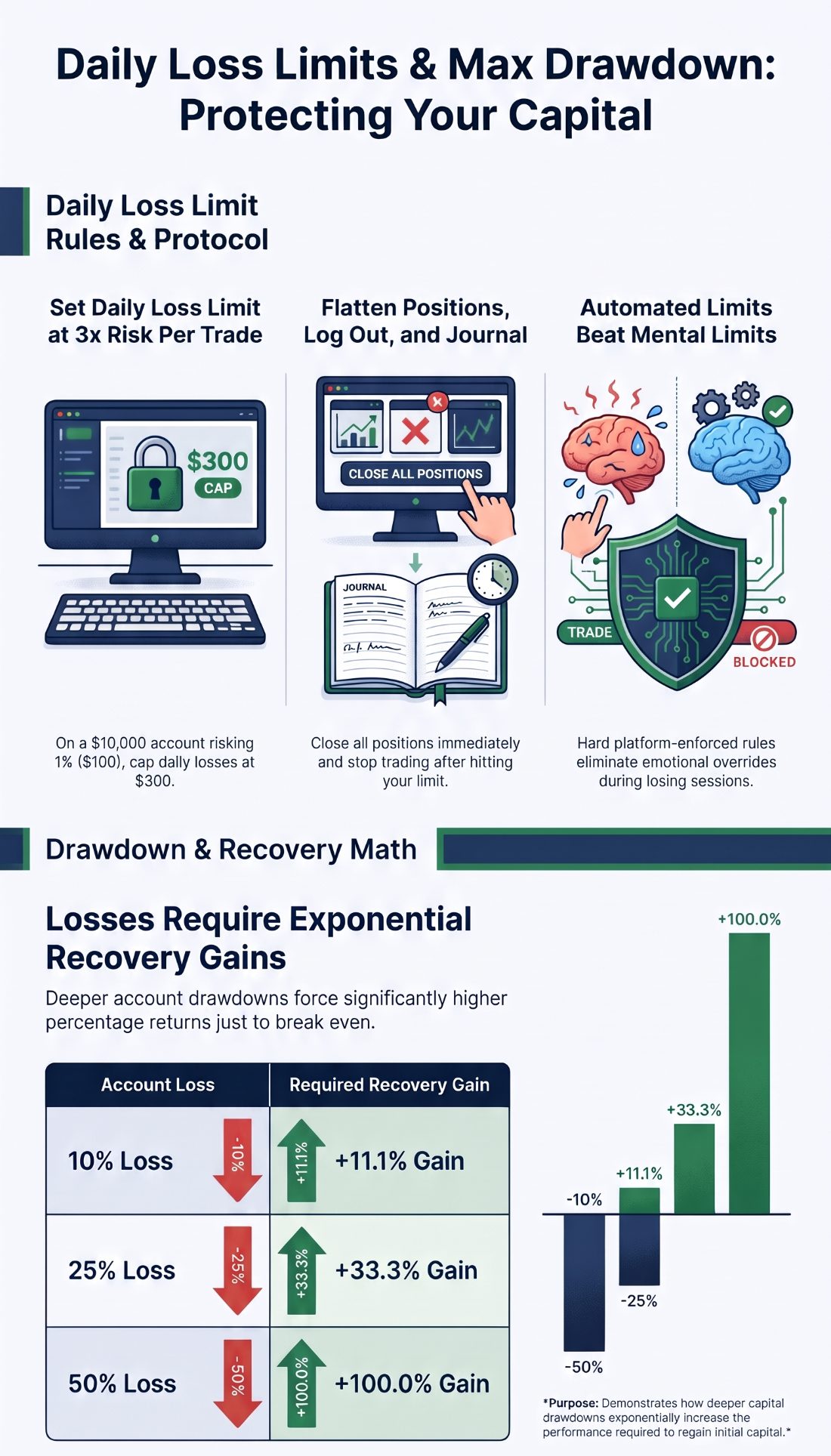
| Daily loss limit | 3 × $100 | $300 (3% of the account) |
| Trades before you stop | $300 ÷ $100 | 3 full losses |
| Recovery after a max-loss day | Two wins of +1.5R ($150 each) | +$300 |
If your first three trades all hit their stops at −$100, your day is done at −$300. Close anything open, cancel resting orders and log off. Because the loss is only 3% of the account, two good trades at 1.5 times your risk can bring you back to even.
The same rule scales to any account. The percentage stays the same, only the dollars change.
| Account size | Risk per trade (1%) | Daily limit (3R) | Trades before stop |
|---|---|---|---|
| $5,000 | $50 | $150 | 3 losses |
| $10,000 | $100 | $300 | 3 losses |
| $25,000 | $250 | $750 | 3 losses |
| $50,000 | $500 | $1,500 | 3 losses |
What to do when you hit the limit
Decide this in advance, because you will not think clearly in the moment. A simple three-step routine works well:
- Flatten and cancel. Close open positions and cancel pending orders.
- Lock out. Log out of the platform. Some platforms and tools offer a lock that blocks new orders until the next session. Use it if you have it.
- Journal the day. Record what happened and tag the session: did you stop at the limit as planned, or trade through it? Our guide on keeping a trading journal shows what to track.
If you keep hitting the limit, that is useful information. Frequent limit days usually point to a problem with your setups or the market conditions you are trading, not bad luck.
Maximum drawdown: definition and math
A daily limit caps one session. Maximum drawdown looks at the bigger picture. Drawdown (the decline from a peak in account value to a later low) is measured like this:
Formula: Drawdown % = (Peak equity − Trough equity) ÷ Peak equity × 100.
Example: your account grows from $10,000 to a $12,000 peak. A losing stretch takes it down to $9,600. The dollar drawdown is $12,000 − $9,600 = $2,400, and the percentage drawdown is $2,400 ÷ $12,000 = 20%. Note that the drawdown is measured from the peak, so you can be in a 20% drawdown even while still above your starting balance.
Why recovering from a drawdown is harder than losing
Losses and gains do not cancel evenly. After a loss, your gains apply to a smaller balance, so the percentage you need to get back to breakeven is always larger than the percentage you lost.
| Loss | Balance left (from $10,000) | Gain needed to break even |
|---|---|---|
| 5% | $9,500 | 5.3% |
| 10% | $9,000 | 11.1% |
| 20% | $8,000 | 25.0% |
| 25% | $7,500 | 33.3% |
| 50% | $5,000 | 100.0% |
| 75% | $2,500 | 300.0% |
The formula is simple: gain needed = loss ÷ (1 − loss). A 10% loss needs 11.1%. A 50% loss needs a full 100%, which means doubling the account. This is why traders set a maximum drawdown limit and cut risk well before they get near it. It keeps the recovery distance short.
Weekly and monthly limits
A single bad session rarely sinks a disciplined trader. The bigger danger is a slow slide where several small losing days stack up. Many traders add a weekly or monthly loss limit on top of the daily one. One example you could adapt: if you hit the daily limit several days in a row, take a short break from live trading and use it to review your journal and trades. Another is to reduce your risk per trade as drawdown deepens. For instance, halve your size after a 3% drawdown and stop live trading to review at a threshold you set in advance. These are examples to adapt, not rules from a regulator. The point is to write your own thresholds down before you need them.
Hard limits vs soft limits
A soft limit (a mental rule that you will stop at a certain loss) depends on you obeying yourself at the worst moment. A hard limit (an automatic rule enforced by software or a broker that blocks new orders or closes positions) does not rely on willpower. Many platforms, trade-management panels and automated tools let you set a daily loss in dollars or percent, and some can close positions and block new orders once it is hit. If your platform offers it, use it. If it does not, a written rule and a pre-agreed accountability step, such as logging off and telling a trading partner, is the next best thing.
Prop firm daily loss rules
If you trade a funded account from a proprietary trading firm (a firm that gives you its capital under set rules), the firm usually enforces its own daily loss limit, and breaking it can end the account. Rules differ between firms, so read yours carefully. Two details matter. First, some firms measure the daily limit from the start-of-day balance, while others trail it from your peak equity during the day, so an unrealized gain that reverses can use up part of your allowance. Second, never trade right up to the firm's line. Set your personal limit well inside it.
For example, if a firm allows a $2,500 daily loss on a $50,000 account (5%), a personal limit of $1,500 (3%) leaves a $1,000 buffer for slippage, commissions and gaps. Also size trades off the allowance, not just the account. Risking 1% of $50,000 is $500 per trade, which means only five losses before the account is gone.
Common daily loss limit mistakes
Common mistake: Trading through the limit because the next trade will "turn the day around." This is exactly the moment the limit was built for.
Common mistake: Widening stops during a losing session so a loss does not get recorded. That raises the risk on each trade and brings the limit closer, faster.
Pro tip: Add a giveback rule for winning days. For example, if you reach +3R, decide in advance to stop if you fall back to +1R. It protects profits the same way the daily limit protects capital.
Stops matter here as well. Know where each stop goes before you enter. Our guide on where to put your stop loss covers it, and the position sizing guide shows how to turn risk into share size.
Put it in your trading plan
A rule you have not written down is a suggestion. Add a short risk section to your trading plan with these lines, and fill in your own numbers:
- Risk per trade: for example 1% of account equity.
- Daily loss limit: for example 3R, which is 3% of the account.
- Weekly loss limit: a number you choose, such as a multiple of the daily limit.
- Maximum drawdown: the peak-to-trough fall at which you stop live trading and review.
- After the limit: flatten, log out, journal, and no new orders until the next session.
Review the numbers every month. As your account grows or your results change, the dollar amounts will change, but the structure stays the same.
FAQ
What is a good daily loss limit?
For beginners, 3 times your risk per trade is a common starting point. At 1% risk per trade that is a 3% daily limit. With more history, base it on your own average and best winning days.
Should the limit use closed trades or open losses too?
Pick one and write it down. Counting open losses is stricter and stops you sooner. Counting only closed trades lets a losing position run, so many traders prefer to include open losses.
What is a safe maximum drawdown?
There is no single number. The recovery table shows why smaller is better: a 20% drawdown needs a 25% gain, while 50% needs 100%. Many traders set a personal cap well below the level where recovery becomes unrealistic, and cut risk before they reach it.
What should I do right after hitting the limit?
Close open trades, cancel pending orders, log out and journal the session. Do not re-enter the market until the next session.
The verdict
A daily loss limit and a drawdown rule do not make you win more. They make sure one bad stretch cannot end your trading. Set the numbers while you are calm, make them as automatic as you can, and treat hitting the limit as the system working. Your next step: calculate 3 times your risk per trade today and write the number on your trading plan.
Trading involves substantial risk of loss. This article is education, not financial advice.
