
- What is a pip in forex?
- What are standard, mini, micro and nano lots?
- How do you calculate pip value for any currency pair?
- How does lot size turn into dollars won or lost?
- How do lot size, leverage and margin fit together?
- How do you choose the right lot size for your stop?
- What does a position sizing calculation look like in practice?
- What are the most common lot size mistakes?
- Which tools help you size forex trades?
- Test yourself: can you size a forex trade?
- FAQ
- What is the minimum account balance needed to trade forex?
- Does lot size affect spread costs?
- What is the difference between a mini lot and a micro lot?
- How do you calculate lot size for gold or silver?
- Why does pip value change on USD/JPY?
- Should you change lot size after a winning trade?
- The verdict
Trading involves substantial risk of loss, and most retail traders lose money. This article is education, not financial advice.
Disclosure: this article contains affiliate links. If you sign up through them, Trader Edge Hub may earn a commission at no extra cost to you. We only mention tools we think fit the topic. As an Amazon Associate, Trader Edge Hub earns from qualifying purchases.
Understanding forex lot sizes [the standardized volume units used to trade currency pairs] is the core foundation for managing risk. At Trader Edge Hub, we examine the exact calculations connecting market movement to real dollar exposure.
Choosing an arbitrary position size is a leading cause of retail account failures. Learning how lot volume dictates your loss per pip keeps your capital protected through market volatility.
This beginner handbook breaks down standard, mini, micro, and nano lots with clear calculation steps. Master these calculations to determine your exact risk before opening any position.
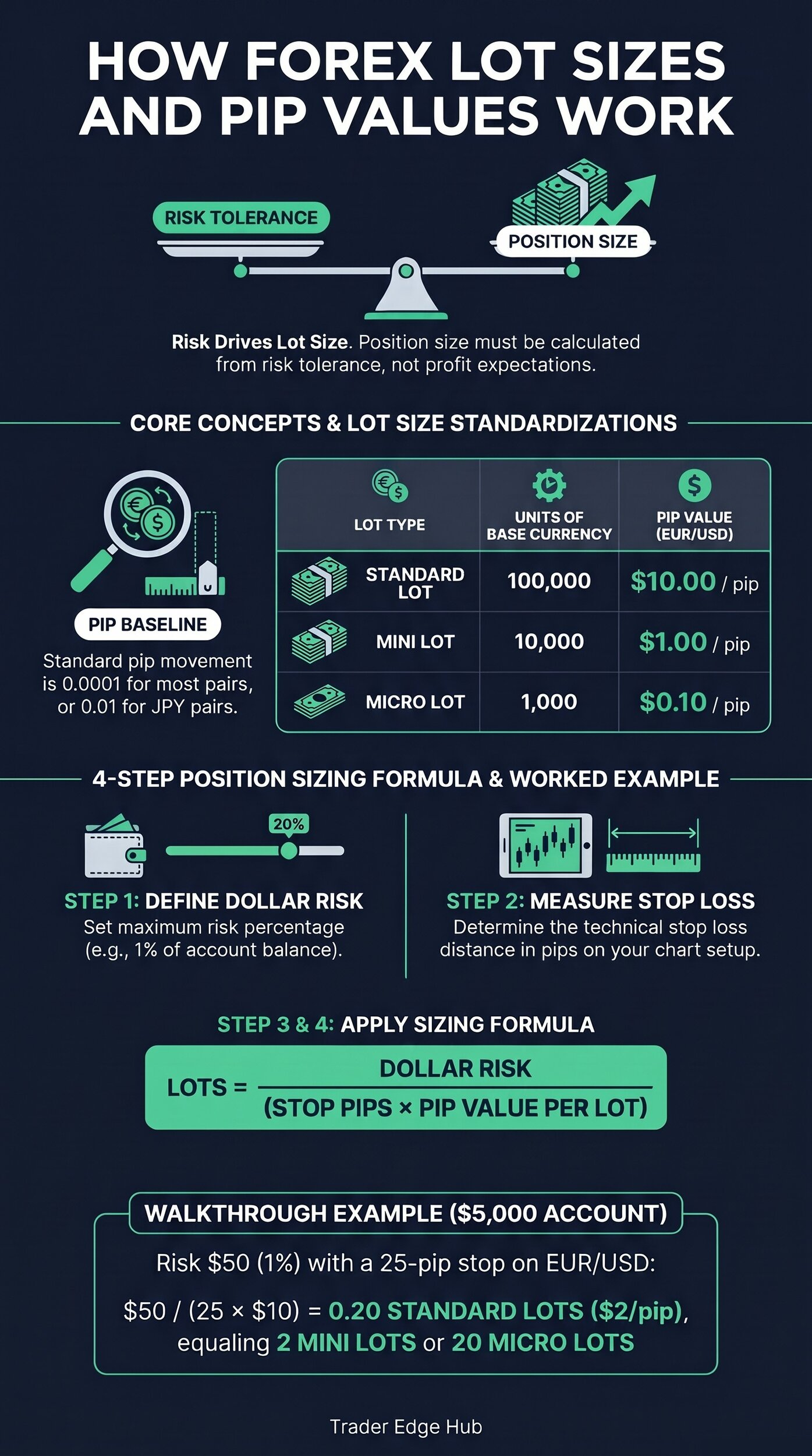
Quick answer: A lot size dictates how much money you win or lose for every pip change. Standard lots equal 100,000 units [$10 per pip on EUR/USD], while mini lots equal 10,000 units [$1 per pip]. Micro lots equal 1,000 units [$0.10 per pip], and nano lots equal 100 units [$0.01 per pip]. Always calculate lot size from stop loss distance and fixed percent risk.
What is a pip in forex?
A pip [percentage in point] is the standardized unit measuring price movement between two currencies. According to ComoFX's guide, a pip represents the fourth decimal place [0.0001] for most currency pairs.
For example, if EUR/USD moves from 1.0850 to 1.0851, that price change equals exactly one pip. According to IG's trading glossary, a 50-pip movement from 1.1600 to 1.1650 represents a typical intraday price swing.
Most modern forex brokers quote prices using five decimal places. According to ComoFX's guide, that fifth decimal digit is called a pipette [one-tenth of a pip].
A price movement from 1.08501 to 1.08516 represents one pipette and five tenths, or 1.5 pips. According to ComoFX's guide, understanding fractional pipettes helps traders evaluate broker spreads accurately.
Japanese Yen pairs follow a different decimal convention. According to ComoFX's guide, one pip on USD/JPY sits at the second decimal place [0.01].
A price move on USD/JPY from 150.50 to 150.75 represents a 25-pip change. According to ComoFX's guide, mistaking Yen decimal places causes beginners to miscalculate stop loss distances by a factor of 100.
Properly measuring pips across major and Yen pairs prevents severe sizing errors.
What are standard, mini, micro and nano lots?
Currencies trade in standardized volume bundles known as lots. According to CMC Markets' guide, lot sizes serve as the primary lever for controlling trade risk.
A standard lot [1.00 in platform terminals] represents 100,000 units of base currency. According to EdgeFlo's report, one standard lot on EUR/USD generates a $10.00 profit or loss per pip.
A mini lot [0.10 in platform terminals] represents 10,000 units of currency. According to CMC Markets' guide, a mini lot yields a $1.00 pip value on major USD quote pairs.
A micro lot [0.01 in platform terminals] equals 1,000 units of base currency. According to TFW Global's guide, micro lots yield a $0.10 pip value, making them ideal for small accounts.
A nano lot [0.001 in platform terminals] represents 100 units of currency. According to ComoFX's guide, a nano lot produces a $0.01 pip value for testing live strategies with minimal capital.
| Lot Category | Terminal Notation | Base Currency Units | Pip Value (EUR/USD) | Suitable Account Size |
|---|---|---|---|---|
| Standard Lot | 1.00 | 100,000 units | $10.00 / pip | $25,000+ [CMC Markets] |
| Mini Lot | 0.10 | 10,000 units | $1.00 / pip | $2,500 – $25,000 [CMC Markets] |
| Micro Lot | 0.01 | 1,000 units | $0.10 / pip | Under $2,500 [CMC Markets] |
| Nano Lot | 0.001 | 100 units | $0.01 / pip | Practice & Testing [CMC Markets] |
Pro tip: Always verify your broker's minimum lot step before trading live. While most retail brokers allow 0.01 micro lots, select providers enforce 0.10 mini lot minimums, which increases baseline account risk.
How do you calculate pip value for any currency pair?
Calculating exact pip values allows you to maintain consistent risk across different asset classes. According to Axon Markets' guide, the core position formula is straightforward.
The standard formula is: Pip Value equals one pip divided by the exchange rate, multiplied by lot size. According to PineConnector's documentation, this formula yields the exact dollar value per pip.
For USD-quoted pairs [where USD is the second currency, such as EUR/USD or GBP/USD], the calculation produces direct dollar values. According to ComoFX's guide, one pip on a 100,000 standard lot evaluates to roughly $10.00 across all USD quote pairs.
For USD-base pairs [where USD is the first currency, such as USD/JPY or USD/CHF], pip value calculates in the quote currency first. According to ComoFX's report, at a USD/JPY exchange rate of 150.50, one standard lot produces ¥1,000 per pip, converting to $6.64 per pip.
For cross currency pairs [where USD is absent, such as EUR/GBP], calculating pip value requires converting through the base currency rate. According to ComoFX's guide, on EUR/GBP at 0.8550 with GBP/USD at 1.2650, one mini lot (10,000 x 0.0001) yields £1.00 per pip, which converts to about $1.27 per pip.
Using chart analysis tools like TradingView helps traders measure exact pip distances across major and cross pairs before opening orders.
How does lot size turn into dollars won or lost?
Lot size converts price movement into actual account balance changes. According to EdgeFlo's report, identical price moves produce vastly different financial outcomes depending on your volume setting.
Consider a trade example where price moves 20 pips in your favor. According to Axon Markets' report, a 20-pip move produces $200.00 profit at 1.00 standard lot on EUR/USD.
That same 20-pip move generates $20.00 profit at 0.10 mini lot. According to Axon Markets' guide, trading 0.01 micro lot yields $2.00 profit on that identical 20-pip price change.
Conversely, if price moves 20 pips against your position, losses mirror those exact figures. According to EdgeFlo's guide, a 20-pip adverse move at 1.00 standard lot costs $200.00, while a 0.01 micro lot loses $2.00.
This linear relationship proves that lot size is a capital preservation decision rather than a profit target setting. According to JaazMarkets' guide, adjusting volume dials your risk exposure up or down precisely.
Tracking historical win metrics alongside position sizing improves account survival. Evaluating mathematical models like Risk-Reward Ratio Explained helps optimize overall trading performance over time.
Common mistake: Choosing a fixed lot size for every trade regardless of stop loss distance. A 20-pip stop and a 100-pip stop at the same volume create a five-fold difference in dollar risk.
How do lot size, leverage and margin fit together?
Understanding the interplay between lot size, leverage, and margin is vital for maintaining account safety. According to ArigoFX's guide, leverage represents borrowed capital allowing you to control larger market positions.
Leverage alters the required margin [the capital buffer held by your broker to keep positions open]. According to ComoFX's guide, increasing leverage reduces required margin but never changes the monetary pip value of your lot size.
For example, opening 1.00 standard lot on EUR/USD controls $100,000 in market value. According to CMC Markets' guide, at 50:1 leverage, your broker locks $2,000 in required margin. Meanwhile, each pip still moves your balance by $10.00.
Excessive leverage tricks beginners into opening oversized lots on small balances. According to EdgeFlo's report, trading 0.40 lots on an $80 balance at 500:1 leverage causes a full wipeout from 20 pips.
Proper position sizing rules dictate total volume based on account equity rather than maximum available margin. According to ArigoFX's risk management rules, professional traders limit risk to 1% or 2% of total account capital per trade.
How do you choose the right lot size for your stop?
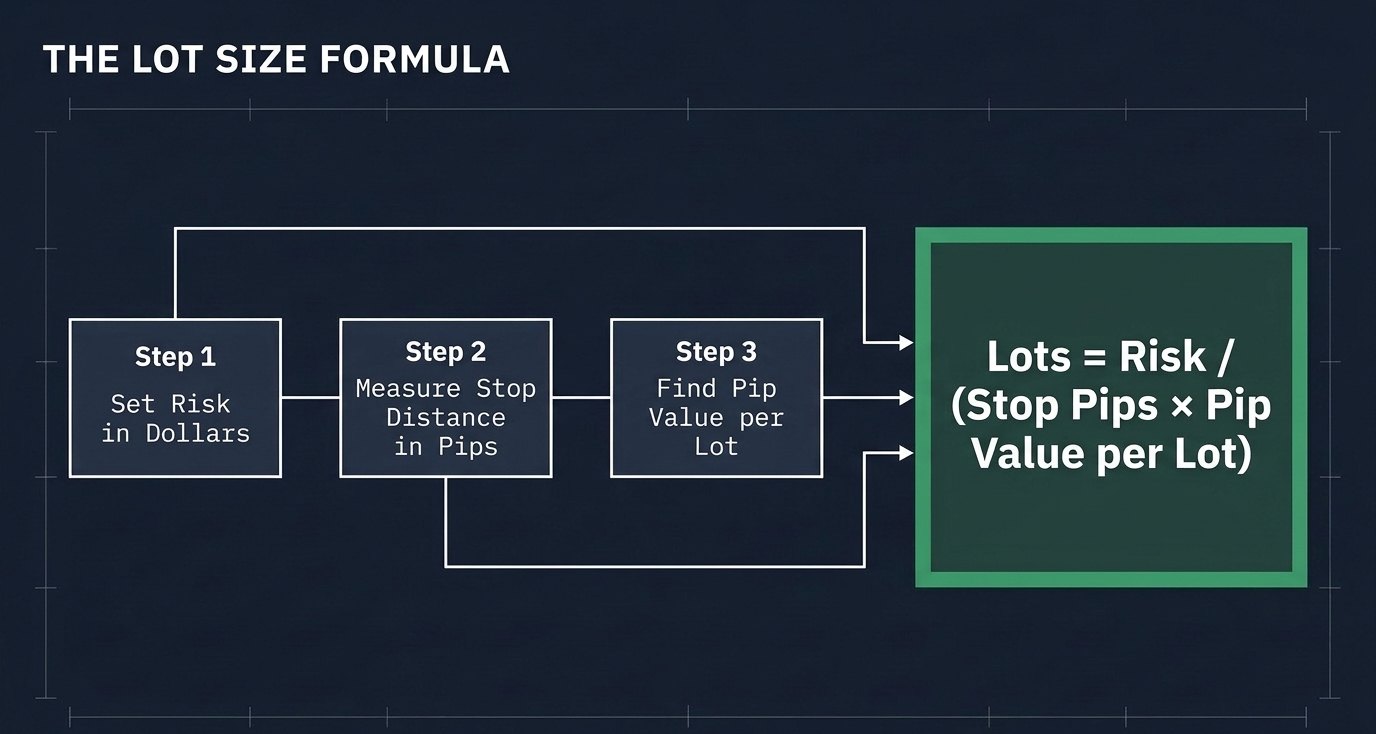
Selecting the correct lot size requires working backward from your stop loss distance. According to Axon Markets' guide, setting volume before stop distance causes severe over-leveraging.
The mathematical position sizing formula is straightforward. Position Size in Standard Lots equals Dollar Risk divided by the product of Stop Distance in Pips and Pip Value per Standard Lot.
Applying this formula keeps your monetary risk constant regardless of market volatility. According to PineConnector's documentation, adjusting volume compensates for wider or tighter stop loss placements.
Understanding how stop distance impacts position volume is essential for capital preservation. Combining precise stop placement with Where to Put Your Stop Loss maintains steady portfolio protection.
The table below shows how a fixed $50 risk allocation shifts lot sizes across different stop loss distances on EUR/USD.
| Fixed Dollar Risk | Stop Loss Distance | Required Pip Value | Standard Lot Position | Micro Lot Position |
|---|---|---|---|---|
| $50.00 | 10 pips | $5.00 per pip | 0.50 standard lots | 50 micro lots |
| $50.00 | 25 pips | $2.00 per pip | 0.20 standard lots | 20 micro lots |
| $50.00 | 50 pips | $1.00 per pip | 0.10 standard lots | 10 micro lots |
What does a position sizing calculation look like in practice?
Walking through step-by-step examples clarifies how position sizing works in live trading environments. Following Position Sizing: The 1% Rule Explained ensures you never over-expose account capital.
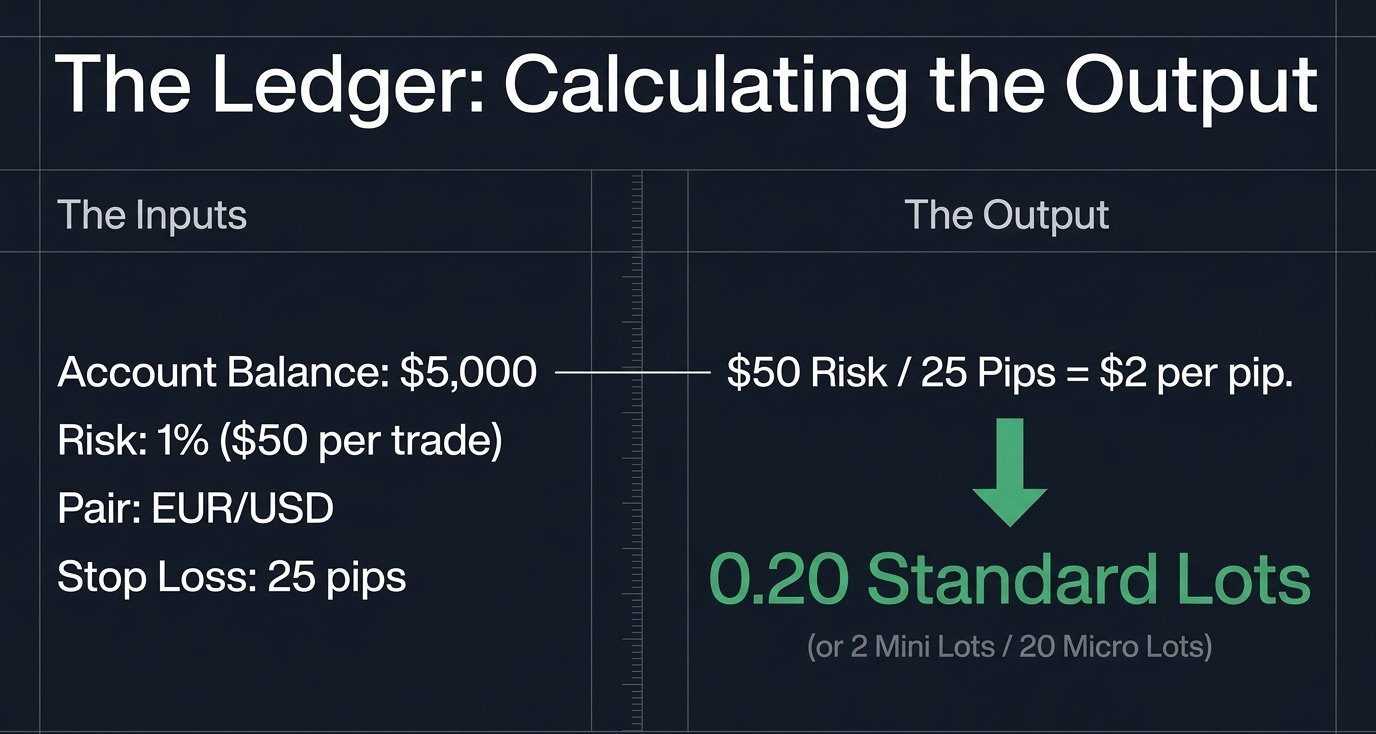
Consider a $5,000 trading account risking 1% ($50) on EUR/USD with a 25-pip stop loss. According to Axon Markets' guide, evaluating every math step prevents execution errors.
First, calculate total risk in dollars: $5,000 multiplied by 1% equals $50.00 total risk.
Second, divide dollar risk by stop distance: $50.00 divided by 25 pips equals $2.00 required pip value.
Third, divide required pip value by standard pip value: $2.00 divided by $10.00 equals 0.20 standard lots.
This 0.20 standard lot position converts directly into 2 mini lots or 20 micro lots. To double check: 25 pips multiplied by $2.00 per pip equals exactly $50.00 risk.
Now consider a second example on USD/JPY at an illustrative exchange rate of 150.00 with a 30-pip stop loss. According to ComoFX's report, pip values on Yen pairs shift with current rates.
First, find pip value per standard lot: 0.01 divided by 150.00 multiplied by 100,000 equals $6.67 per pip.
Second, divide $50.00 risk by 30 pips: $50.00 divided by 30 pips equals $1.67 required pip value.
Third, divide required pip value by standard pip value: $1.67 divided by $6.67 equals 0.25 standard lots. The table below outlines these calculations side by side.
| Calculation Stage | EUR/USD Setup (25-Pip Stop) | USD/JPY Setup (30-Pip Stop at 150.00) |
|---|---|---|
| Account Balance & Risk | $5,000 balance x 1% = $50.00 risk | $5,000 balance x 1% = $50.00 risk |
| Target Pip Value | $50.00 / 25 pips = $2.00 per pip | $50.00 / 30 pips = $1.67 per pip |
| Standard Lot Pip Value | $10.00 per standard lot | (0.01 / 150) x 100,000 = $6.67 per lot |
| Final Position Size | 0.20 standard lots (2 mini / 20 micro) | 0.25 standard lots (2.5 mini / 25 micro) |
| Sanity Check Verification | 25 pips x $2.00/pip = $50.00 risk | 30 pips x $1.67/pip = $50.00 risk |
What are the most common lot size mistakes?
Avoiding frequent sizing errors protects trading capital from sudden drawdowns.
1. Trading fixed lot sizes on every trade. Ignoring stop loss distance causes wildly unpredictable dollar risk per trade setup.
2. Confusing margin requirements with risk. High broker leverage reduces required margin but never changes actual dollar risk per pip.
3. Miscounting decimal places on Japanese Yen pairs. Mistaking the second decimal for the fourth causes a 100-fold sizing miscalculation.
4. Revenge sizing after losing trades. Doubling volume to recover previous losses violates risk guidelines and accelerates account depletion.
5. Ignoring broker spread costs. Failing to add spread buffer to stop distances under-estimates total trade loss potential.
6. Disregarding daily loss limits on prop firm accounts. Over-sizing positions breaches daily drawdown rules instantly. Managing risks in Daily Loss Limits and Max Drawdown prevents fatal rule breaches.
Which tools help you size forex trades?
Utilizing proper software tools simplifies position sizing and charting precision. Maintaining disciplined trade records ensures long-term execution consistency.
Using TradingView enables precise stop loss measurement through its long and short position drawing tools.
For traders seeking structured rules, evaluation accounts at ForTraders and Instant Funding enforce strict lot sizing against daily drawdown limits. Note that prop firms charge evaluation fees and most traders fail evaluations.
For deep theoretical insights into position sizing models, read Trade Your Way to Financial Freedom by Van K. Tharp. Check the current price on Amazon. Aligning mathematical models with Trading Expectancy builds sustainable performance over time.
Test yourself: can you size a forex trade?
Test your understanding of pips, lot sizes, and risk calculations with this five-question quiz.
1. What is the dollar value per pip for one standard lot on EUR/USD?
A) $1.00
B) $5.00
C) $10.00
D) $100.00
Answer: C. One standard lot equals 100,000 units, yielding $10.00 per pip on EUR/USD.
2. How many base currency units are in one micro lot?
A) 100 units
B) 1,000 units
C) 10,000 units
D) 100,000 units
Answer: B. A micro lot (0.01 in terminal notation) represents exactly 1,000 units of base currency.
3. If you risk $50 on a 50-pip stop loss, what is your target pip value?
A) $0.50 per pip
B) $1.00 per pip
C) $2.00 per pip
D) $5.00 per pip
Answer: B. Dividing $50.00 dollar risk by 50 pips yields $1.00 per pip (0.10 mini lot on EUR/USD).
4. How does increasing broker leverage affect pip value?
A) It increases pip value proportionately.
B) It decreases pip value proportionately.
C) It has zero effect on pip value.
D) It doubles pip value on Yen pairs.
Answer: C. Leverage alters required margin but never changes the monetary pip value of a lot size.
5. Which decimal place represents one pip on USD/JPY?
A) First decimal place (0.1)
B) Second decimal place (0.01)
C) Third decimal place (0.001)
D) Fourth decimal place (0.0001)
Answer: B. Japanese Yen currency pairs use the second decimal place to represent one pip.
FAQ
What is the minimum account balance needed to trade forex?
According to CMC Markets' guide, micro and nano lots let beginners trade small accounts while keeping the dollar risk per pip small.
Does lot size affect spread costs?
Yes, spread costs scale directly with lot volume because spread is charged per lot traded.
What is the difference between a mini lot and a micro lot?
A mini lot equals 10,000 units ($1/pip on EUR/USD), while a micro lot equals 1,000 units ($0.10/pip).
How do you calculate lot size for gold or silver?
Contract specifications vary by broker, so verify contract size per lot in your trading terminal before sizing.
Why does pip value change on USD/JPY?
USD/JPY pip value fluctuates because USD is the base currency and the exchange rate fluctuates constantly.
Should you change lot size after a winning trade?
No, position size should depend strictly on account balance and stop distance, not recent trade outcomes.
The verdict
Mastering forex lot sizing transforms speculative guessing into disciplined capital management. Calculating position volume from stop loss distance protects your account from catastrophic drawdowns.
Your immediate next step is to calculate the exact lot size for your next setup before placing an order.
Sources: CMC Markets Lot Size Guide, Axon Markets Position Sizing Guide, ComoFX Pip Value Guide, EdgeFlo Forex Lot Sizes, ArigoFX Beginner Guide, PineConnector Position Sizing Documentation.
Trading involves substantial risk of loss, and most retail traders lose money. This article is education, not financial advice.
