

- What is a REIT and how does it work?
- What does owning a rental property involve?
- How do REITs and rental properties compare side by side?
- How do effort, liquidity, minimum cash, and risk compare?
- How do the effort and time compare?
- How do liquidity and getting your money out compare?
- How much cash do you need to start?
- How do diversification and risk compare?
- What does a worked example look like in numbers?
- What changes if things go wrong?
- Who might each option suit?
- What common mistakes do real estate investors make?
- Which tools help you evaluate real estate options?
- Test yourself
- FAQ
- Are REIT dividends taxed at the same rate as rental income?
- Can you use mortgage leverage when buying REIT shares?
- How quickly can you sell REIT shares compared to a rental property?
- Do REITs protect against inflation as well as physical rentals?
- What is the main advantage of direct property ownership?
- Is investing in REITs completely hands-off?
- The verdict
Real estate investing involves substantial risk. Money can be locked up and lost, and examples include vacancies, repairs and fees. This article is education, not financial advice.
Disclosure: this article contains affiliate links. If you buy or sign up through them, Trader Edge Hub may earn a commission at no extra cost to you. We only mention products we think fit the topic. As an Amazon Associate, Trader Edge Hub earns from qualifying purchases.
Evaluating reits vs rental property helps you select the right real estate investment strategy. At Trader Edge Hub, we analyze financial assets using objective data rather than sales claims. Comparing public real estate trusts against physical property requires examining cash requirements, liquidity, effort, and risk factors.
Quick answer: REITs offer liquid stock exchange access to real estate portfolios with low cash minimums and zero landlord duties. Rental properties require substantial upfront capital and active management but provide direct leverage, tax depreciation benefits, and operational control.
What is a REIT and how does it work?
A Real Estate Investment Trust [a company that owns, operates, or finances income-producing real estate] allows individual investors to buy shares. Investor.gov documentation from the Securities and Exchange Commission explains that REITs model their structure after mutual funds. They pool capital to purchase commercial and residential property portfolios.
Internal Revenue Code rules dictate how REITs manage corporate earnings and tax obligations. Federal tax law requires a REIT to distribute at least 90% of its taxable income to shareholders annually as dividends. In exchange, REITs generally pay no corporate income tax at the entity level, according to Taxstra guidelines.
REITs fall into two primary operating categories based on asset holdings. Equity REITs own and manage physical properties, generating income through tenant lease payments. Mortgage REITs [companies that finance real estate by purchasing or originating mortgages] earn interest income from property loans, according to Investor.gov.
Most public REITs trade on major stock exchanges like regular shares. You can buy or sell shares instantly during standard trading hours without physical property transactions. Investor.gov notes that public REITs provide retail investors access to commercial real estate portfolios.
What does owning a rental property involve?
Owning a rental property involves purchasing physical residential or commercial real estate directly. As a direct property owner, you hold legal title to the land and buildings. You receive monthly rent payments directly from occupying tenants.
Direct ownership requires managing property operations or hiring professional management. Big Mike Grant outlines a four-block cash flow model in guidelines for property analysis. These blocks include gross rental income, operating expenses, mortgage debt service, and tax liabilities.
Operating expenses consume a large portion of gross rental revenue. Real-Estate Analyzer guidelines show operating costs typically consume 35% to 50% of gross rent. Property management studies by MRI Software show management fees consume another 5% to 10% of collected rent.
Physical rental property represents an illiquid asset [an investment that cannot be converted to cash quickly without price concessions]. Direct ownership allows investors to use mortgage debt leverage [borrowing capital to amplify purchasing power]. According to Landlord Studio metrics, leverage can increase cash-on-cash yields when property income exceeds borrowing costs.
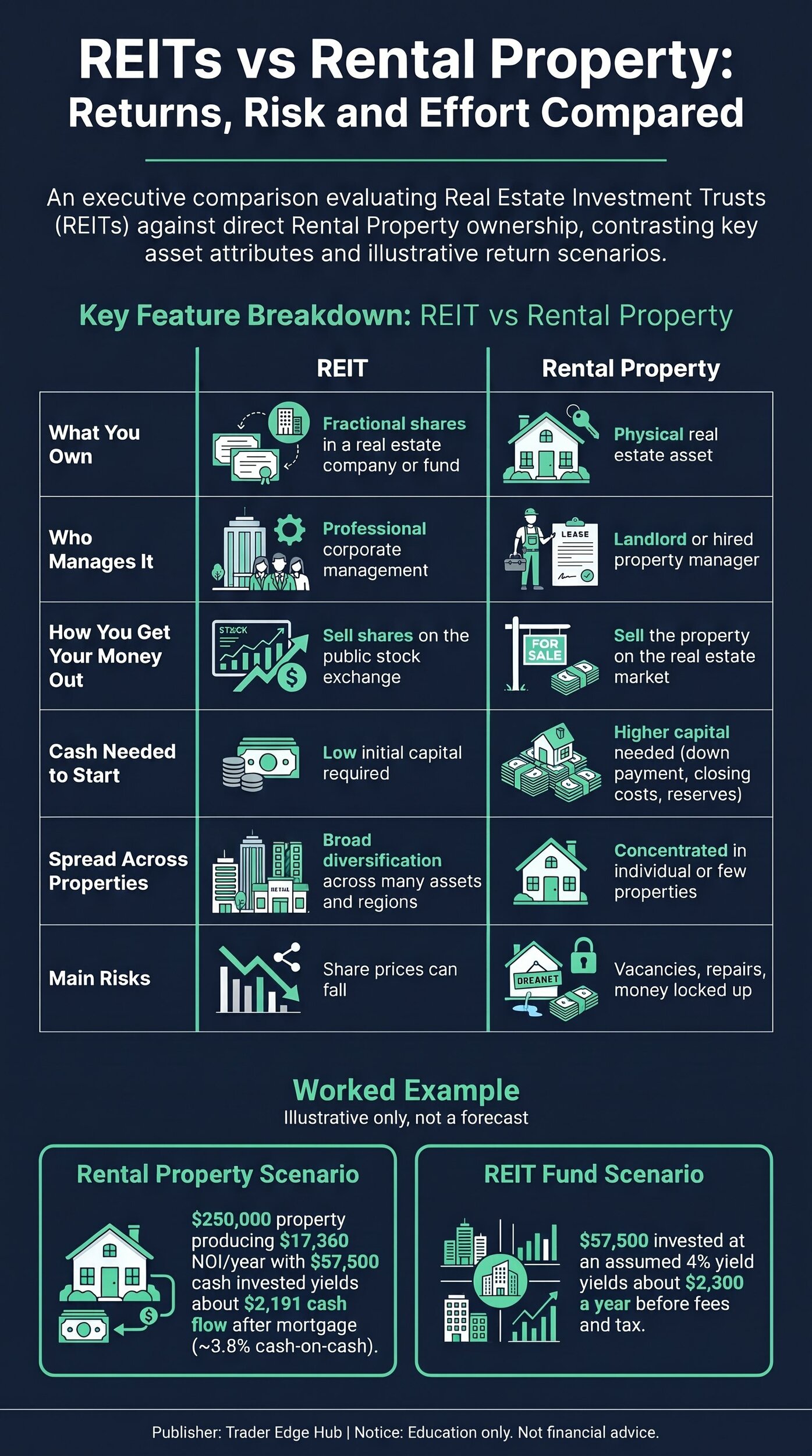
How do REITs and rental properties compare side by side?
Comparing structural features clarifies trade-offs between indirect shares and physical property. The comparison table below outlines fundamental differences across seven key investment criteria.
| Investment Criterion | Real Estate Investment Trust (REIT) | Physical Rental Property |
|---|---|---|
| Management Effort | Hands-off (managed by corporate officers) | Hands-on active management or manager oversight |
| Asset Liquidity | High (trades daily on stock exchanges) | Low (requires months to market and sell) |
| Minimum Cash Needed | Low ($10 to $100 per share) | High ($57,500 for $250k property sample) |
| Portfolio Diversification | High (hundreds of properties across sectors) | Low (concentrated in single local property) |
| Transaction Costs | Minimal (zero-commission stock brokerage) | High (3% closing fees plus 7% selling costs) |
| Operational Control | None (corporate management decides strategy) | Full (owner controls rents, repairs, and sales) |
| Primary Investment Risks | Stock market volatility and interest rate hikes | Tenant vacancies, maintenance, and illiquidity |
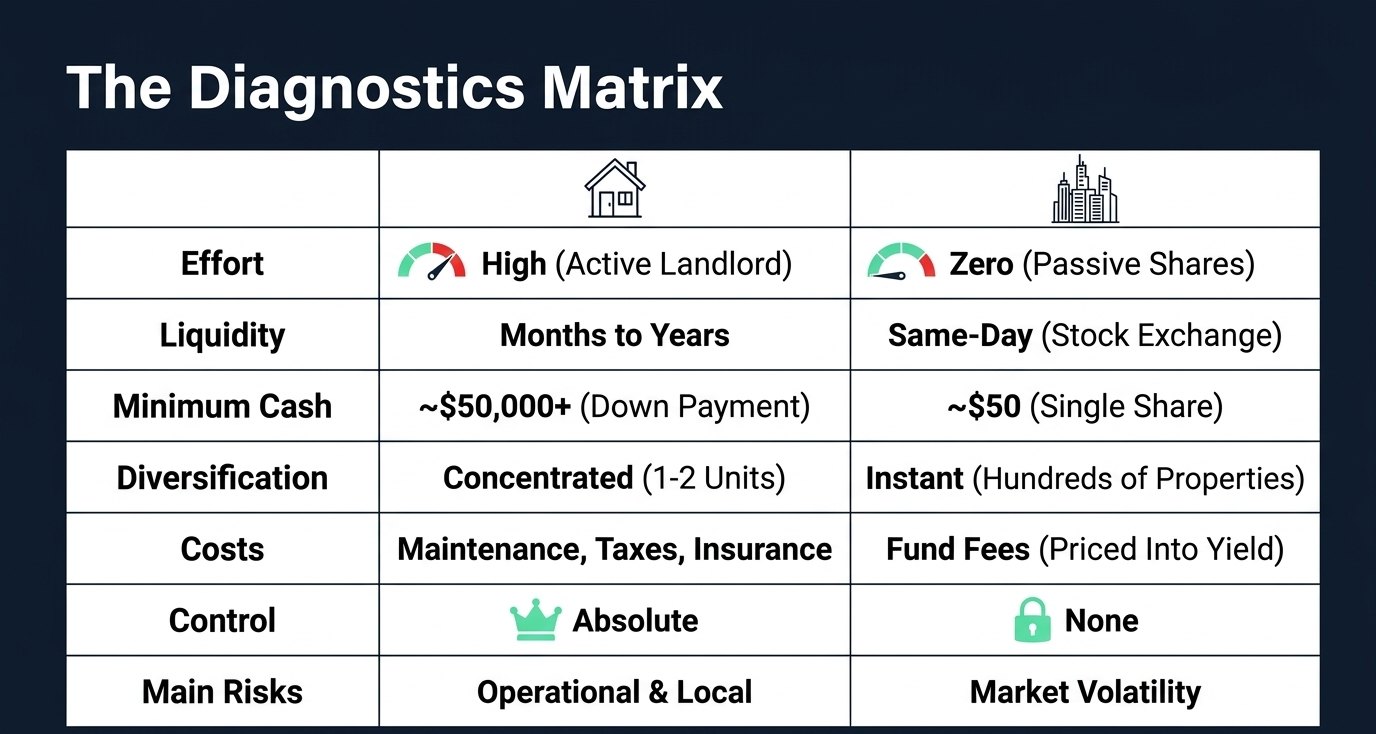
How do effort, liquidity, minimum cash, and risk compare?
How do the effort and time compare?
Time commitments vary between public shares and physical property ownership. Purchasing REIT shares requires zero landlord duties. Corporate management teams handle building acquisitions, tenant leases, and property repairs directly.
Managing rental properties demands ongoing labor from owners. Landlords must handle tenant calls, schedule maintenance, and manage lease renewals. Big Mike Grant notes that property inspections require regular time investments.
Hiring a property manager reduces daily operational burdens but adds cost. MRI Software documentation states property managers charge 5% to 10% of gross rent. Additional costs include tenant placement fees equal to half or full month rent.
Pro tip: Calculate your hourly personal labor return before buying rental properties. If managing tenants consumes 10 hours monthly, subtract that labor value from cash flow yields.
How do liquidity and getting your money out compare?
Asset liquidity determines how quickly you can convert investments back into cash. Publicly traded REITs offer daily stock market liquidity. You can sell share holdings instantly during exchange operating hours with minimal trading fees.
Private REITs and real estate crowdfunding platforms operate under different liquidity rules. Fundrise documentation explains that private deals can lock up investor capital for multi-year redemption periods, with potential redemption penalties during downturns.
Physical real estate represents an illiquid long-term commitment. Selling a rental property takes weeks or months to market, negotiate, and close. BoloSign due diligence checklists confirm closing processes require title search and property inspections.
Selling physical property incurs substantial transaction expenses. CapRateCity models factor a 7% selling cost for real estate agent commissions and fees. Additionally, the 2026 Closing Costs Guide shows buyers pay 2% to 5% in upfront fees.
How much cash do you need to start?
Initial capital requirements present a major barrier for new investors. You can purchase public REIT shares for the price of one share, often under $100. Fundrise guides explain that fractional shares lower entry thresholds further.
Buying physical rental property requires substantial cash reserves. Conventional lenders typically require 20% to 25% down payments for non-owner occupied properties. Purchasing a $250,000 property with a 20% down payment requires $50,000 cash.
Upfront closing costs increase initial capital requirements further. The 2026 Closing Costs Guide establishes buyer closing fees at 2% to 5% of purchase price. Adding 3% closing costs ($7,500) to a $50,000 down payment brings total capital to $57,500.
Landlords must also maintain liquid cash reserves for emergency property repairs. Red Rooster PM guidelines recommend keeping 1.0% of property value annually in dedicated maintenance funds. Red Rooster PM also notes landlords should budget $1.00 per square foot annually for ongoing upkeep.
Common mistake: Purchasing a rental property without adequate cash reserves. Forgetting maintenance reserves can force owners to cover unexpected repair bills out of personal savings.
How do diversification and risk compare?
Portfolio diversification spreads risk across multiple assets and locations. A single public REIT or REIT ETF holds hundreds of properties across commercial and residential sectors. Fidelity Investments reports show REIT ETFs provide broad sector diversification.
Physical rental ownership concentrates capital into specific buildings and neighborhoods. A vacant home halts rental income completely until finding new tenants. Census Bureau survey data shows national rental vacancy averaging 7.3%.
Risks differ structurally between public equities and physical property holdings. REIT shares experience price volatility and react to interest rate shifts, according to Bankrate reports. When mortgage rates rise, REIT share valuations often decline.
Physical rentals face tenant property damage, localized economic declines, and unexpected maintenance costs. A Zillow and Thumbtack study revealed hidden ownership costs top $16,566 annually. Hidden costs include property taxes, insurance, and structural repairs.
What does a worked example look like in numbers?
Comparing physical real estate to public trusts requires analyzing equal cash outlays. The table below models an illustrative $57,500 cash investment in a rental property versus a REIT fund. Every figure is an illustrative assumption and not a financial forecast.
| Financial Metric | Rental Property Option (Illustrative) | REIT Fund Option (Illustrative) |
|---|---|---|
| Initial Cash Invested | $50,000 down (20%) + $7,500 closing costs (3%) = $57,500 | $57,500 invested in REIT fund shares |
| Gross Asset Value & Debt | $250,000 purchase price ($200,000 mortgage loan) | $57,500 share market value (zero personal mortgage debt) |
| Annual Revenue Baseline | $28,800 gross rent ($2,400/mo) minus $1,440 vacancy (5%) = $27,360 EGI | Assumed 4% dividend yield (illustrative assumption) = $2,300/yr |
| Less Operating Expenses | -$10,000/yr operating expenses (illustrative assumption) | N/A (fund expenses deducted before dividend distribution) |
| Net Operating Income (NOI) | $17,360 annual net operating income ($27,360 minus $10,000) | N/A (not applicable for equity shares) |
| Annual Debt Service | -$15,169 annual debt service ($200k loan at illustrative 6.5% rate) | $0 (no personal mortgage debt payments) |
| Net Annual Income / Cash Flow | About $2,191 annual net cash flow ($17,360 NOI minus $15,169 debt) | About $2,300 annual dividend income before fund fees and taxes |
| Cash-on-Cash / Dividend Yield | About 3.8% cash-on-cash return ($2,191 / $57,500) | 4.0% assumed dividend yield ($2,300 / $57,500) |
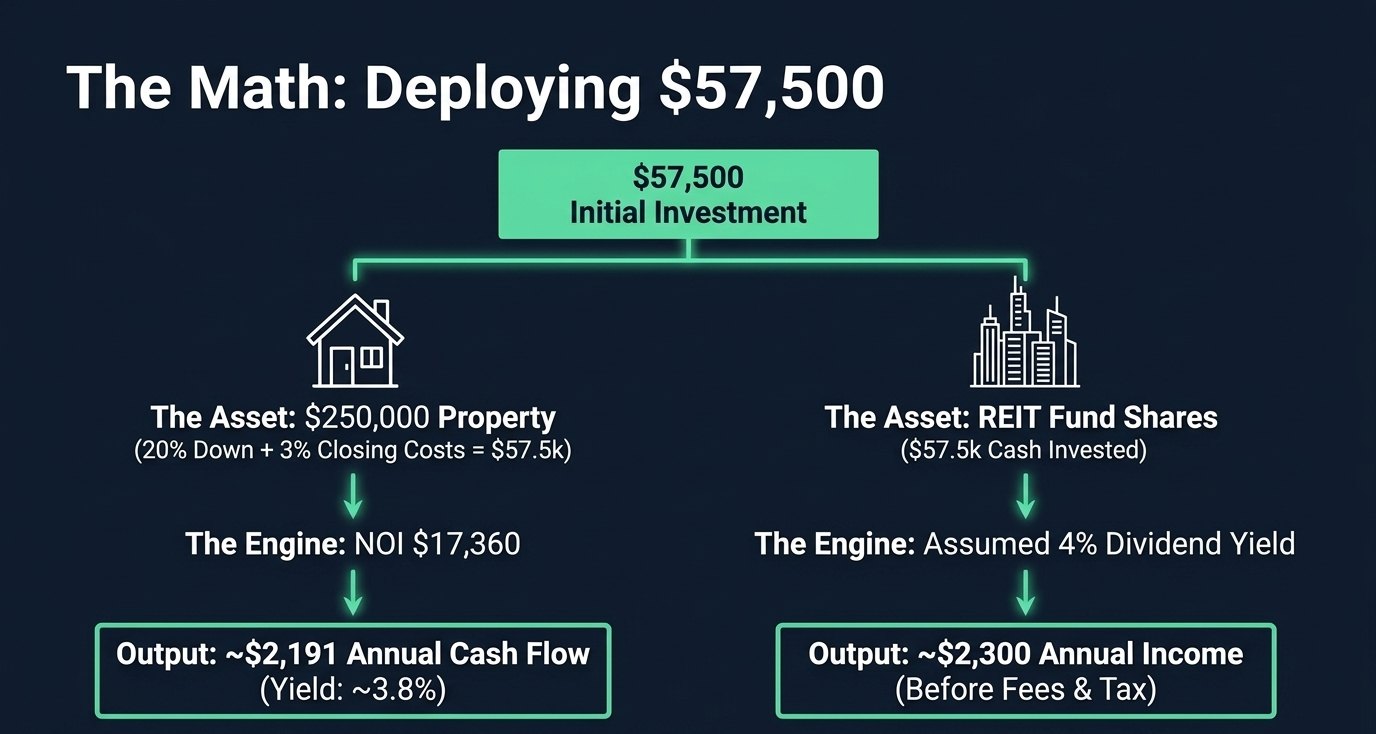
Rental cash flow is calculated after mortgage debt payments are subtracted. Conversely, the REIT figure is a pre-tax dividend estimate before fund fees and personal taxes. These figures are not directly comparable due to structural differences.
Leverage, tax treatment, and personal effort explain why comparisons require nuance. Rental cash flow reflects mortgage leverage and tax depreciation benefits, but demands active management. REIT dividends provide liquid cash distributions without landlord duties, but carry stock market price risk.
What changes if things go wrong?
Stress testing reveals how market scenarios impact returns. Rental property owners face gross rent reductions and fixed mortgage obligations. REIT fund shareholders experience stock price drops during market downturns.
In a scenario where gross rent drops 5%, monthly rent falls from $2,400 to $2,280 ($27,360 annual gross). After subtracting $1,368 vacancy (5%) and $10,000 operating expenses, NOI drops from $17,360 to $15,992. Subtracting $15,169 annual debt service leaves $823 net annual cash flow ($15,992 minus $15,169), reducing cash-on-cash yield to 1.4% ($823 / $57,500).
In a scenario where REIT share prices drop 20%, the market value of a $57,500 REIT portfolio falls to $46,000 ($57,500 times 0.80). This represents an unrealized capital loss of $11,500 ($57,500 minus $46,000), showing that REIT share prices can fall. If the 4% dividend yield holds, annual dividend income on $46,000 equals $1,840.
| Adverse Market Scenario | Impact on Rental Property Option | Impact on REIT Fund Option |
|---|---|---|
| Baseline Scenario ($57,500 invested) | NOI $17,360 | Debt $15,169 | Cash Flow $2,191 (3.8%) | Shares $57,500 | Assumed 4% Yield = $2,300/yr |
| Gross Rent Drops 5% ($2,280/mo) | NOI drops to $15,992 | Cash Flow falls to $823 (1.4%) | No direct change unless commercial market leases drop |
| REIT Share Price Drops 20% | No direct impact on rental cash flow or physical property | Portfolio value drops to $46,000 (-$11,500 unrealized loss) |
When evaluating public equities alongside real estate, review our guide comparing SCHD vs VOO dividend ETFs. Understanding market volatility helps maintain realistic asset expectations.
Who might each option suit?
Selecting between REITs and rental properties depends on capital, time, and risk tolerance. Neither option provides a universally superior path.
Public REITs suit investors seeking liquid real estate exposure without property management. Investors with limited capital benefit from low share minimums. Buying shares inside brokerage accounts allows easy rebalancing.
Physical rental properties suit investors seeking operational control and mortgage leverage. Investors willing to handle maintenance and tenants can build property equity. Direct ownership provides valuable tax depreciation deductions.
If you prefer building a balanced stock portfolio, read our guide on how to build a simple 3-ETF portfolio. Diversifying across asset classes protects long-term capital.
What common mistakes do real estate investors make?
Avoiding analytical errors protects your investment capital. We track six frequent mistakes made when evaluating REITs and rental properties.
1. Comparing REIT dividend yields directly to rental cash flow: Rental cash flow is calculated after deducting debt service. REIT yields represent pre-tax fund distributions before fees and taxes.
2. Underestimating physical landlord labor: Managing physical rental properties requires time and effort. Failing to account for labor values inflates perceived rental returns.
3. Ignoring transaction and exit fees: Selling physical real estate incurs 7% transaction costs in CapRateCity models. Public REIT shares trade with zero commissions on exchanges.
4. Assuming REIT share prices remain stable: Public REIT shares experience daily price swings. Share valuations fluctuate based on market sentiment and interest rate trends.
5. Forgetting emergency repair reserves: Physical properties experience unexpected failures. Red Rooster PM recommends budgeting 1.0% of property value annually for maintenance.
6. Overlooking local vacancy risks: Physical rentals concentrate capital into single buildings. Census Bureau survey data shows national vacancy averaging 7.3%.
Which tools help you evaluate real estate options?
Want a deeper walk-through of buying rentals? The Book on Rental Property Investing by Brandon Turner is a beginner-friendly guide to buy-and-hold rentals. Check the current price on Amazon.
Prefer real estate without being a landlord? Fundrise is an online platform that offers real estate investment funds. These funds can lose value, and your money may be hard to withdraw, so read each fund's offering documents before you invest.
If you prefer liquid real estate exposure without managing physical tenants, you can purchase public REIT shares through brokerage platforms like Robinhood. This approach suits investors seeking low cash minimums and zero landlord responsibilities. Remember that REIT share prices can fall during market downturns.
Before purchasing public fund shares, review our checklist on 10 things to check before you buy an ETF. Reviewing fund structures prevents unexpected expense ratio costs.
To understand how interest rate movements affect yields, read our guide on why bond prices fall when interest rates rise. Rate cycles influence overall borrowing costs.
Test yourself
1. Why are rental cash flow and REIT dividend yields not directly comparable?
A) Rental cash flow is calculated after mortgage debt service.
B) REITs do not pay cash dividends.
C) Rental properties charge no property management fees.
D) REIT share prices never change.
Answer: A. Rental cash flow is calculated after mortgage debt service, while REIT yields represent pre-tax fund distributions.
2. What happens to REIT share valuations when market interest rates rise?
A) Share prices rise rapidly.
B) Share valuations often decline as borrowing costs expand.
C) Dividend payouts drop to zero.
D) Shares convert into physical deeds.
Answer: B. Rising interest rates increase borrowing costs and make competing yield assets more attractive, often lowering REIT share prices.
3. How much cash is required to purchase $57,500 of public REIT shares?
A) Exactly $57,500 with zero mortgage debt or closing fees.
B) $115,000 including bank reserves.
C) $250,000 minimum deposit.
D) $10,000 plus closing costs.
Answer: A. Buying public REIT shares requires only the share purchase capital without mortgage underwriting or closing fees.
4. What is a primary risk of holding a single physical rental property?
A) Income loss during tenant vacancy periods.
B) Daily stock market price volatility.
C) Mandatory corporate board meetings.
D) Automatic conversion to REIT shares.
Answer: A. Owning a single rental property concentrates risk, halting income entirely when the property sits vacant.
5. What percentage of taxable income must a REIT distribute to shareholders annually?
A) At least 50%.
B) At least 75%.
C) At least 90%.
D) Exactly 100%.
Answer: C. Federal tax law requires REITs to distribute at least 90% of taxable income annually to maintain entity tax exemptions.
FAQ
Are REIT dividends taxed at the same rate as rental income?
REIT dividends are typically taxed as ordinary income, according to Taxstra tax guides. Conversely, direct property owners offset rental cash flow using building depreciation deductions.
Can you use mortgage leverage when buying REIT shares?
Individual investors typically buy public REIT shares with cash capital without personal mortgage debt. Direct property purchases allow owners to use 80% mortgage debt leverage.
How quickly can you sell REIT shares compared to a rental property?
Public REIT shares sell instantly during exchange operating hours. Physical rental properties require weeks or months to market, inspect, and close. CapRateCity models factor 7% transaction fees when selling physical properties.
Do REITs protect against inflation as well as physical rentals?
Both assets provide inflation hedges through rising rents. Real-Estate Analyzer reports show landlords adjust lease rates upon renewal, while REITs adjust commercial rents across portfolios.
What is the main advantage of direct property ownership?
Direct ownership provides operational control, mortgage leverage, and tax deductions. Landlord Studio metrics show leverage can increase cash returns when income exceeds borrowing costs.
Is investing in REITs completely hands-off?
Public REIT investing requires zero property management or tenant interaction. Corporate executive teams handle property acquisitions, leasing, and maintenance directly.
The verdict
Choosing between REITs and rental properties depends on available capital, liquidity, and time commitment. Public REITs offer liquid exposure without landlord labor, while physical rentals provide leverage and control.
Your immediate next step is calculating your available capital and time budget. Use these constraints to decide whether public REIT funds or physical property underwriting fits your strategy.
Sources: Investor.gov, Taxstra, Landlord Studio, Big Mike Grant, Real-Estate Analyzer, MRI Software, CapRateCity, 2026 Closing Costs Guide, Red Rooster PM, Census Bureau, Bankrate, Zillow/Thumbtack, Fidelity Investments, Fundrise.
Real estate investing involves substantial risk. Money can be locked up and lost, and examples include vacancies, repairs and fees. This article is education, not financial advice.
