

- What is a bond and how does it pay you?
- Why do bond prices fall when interest rates rise?
- What is yield to maturity, and how is it different from the coupon?
- What is duration, and how does it measure interest rate risk?
- Which bonds are most sensitive to rate changes?
- Individual bonds or bond funds: what changes when rates rise?
- What happens to $5,000 in bonds when rates rise 1%?
- What are the most common mistakes stock investors make with bonds?
- What tools help you track bonds and rates?
- Test yourself: how well do you understand bonds?
- FAQ
- How do bonds work when interest rates fall?
- What is the difference between coupon rate and current yield?
- Why does long duration increase interest rate risk?
- Can you lose money on Treasury bonds?
- What is bond convexity?
- Are bond funds safer than individual stocks?
- The verdict
Investments can go down as well as up, and past performance does not guarantee future results. This article is education, not financial advice; check the tax rules where you live.
Disclosure: this article contains affiliate links. If you sign up through them, Trader Edge Hub may earn a commission at no extra cost to you. We only mention tools we think fit the topic.
Stock investors transitioning to fixed income often ask how bonds work in changing market regimes. A bond represents a formal debt contract where you lend capital to a government or corporation. While equity values depend on earnings growth, fixed income asset prices move inversely to interest rates. At Trader Edge Hub, we explain the mechanics of interest rate sensitivity and portfolio valuation.
Quick answer: Bond prices fall when interest rates rise because existing fixed coupon payments become less competitive against newly issued higher-yielding bonds. To attract buyers, existing bond prices must drop to a discount. Duration measures this interest rate sensitivity, showing roughly how much a bond price changes for every 1 percentage point shift in benchmark rates.
What is a bond and how does it pay you?
Understanding fixed income begins with basic contractual terms between lenders and borrowers. According to Investor.gov, a bond is a debt security where you act as the lender to an issuer. The issuing entity can be a national government, local municipality, or public corporation.
FINRA documentation notes that the borrower promises to pay regular interest and return the par value (face value) at maturity. For most fixed income securities, par value is set at exactly $1,000 per bond. The issuer pays periodic interest known as the coupon payment, typically distributed semiannually according to FINRA guides.
Fixed income assets fall into three primary issuer categories across public and private debt markets. According to TreasuryDirect, Treasury bills mature up to 52 weeks, Treasury notes in 2 to 10 years, and Treasury bonds in 30 years. Treasuries carry full backing from the federal government, giving them low default risk according to Investor.gov.
According to the SEC investor bulletin, corporate bonds are issued by businesses to fund capital expansion and carry higher credit risk. Meanwhile, FINRA guides note that municipal bonds are issued by state or local governments to finance public infrastructure projects. Investors can analyze market risk using our breakdown of Position Sizing: The 1% Rule Explained.
Why do bond prices fall when interest rates rise?
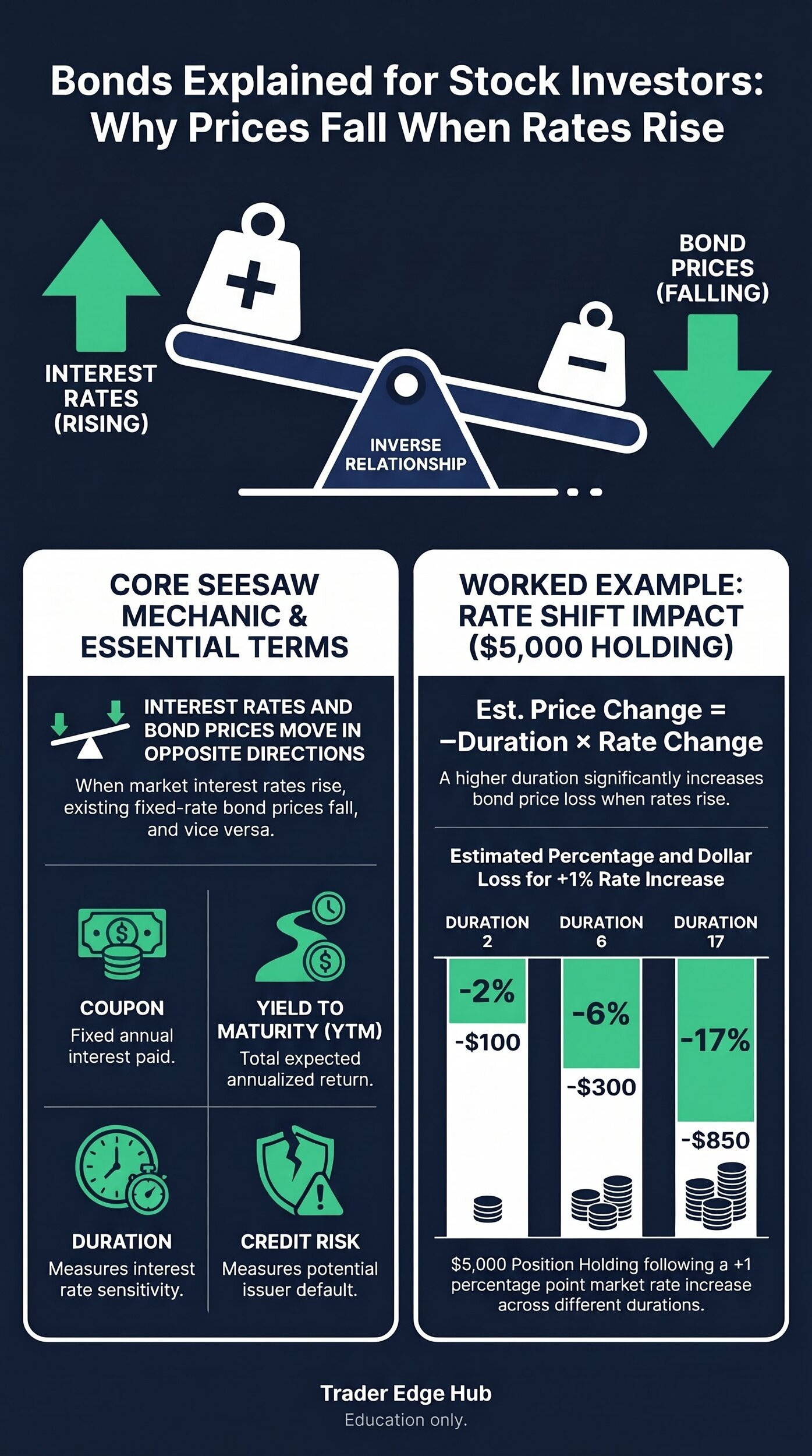
The inverse relationship between market rates and fixed income values forms the core foundation of bond valuation. According to the SEC investor bulletin on interest rate risk, bond prices and interest rates operate on a financial seesaw. When market benchmark rates increase, existing fixed-rate bond prices automatically decline.
To visualize this mechanism, consider a concrete numerical example using standard par values. According to FINRA guides, a $1,000 par bond with a 4% coupon rate pays exactly $40 in annual interest. That $40 annual check remains fixed for the entire life of the security.
Suppose market interest rates rise one year later, and newly issued $1,000 bonds now pay a 5% coupon ($50 annually). Hartford Funds research notes that no buyer will pay $1,000 for your old bond paying $40 when new issues pay $50. To compete, your existing bond must get cheaper in the secondary market.
According to SEC investor bulletins, your bond price must drop to a discount below $1,000. That price drop ensures a new buyer earns a total yield equal to the prevailing 5% market rate. Conversely, when market rates fall to 3%, your 4% bond becomes more valuable and trades at a premium above $1,000.
Common mistake: Assuming government-backed bonds cannot lose market value before maturity is a frequent investor error. SEC investor bulletins emphasize that while the government guarantees principal repayment at maturity, market prices fluctuate daily based on prevailing interest rates.
What is yield to maturity, and how is it different from the coupon?
Evaluating fixed income returns requires distinguishing between fixed annual cash flows and overall investment yields. According to Investor.gov, the coupon rate is the fixed annual interest percentage set when the bond is born. That coupon percentage never changes regardless of broader economic fluctuations.
Current yield measures immediate annual cash income relative to the current market price of the security. Varsity Tutors educational guides state that current yield is calculated by dividing the annual dollar coupon by current market price. For instance, a $1,000 par bond with a $40 coupon trading at $950 offers a current yield of 4.21%.
Yield to maturity (YTM) provides a far more complete metric for fixed income evaluation. According to Blue Chip Partners research, YTM is the annualized discount rate that balances current market price with all future cash flows. YTM accounts for periodic coupon checks, time value of money, and capital gains or losses at maturity.
Farhat Lectures accounting documentation states that when you buy a bond at a discount, YTM exceeds current yield due to terminal price appreciation. Conversely, buying a bond at a premium causes YTM to fall below current yield. According to Varsity Tutors guides, this occurs because you absorb a capital loss at maturity. You can evaluate strategy outcomes using our analysis of Trading Expectancy.
What is duration, and how does it measure interest rate risk?
Duration provides fixed income investors with a single summary statistic for quantifying interest rate sensitivity. According to PIMCO research, duration combines maturity date, coupon size, yield, and call features into one risk measurement. Expressed in years, duration estimates how much a bond price moves when interest rates change.
The standard rule of thumb links duration directly to percentage price changes in fixed income assets. According to Fidelity guides, if benchmark rates rise 1 percentage point (100 basis points), a 5-year duration bond loses roughly 5% in market value. Conversely, if interest rates fall 1 percentage point, that same 5-year duration bond gains approximately 5% in value.
Financial literature defines two primary forms of duration that investors must not confuse. According to Risk Hub documentation, Macaulay duration measures the present-value-weighted average time required to receive all cash flows. Developed by Frederick Macaulay in 1938, Macaulay duration represents a balance point measured in actual years according to CA.gov debt advisory reports.
Modified duration converts Macaulay duration directly into percentage price sensitivity. According to Risk Hub guides, modified duration equals Macaulay duration divided by one plus the periodic yield. For example, a bond with a 4.39-year Macaulay duration and a 3% semiannual yield carries a modified duration of 4.26 years. That 4.26 figure estimates the percentage price change per 100 basis point rate shift.
Pro tip: Always check average duration on fund fact sheets before investing in fixed income portfolios. PIMCO research notes that matching portfolio duration to your planned investment horizon helps neutralize interest rate volatility through offsetting price and reinvestment effects.
Which bonds are most sensitive to rate changes?
Not all fixed income securities react to interest rate shifts with equal intensity. Structural characteristics like maturity length, coupon size, and credit quality dictate individual bond price volatility. We examine these sensitivity drivers to help you manage portfolio risk effectively.
According to CA.gov debt advisory reports, long-term bonds experience far greater price volatility than short-term bonds. As one educational video in our sources puts it, a 30-year Treasury bond has a longer seesaw beam than a 2-year Treasury note. Therefore, interest rate shifts cause much larger percentage price swings in long-term debt securities.
Coupon size also exerts a powerful mathematical influence on interest rate sensitivity. According to BYU Stat 274 lecture notes, lower coupon rates increase duration sensitivity because more cash flow weight is deferred until maturity. Zero-coupon bonds, which pay no periodic interest, carry the maximum possible duration equal to their full maturity time according to NAIC market risk reports.
| Bond Structural Variable | Interest Rate Sensitivity Impact | Primary Source Reference |
|---|---|---|
| Longer Maturity (e.g. 30 Years) | Higher duration and increased price volatility | CA.gov debt advisory guidelines |
| Shorter Maturity (e.g. 2 Years) | Lower duration and reduced price volatility | Fidelity fixed income guides |
| Lower Coupon Rate (or Zero-Coupon) | Higher duration; maximum sensitivity for zero-coupon | BYU Stat 274 lecture documentation |
| Higher Coupon Rate (e.g. 6%) | Lower duration due to earlier cash flow recovery | Risk Hub fixed income guides |
| Inflation Risk Shield (TIPS) | Principal adjusts semiannually for Consumer Price Index | FINRA investor insights |
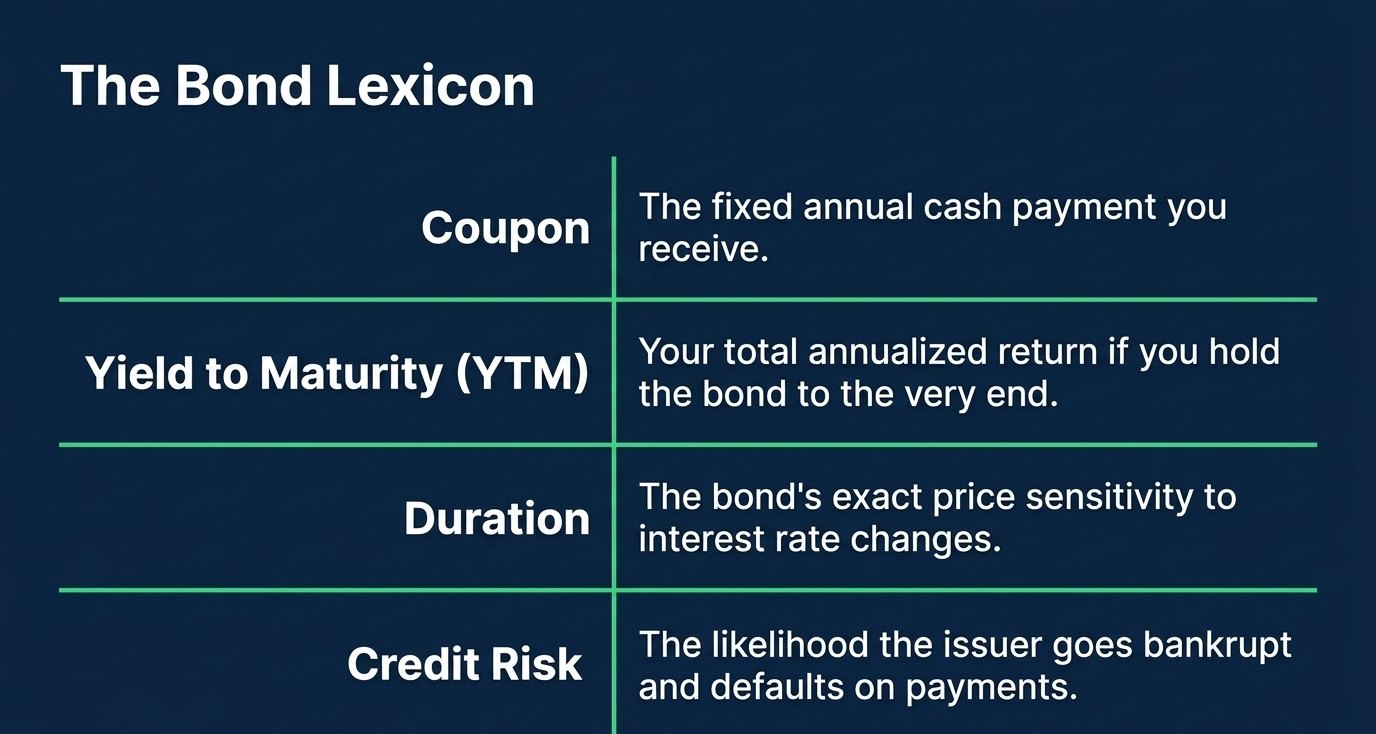
In addition to rate risk, investors must account for credit risk and inflation risk. According to Fidelity guides, credit risk reflects the probability that a corporate issuer defaults on interest or principal repayments. Meanwhile, according to FINRA guides, Treasury Inflation-Protected Securities (TIPS) adjust principal value semiannually to preserve real purchasing power.
Individual bonds or bond funds: what changes when rates rise?
Holding an individual bond directly differs significantly from owning shares in a bond mutual fund or ETF. According to FINRA investor guides, an individual bond has a fixed maturity date when the issuer returns the par value. If you hold an individual bond until maturity, market price fluctuations along the way do not alter your principal return.
Conversely, according to SEC investor bulletins, bond funds do not have a single fixed maturity date. Fund managers continuously buy and sell debt securities to maintain a targeted portfolio duration. When interest rates rise, bond fund share values drop and may not recover unless rates fall back down.
Reinvestment mechanics also operate differently between direct bonds and bond funds. According to Fidelity fixed income guides, rising interest rates allow bond fund managers to reinvest maturing cash into higher-yielding new bonds. Over longer holding periods, higher coupon income can eventually offset initial capital losses caused by rising benchmark rates.
What happens to $5,000 in bonds when rates rise 1%?
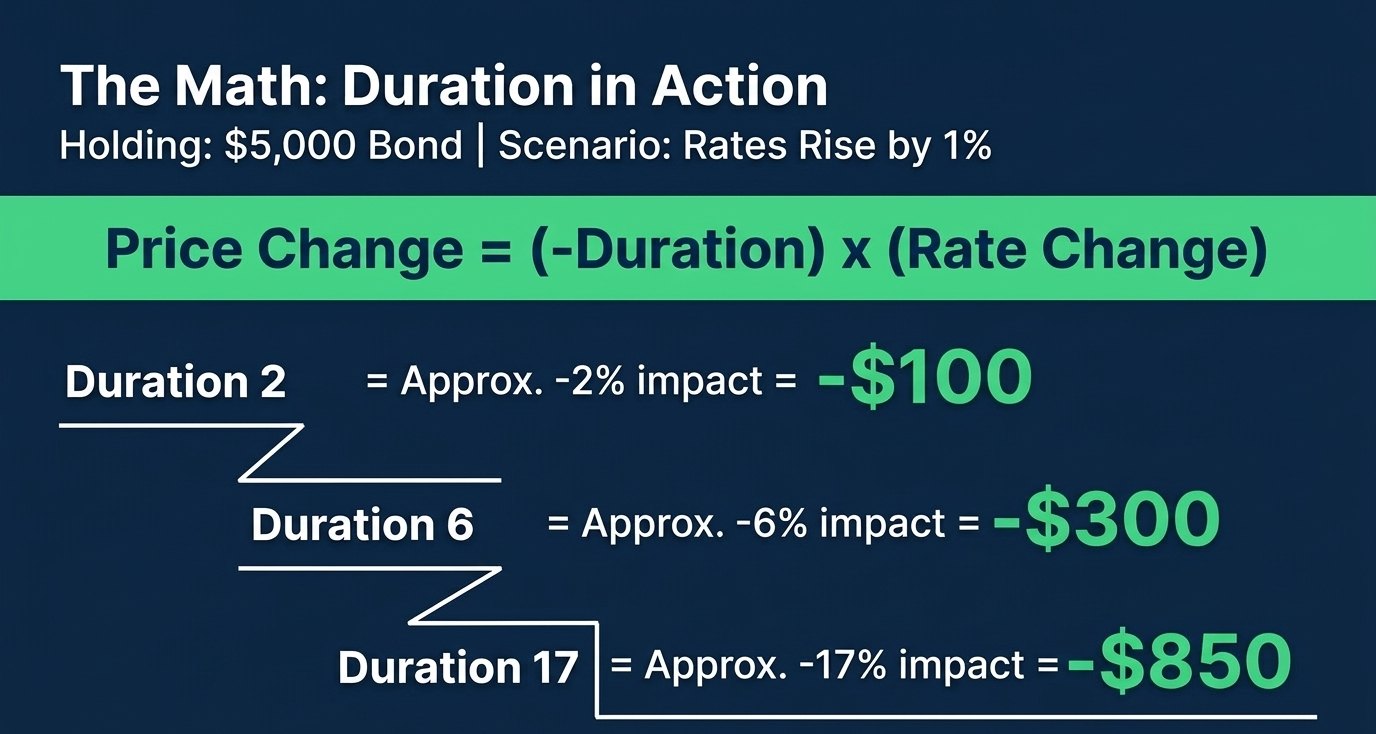
To evaluate how duration impacts real capital, we analyze a hypothetical $5,000 bond allocation. We examine three different fixed income portfolios following a 1 percentage point (100 basis point) rate increase. According to PIMCO research, estimating price changes requires multiplying negative duration by the benchmark rate change.
| Portfolio Duration Profile | Rate Shift & Calculation | Estimated Value Change | New Portfolio Position Value |
|---|---|---|---|
| Short Duration (2 Years) | +1% rate rise (-2 x 1%) | -2.00% (-$100.00 loss) | $4,900.00 remaining value |
| Intermediate Duration (6 Years) | +1% rate rise (-6 x 1%) | -6.00% (-$300.00 loss) | $4,700.00 remaining value |
| Long Duration (17 Years) | +1% rate rise (-17 x 1%) | -17.00% (-$850.00 loss) | $4,150.00 remaining value |
A 1 percentage point drop in benchmark rates produces roughly equal percentage gains across each duration profile. According to NAIC market risk reports, this linear duration rule of thumb simplifies reality because it completely ignores bond convexity.
What are the most common mistakes stock investors make with bonds?
Transitioning from stocks to bonds without understanding debt mechanics leads to costly analytical errors. At Trader Edge Hub, we identified six frequent mistakes stock investors make when entering fixed income markets. Avoiding these analytical errors protects your portfolio against unexpected capital losses.
First, assuming government-backed Treasuries carry zero market loss risk before maturity causes severe capital surprises. According to SEC investor bulletins, government guarantees apply only to principal repayment at final maturity date. Selling government bonds before maturity during rising rate regimes creates immediate capital losses.
Second, confusing coupon rate with yield to maturity leads to inaccurate income expectations. According to Varsity Tutors guides, buying a bond at a premium lowers your net yield below the printed coupon percentage. Yield to maturity provides a complete return calculation by accounting for terminal capital losses.
Third, ignoring portfolio duration when interest rates rise exposes investors to unexpected paper capital losses. According to Fidelity guides, holding long-duration funds during rate-hiking cycles creates severe price drawdowns. Evaluating duration sensitivity helps you match portfolio risks to your target investment horizon.
Fourth, treating long-term bond funds as equivalent to individual bonds creates liquidity misunderstandings. According to SEC investor bulletins, open-ended bond funds never mature, so they never return a fixed principal amount. Fund investors remain exposed to ongoing market price shifts caused by interest rate fluctuations.
Fifth, ignoring credit default risk when chasing high-yield corporate bonds increases loss probabilities. According to FINRA guides, higher coupon yields compensate investors for elevated corporate default and downgrade risk. High-yield corporate bonds often correlate closely with equity market declines during economic recessions.
Sixth, neglecting inflation risk causes real purchasing power erosion over extended holding periods. According to U.S. Bank reports, fixed coupon payments lose real purchasing value when inflation exceeds nominal bond yields. For a framework on weighing potential gains against losses, see our guide on Risk-Reward Ratio Explained.
What tools help you track bonds and rates?
Tracking benchmark yields and economic data helps fixed income investors monitor changing interest rate regimes. Using dedicated charting tools and direct treasury portals simplifies portfolio analysis. Monitoring duration and yield trends ensures your portfolio remains aligned with your risk budget.
To track real-time Treasury yield curves and chart macro interest rate trends, use TradingView. To manage diversified holdings including stocks and fixed income funds on a mobile brokerage platform, consider Robinhood.
For direct purchases of individual U.S. Treasury bills, notes, and bonds without brokerage fees, visit TreasuryDirect. TreasuryDirect provides direct access to primary federal debt auctions for individual retail investors. To learn how professional traders navigate shifting market cycles across asset classes, read our breakdown on Beyond HODLing.
Test yourself: how well do you understand bonds?
1. Why do existing bond prices drop when market interest rates increase?
A) Issuers reduce promised coupon payments
B) Existing fixed coupons become less competitive against new higher-yielding issues
C) Maturity dates are automatically extended by the issuer
D) Regulatory agencies cap annual bond yields
Answer: B. Secondary market prices fall to increase the yield of existing bonds until they match new market rates.
2. If a bond portfolio has a duration of 6 years and interest rates rise 1%, what is the estimated price change?
A) Gain of 6%
B) Loss of 1%
C) Loss of 6%
D) No change in value
Answer: C. According to Fidelity guides, estimated percentage price change roughly equals negative duration multiplied by the rate change.
3. Which yield metric accounts for both periodic coupon payments and capital gains or losses at maturity?
A) Coupon rate
B) Current yield
C) Yield to maturity (YTM)
D) Dividend yield
Answer: C. Yield to maturity calculates the total annualized return earned if the bond is held until maturity.
4. How does holding an individual bond to maturity differ from owning a bond fund?
A) Individual bonds pay no interest checks
B) Individual bonds return par value at a fixed maturity date
C) Bond funds are completely backed by government guarantees
D) Bond funds never experience price changes
Answer: B. According to FINRA documentation, holding individual bonds returns face value at maturity, whereas bond funds never mature.
5. Which type of bond carries zero coupon payments and the maximum possible duration relative to its maturity?
A) Floating-rate note
B) Municipal revenue bond
C) Zero-coupon bond
D) High-yield corporate bond
Answer: C. According to NAIC reports, zero-coupon bonds pay no periodic interest, making their duration equal to full maturity time.
FAQ
How do bonds work when interest rates fall?
When benchmark interest rates decrease, existing bond prices rise to a premium above face value. According to Hartford Funds research, older higher-coupon bonds become more attractive to market buyers. The price rises until the total yield matches lower prevailing market rates.
What is the difference between coupon rate and current yield?
The coupon rate is the fixed annual interest percentage established when the bond is issued. Current yield divides the annual dollar coupon by the current market price according to Varsity Tutors guides. Current yield fluctuates daily as the bond market price moves.
Why does long duration increase interest rate risk?
Long duration means cash flows are received far in the future, increasing sensitivity to rate shifts. According to CA.gov debt advisory reports, cash flows arriving decades away suffer greater present value discounting when rates rise. Therefore, long-duration bonds experience larger percentage price drops.
Can you lose money on Treasury bonds?
Yes, you can lose money if you sell a Treasury bond before its final maturity date. According to SEC investor bulletins, government backing promises full face value return at maturity. However, secondary market prices fluctuate daily based on prevailing interest rate movements.
What is bond convexity?
Convexity measures the curved relationship between bond prices and interest rate changes. According to NAIC market risk documentation, duration provides a straight-line estimate of price sensitivity. Convexity corrects duration estimates for large benchmark interest rate shifts.
Are bond funds safer than individual stocks?
High-quality bond funds generally exhibit lower price volatility than individual equity stocks. According to Investor.gov, fixed income assets provide income stability and capital preservation. However, bond funds still carry interest rate risk and can lose market value when rates rise.
The verdict
Understanding how bonds work enables stock investors to navigate interest rate cycles with confidence. By evaluating duration, yield metrics, and structural fund differences, you protect your portfolio against unexpected price drawdowns. Take your next step by checking the average duration on your fixed income fund fact sheets today.
Sources: SEC investor bulletin, FINRA bond guide, TreasuryDirect, Investor.gov glossary, Fidelity duration guide, PIMCO understanding duration report, Hartford Funds interest rate guide, U.S. Bank bond market report, CA.gov duration basics, NAIC market risk report, Risk Hub duration guide, Varsity Tutors yield measures, BYU Stat 274 lecture notes, Blue Chip Partners bond research.
Investments can go down as well as up, and past performance does not guarantee future results. This article is education, not financial advice; check the tax rules where you live.
