
- What is an ETF and why does a checklist matter?
- What does the ETF actually hold and track?
- How do you evaluate the fund objective and index methodology?
- How do you check holdings concentration and portfolio overlap?
- How much will the ETF cost you each year?
- How does the expense ratio impact your long-term wealth?
- What are tracking difference and tracking error?
- How easy is the ETF to buy and sell?
- Why do liquidity and bid-ask spread matter more than daily volume?
- How do premiums, discounts, and order timing affect trades?
- What else should you check before you buy an ETF?
- How do fund size and age impact closure risk?
- Why are leveraged, inverse, and complex ETFs dangerous for long-term investors?
- How do taxes and capital gain distributions work for ETFs?
- How do you evaluate the issuer, fund structure, and portfolio fit?
- What does an ETF checklist look like with real numbers?
- What are the most common mistakes when choosing an ETF?
- Which tools help you compare ETFs?
- Test yourself: can you vet an ETF?
- FAQ
- How do you choose an ETF for beginners?
- What is a good expense ratio for an ETF?
- Why do ETFs trade at a premium or discount?
- Is daily trading volume the best measure of ETF liquidity?
- What happens if an ETF closes down?
- How many ETFs should you hold in a portfolio?
- The verdict
Investments can go down as well as up, and past performance does not guarantee future results. Check your local tax rules. This article is education, not financial advice.
Disclosure: this article contains affiliate links. If you sign up through them, Trader Edge Hub may earn a commission at no extra cost to you. We only mention tools we think fit the topic.
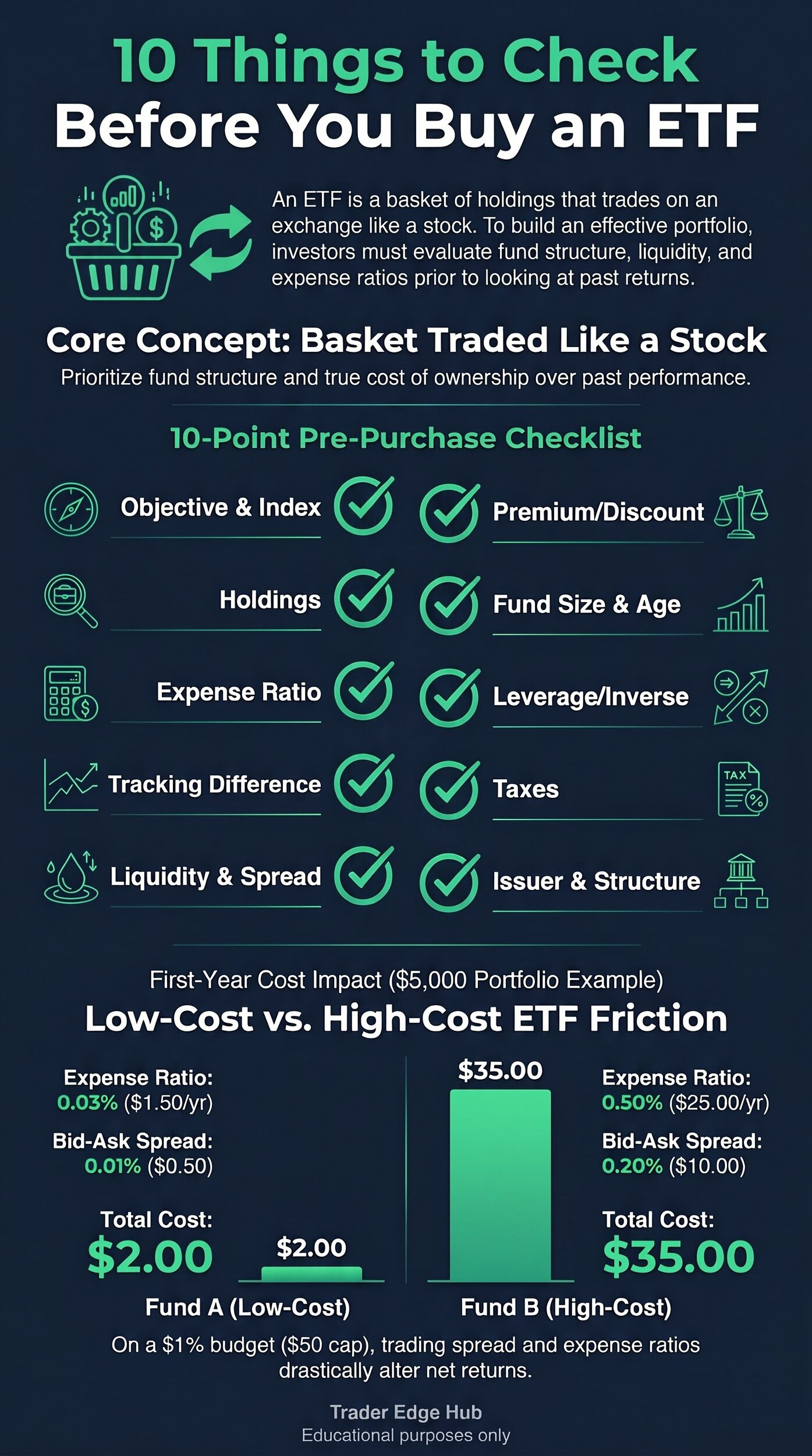
Selecting an exchange-traded fund requires analyzing structural metrics rather than past returns. Many investors struggle when evaluating hundreds of competing financial products. In this guide, we show you how to choose an ETF using a proven ten-step framework. You will learn to inspect fund costs, underlying holdings, and trading liquidity before investing.
Quick answer: To choose the best fund, check ten core metrics before buying. Look at management fees, tracking accuracy, underlying holdings, and top ten concentration. Evaluate true liquidity through the bid-ask spread rather than daily volume alone. Always use limit orders, check AUM stability, and avoid trading during market open or close.
What is an ETF and why does a checklist matter?
An exchange-traded fund (ETF) is a pooled investment vehicle that holds a basket of assets. Unlike traditional mutual funds, ETF shares trade continuously on public stock exchanges throughout the trading day. According to the SEC investor bulletin, ETFs combine mutual fund diversification with stock trading flexibility. You can buy or sell shares at fluctuating intraday market prices.
Evaluating an ETF requires looking beyond historical performance figures. According to QMA Akademie research, past return is the single most overrated metric on a fund fact-sheet. A strong annual return often reflects temporary market luck rather than fund quality. We focus on structural design, annual costs, and portfolio fit to build long-term wealth.
ETFs operate across two distinct layers of market liquidity. According to FINRA investor guides, retail trades occur in the secondary market on public exchanges. Meanwhile, institutional broker-dealers known as authorized participants (APs) operate in the primary market. APs assemble or redeem large blocks of shares called creation units, typically containing 50,000 shares according to SEC disclosures.
This unique creation and redemption mechanism provides structural tax efficiency. When investors redeem shares, the fund delivers underlying securities in-kind to APs. According to the SEC investor bulletin, in-kind transactions allow funds to avoid selling assets and triggering capital gains taxes.
What does the ETF actually hold and track?
Before purchasing shares, you must examine what securities sit inside the fund wrapper. Seemingly identical fund names often follow completely different construction rules. We analyze benchmark rules and asset concentration to prevent unexpected portfolio risks.
How do you evaluate the fund objective and index methodology?
Every index-based ETF follows specific rules to select and weight its holdings. State Street Global Advisors recommends checking how long an index has existed and how frequently it rebalances. Frequent rebalancing increases internal transaction costs, which can quietly lower your net returns over time.
Weighting methodology determines how much influence each company has inside the fund. According to the SEC investor bulletin, capitalization-weighted funds allow larger corporations to dominate performance. Conversely, equal-weighted indexes assign identical weights to every constituent regardless of company size. According to atlasETF guides, fund issuers also choose between full replication and sampling strategies.
Full replication means the fund buys every single stock in the target benchmark. When indexes contain illiquid assets, managers use sampling or optimization to hold proxy securities. VettaFi research indicates that sampling reduces execution friction but introduces small variations against index returns.
How do you check holdings concentration and portfolio overlap?
Concentration risk occurs when a fund allocates excessive capital to a few giant companies. State Street Global Advisors advises reviewing the percentage of assets held in the top ten positions. Heavy concentration means the fund behaves like a bet on a few corporate giants rather than a broad basket.
Portfolio overlap is another critical metric that investors frequently overlook. According to QMA Akademie research, adding a new growth fund to a broad market fund often duplicates holdings. You might quietly double your financial exposure to the same mega-cap technology stocks. Checking asset overlap ensures your portfolio stays properly diversified across different sectors.
Common mistake: Buying multiple ETFs without checking holdings overlap creates accidental concentration. Investors often think owning five funds provides diversification, but all five may hold the same top ten stocks. Always inspect underlying holdings before placing a trade.
How much will the ETF cost you each year?
How does the expense ratio impact your long-term wealth?
The annual expense ratio represents the fee fund managers deduct to cover operating costs. Dr Wealth analysis shows that passive index-tracking equity funds typically charge 0.09% or less. For example, popular broad index funds carry annual fees as low as 0.03%. Conversely, active or thematic equity funds charge higher fees averaging between 0.50% and 0.90%.
According to Dr Wealth research, average expense ratios vary significantly across different asset categories. Bond funds average 0.35%, while broad commodity funds average 0.70%. Specialized cryptocurrency funds average 0.95%, and volatility funds charge an average of 1.07%. Saxo Bank notes that a 0.30% fee difference on a 100,000 euro portfolio costs 300 euros every year.
What are tracking difference and tracking error?
Fund fees represent only part of your total holding cost. You must also monitor how accurately a fund shadows its underlying benchmark index. According to VettaFi reports, tracking difference measures the actual net return gap between the fund and its index over time.
Tracking error measures the volatility and day-to-day consistency of that performance gap. According to atlasETF guides, tracking error is calculated as the standard deviation of daily return differences. VettaFi research identifies cash drag, dividend reinvestment timing, rebalancing fees, and management expense ratios as primary causes of performance drift.
Pro tip: Compare tracking difference across competing funds over three-year periods. A fund with a slightly higher expense ratio may generate better net returns if its managers execute superior tax optimization or securities lending strategies.
How easy is the ETF to buy and sell?
Why do liquidity and bid-ask spread matter more than daily volume?
A common misconception is that funds with low daily volume are illiquid. According to BMO Global Asset Management, an ETF possesses true liquidity derived directly from its underlying securities.
According to BMO Global Asset Management documentation, large trades can be executed off-exchange without impacting market prices. Evaluating the bid-ask spread provides a far clearer picture of true trading costs than trading volume alone.
| ETF Selection Metric | Target Benchmark Range | Primary Data Source |
|---|---|---|
| Passive Equity Expense Ratio | 0.09% or lower (as low as 0.03% for core index funds) | Dr Wealth analysis |
| Fund Assets Under Management (AUM) | $50 million minimum for long-term viability | State Street Global Advisors |
| Bid-Ask Spread Gap | Narrow spread close to underlying asset value | Schwab Asset Management |
| Execution Order Type | Limit orders set near net asset value (NAV) | Fidelity Investments |
How do premiums, discounts, and order timing affect trades?
An ETF trades at a premium when its exchange price exceeds its net asset value (NAV). Conversely, a fund trades at a discount when its market price falls below its underlying asset value. According to Fidelity Investments, price deviations occur during volatile markets or when underlying international exchanges are closed.
For example, NYSE-listed funds tracking international stocks trade after foreign markets close. Fidelity Investments notes that prices adjust to real-time sentiment while official NAV relies on earlier closing prices. According to Schwab Asset Management, authorized participants correct these pricing gaps through arbitrage once markets align.
Execution timing significantly impacts trading costs. Schwab Asset Management advises avoiding trades during the first and last fifteen minutes of the market session. Authorized participants face pricing uncertainty at market open before underlying stocks begin trading.
Furthermore, APs balance inventory near market close and widen bid-ask spreads. According to Schwab Asset Management and Fidelity Investments, using limit orders near NAV protects you from poor execution price slips.
What else should you check before you buy an ETF?
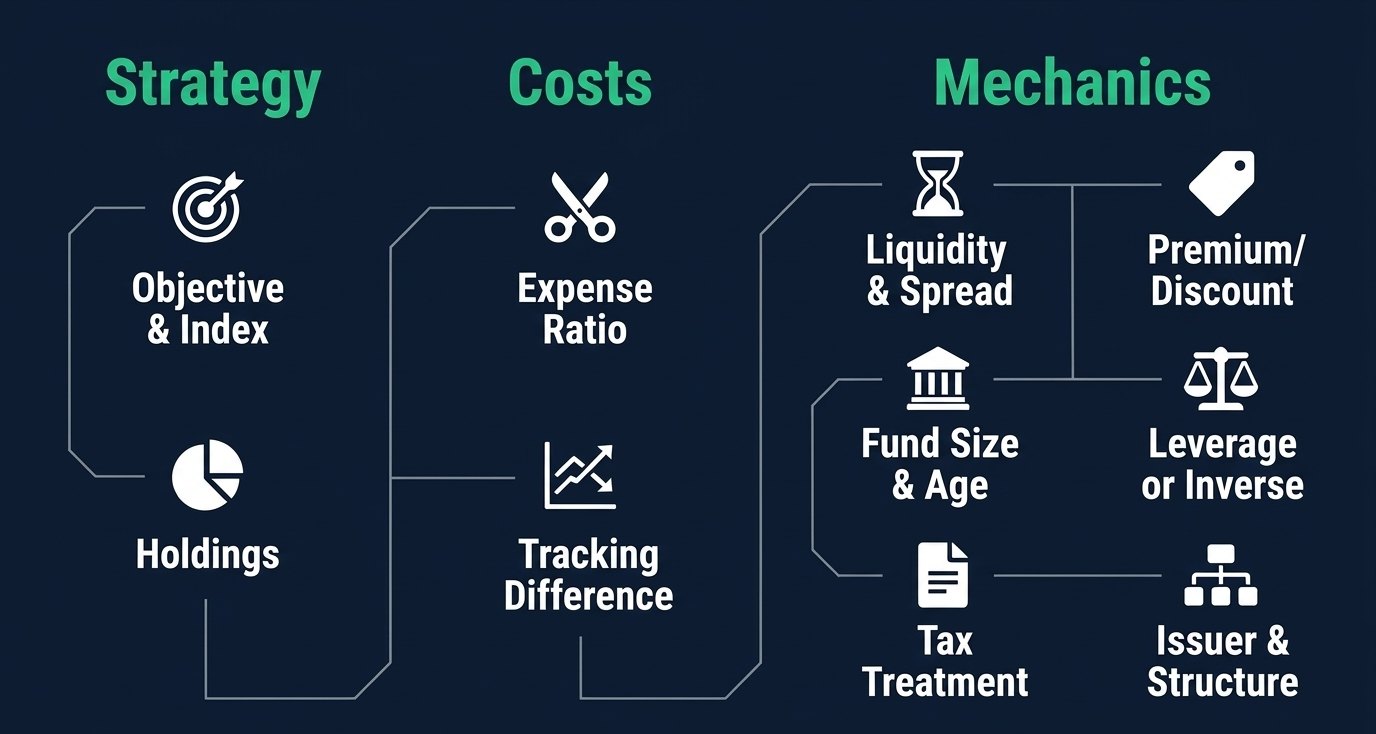
Beyond ongoing costs and immediate trading spreads, long-term fund survival depends on structural factors. We must evaluate asset size, fund complexity, tax mechanics, and overall portfolio fit. Examining these four final checks helps you avoid operational surprises.
How do fund size and age impact closure risk?
Small or newly launched funds face significant closure risk if they fail to attract investor capital. According to State Street Global Advisors, funds with less than $50 million in assets under management (AUM) struggle to remain commercially viable. When a fund shuts down, managers liquidate underlying assets and distribute remaining cash to shareholders.
Fund liquidation forces an unexpected taxable event for investors holding shares in taxable brokerage accounts. According to atlasETF selection guides, fund age also provides important operational track record history. Newer funds with less than three years of trading history make evaluating long-term tracking consistency difficult. You can learn more about managing capital risk in our guide on Position Sizing: The 1% Rule Explained.
Why are leveraged, inverse, and complex ETFs dangerous for long-term investors?
Leveraged and inverse funds use financial derivatives to magnify or reverse daily benchmark index returns. According to the SEC investor bulletin, these specialized products reset leverage exposure on a daily basis. Daily compounding causes long-term fund performance to deviate dramatically from multi-day benchmark movements.
In volatile markets, severe value erosion occurs even if the underlying index finishes flat over time. According to FINRA investor guides, complex funds are designed for short-term institutional tactical trading rather than buy-and-hold strategies. Holding complex funds long-term introduces compounding decay that quietly destroys capital.
How do taxes and capital gain distributions work for ETFs?
Although ETFs are generally tax-efficient, certain specialized fund structures trigger unexpected tax liabilities. According to the SEC investor bulletin, funds holding physical commodities or currency futures generate unique tax reporting requirements. For instance, some commodity funds structured as limited partnerships issue Schedule K-1 tax forms instead of standard Form 1099s.
Additionally, actively managed ETFs with high portfolio turnover rates may generate taxable capital gains distributions. Saxo Bank research notes that dividend distributions face varying withholding tax rates depending on local tax treaties. Always review official fund prospectuses to understand annual tax obligations before committing capital.
How do you evaluate the issuer, fund structure, and portfolio fit?
Fund issuer stability and legal product structure determine investor protection standards. According to FINRA investor guides, true exchange-traded funds hold physical basket assets or representative proxy samples. Conversely, exchange-traded notes (ETNs) are unsecured debt instruments backed only by the issuing bank credit rating.
If an ETN issuing bank defaults, investors face severe credit risk and total loss of principal. Finally, assess how a new fund complements your broader holdings and overall trading framework. You can evaluate strategy performance across market regimes using our guide on Trading Expectancy, as well as our analysis of margin trading rules in The PDT Rule Is Gone.
What does an ETF checklist look like with real numbers?
To understand the financial impact of fees and execution spreads, we analyze a hypothetical investment scenario. Consider an investor allocating a $5,000 cash sum with a 1% annual total cost budget of $50. We compare a low-cost core index fund against a higher-cost thematic fund.
| Cost Component & Metric | Fund A (Low-Cost Index Fund) | Fund B (High-Cost Thematic Fund) |
|---|---|---|
| Starting Account Capital | $5,000 flat investment | $5,000 flat investment |
| Annual Expense Ratio Fee | 0.03% = $1.50 per year | 0.50% = $25.00 per year |
| Trading Bid-Ask Spread Cost | 0.01% = $0.50 entry cost | 0.20% = $10.00 entry cost |
| Total First-Year Holding Cost | $2.00 (4% of $50 budget) | $35.00 (70% of $50 budget) |
| Ten-Year Cumulative Expense Fees | $15.00 total expense cost | $250.00 total expense cost |
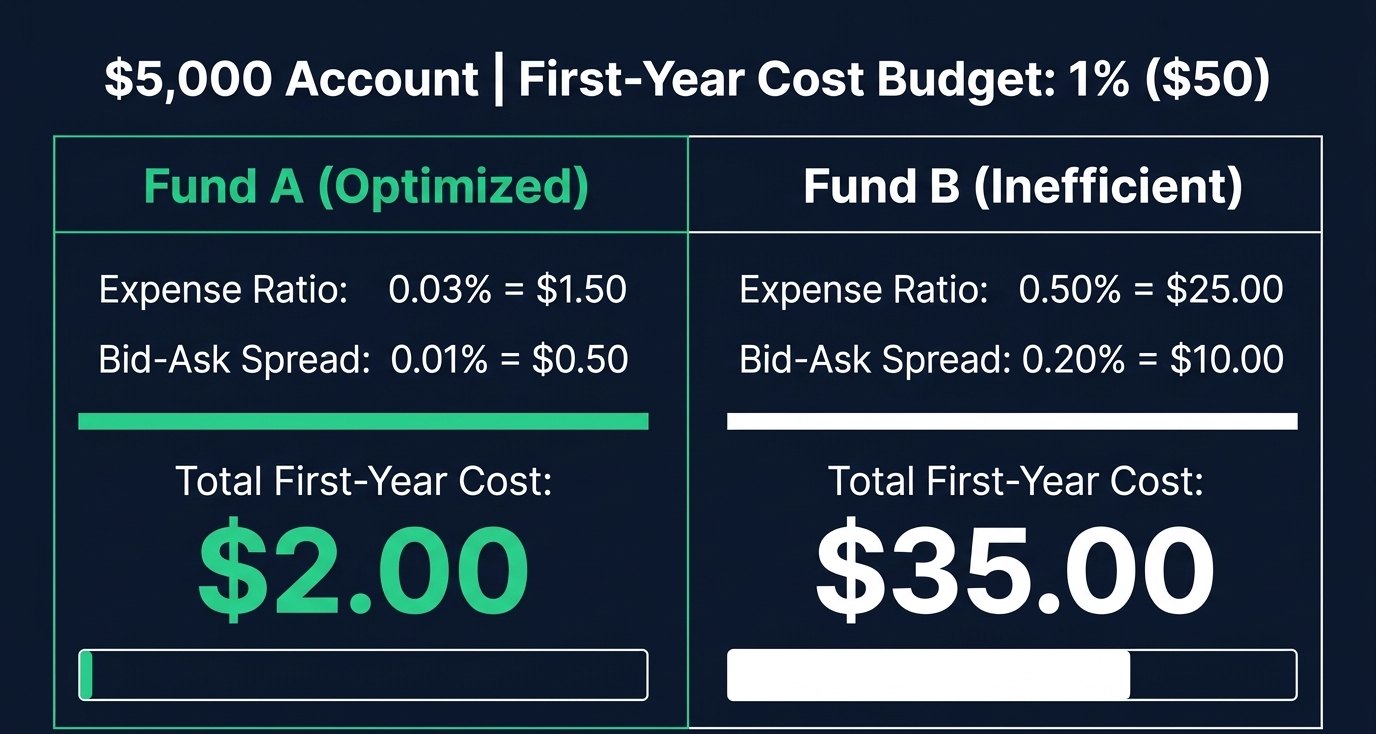
This worked calculation demonstrates how structural costs consume your allocation budget over time. Note that this illustrative comparison assumes flat asset values and deliberately ignores market growth. Fund A preserves $48.00 of your annual cost budget for future growth. Conversely, Fund B consumes $35.00 in initial entry fees and ongoing management charges.
What are the most common mistakes when choosing an ETF?
First, buying funds based solely on recent high returns leads to poor timing decisions. According to QMA Akademie research, past performance fails to predict future structural stability.
Second, ignoring bid-ask spreads creates hidden transaction costs upon initial market entry. Schwab Asset Management warns that wide spreads erode capital as quickly as high expense ratios.
Third, failing to verify portfolio overlap leads to unintentional sector concentration. You might inadvertently own identical technology stocks across three different broad market funds.
Fourth, holding daily reset leveraged funds long-term leads to severe compounding decay. According to SEC investor bulletins, daily resetting derivative funds are unsuited for long-term investing.
Fifth, placing market orders during volatile opening or closing market minutes increases trade slippage. Schwab Asset Management recommends using limit orders during stable midday trading hours.
Sixth, selecting funds with less than $50 million AUM increases sudden liquidation risks. State Street Global Advisors notes that small funds face a higher risk of closure. For trade management rules, review our guide on Risk-Reward Ratio Explained.
Which tools help you compare ETFs?
Using digital analytical platforms streamlines your pre-purchase research workflow. You can screen funds, check holdings overlap, and monitor daily execution spreads efficiently.
To research broad market funds and place commission-free trades, consider using Robinhood. To analyze institutional stock factor scores and portfolio data using artificial intelligence, explore Kavout. For advanced technical charting and intraday bid-ask tracking, rely on TradingView.
In addition to private trading platforms, use free official regulatory utilities. Download official issuer fact sheets and Key Information Documents directly from fund manager websites. Furthermore, use FINRA fund analyzer tools to evaluate long-term fee compounding before committing capital.
Test yourself: can you vet an ETF?
Question 1: Which metric matters most when predicting long-term fund performance?
A) Past three-year return
B) Annual expense ratio and tracking accuracy
C) Daily share trading volume
D) Fund marketing name
Answer: B. Low expense ratios and tight tracking directly preserve long-term investor capital.
Question 2: What is the primary risk of holding a 3x leveraged ETF for multiple months?
A) Income tax rates increase
B) Fund managers change benchmarks
C) Daily resetting causes compounding decay in choppy markets
D) Exchange trading halts permanently
Answer: C. Daily leverage resets cause severe performance drift over multi-day holding periods.
Question 3: Why should you use limit orders instead of market orders when buying ETF shares?
A) Limit orders eliminate brokerage commissions
B) Limit orders specify maximum execution price to prevent spread slippage
C) Limit orders guarantee instant trade execution
D) Limit orders bypass market-maker routing
Answer: B. Limit orders protect traders from unexpected price slips and wide bid-ask spreads.
Question 4: What indicates that an ETF has low commercial viability and high closure risk?
A) AUM below $50 million
B) Holding more than 500 stocks
C) Expense ratio below 0.10%
D) Trading at a small discount to NAV
Answer: A. State Street Global Advisors notes small funds under $50 million risk liquidation.
Question 5: How does an ETF differ structurally from an ETN?
A) ETFs trade only once daily
B) ETNs hold physical stock baskets while ETFs do not
C) ETNs are unsecured debt obligations subject to issuer credit risk
D) ETFs carry higher dividend tax rates
Answer: C. ETNs are bank debt notes exposed to issuer default rather than asset baskets.
FAQ
How do you choose an ETF for beginners?
Beginners should focus on broad-market passive index funds with low expense ratios. According to Dr Wealth research, target funds with fees under 0.10% and assets above $50 million. Use limit orders to execute trades safely during stable midday market hours.
What is a good expense ratio for an ETF?
For broad index tracking equity funds, a good expense ratio sits at or below 0.09%. According to Dr Wealth analysis, specialized or active funds average higher fees between 0.50% and 0.95%. Lower fees ensure more of your money stays invested over multi-decade periods.
Why do ETFs trade at a premium or discount?
Price deviations occur when fund exchange trading operates separately from underlying asset liquidity pools. According to Fidelity Investments, market volatility or closed foreign exchanges cause temporary value gaps. Authorized participants eliminate these gaps through arbitrage during normal trading sessions.
Is daily trading volume the best measure of ETF liquidity?
No, daily share volume does not define total available fund liquidity. According to BMO Global Asset Management, true liquidity depends on the accessibility and trading depth of underlying securities. Market makers can create new shares easily for large institutional orders.
What happens if an ETF closes down?
When a fund closes, fund managers liquidate underlying holdings and pay cash directly to shareholders. According to atlasETF guides, liquidation forces an unplanned taxable event for account holders. Checking fund AUM helps you avoid sudden fund closure risks.
How many ETFs should you hold in a portfolio?
Many investors achieve broad diversification using three to five non-overlapping funds. According to QMA Akademie research, buying too many funds leads to portfolio overlap without adding diversification. Review top ten holdings to ensure funds hold distinct assets.
The verdict
Choosing the right ETF requires evaluating structural metrics including costs, tracking accuracy, holdings overlap, and underlying liquidity. By using our ten-point checklist before every trade, you protect your capital from unnecessary fees and execution slippage. Take your next step by auditing your current holdings for portfolio overlap using free issuer fact sheets today.
Sources: SEC investor bulletin, FINRA ETF guide, State Street Global Advisors due diligence checklist, Schwab Asset Management best practices, Fidelity Investments premium and discount guide, BMO true liquidity report, VettaFi tracking error guide, Dr Wealth expense ratio study, Saxo Bank ETF metrics guide, QMA Akademie 7 metrics study, atlasETF selection framework.
Investments can go down as well as up, and past performance does not guarantee future results. Check your local tax rules. This article is education, not financial advice.
Further reading: If the fee section of this checklist surprised you, John Bogle's The Little Book of Common Sense Investing shows in plain numbers how costs compound against fund investors over time. Check the current price on Amazon.
As an Amazon Associate, Trader Edge Hub earns from qualifying purchases.
