

- What is a 3-ETF portfolio?
- Why do investors keep it to just three funds?
- How do you choose your stock and bond mix?
- How do you split US and international stocks?
- What should you check before picking each ETF?
- How do you build a 3-ETF portfolio step by step?
- How does a 3-ETF portfolio compare with a target-date fund or a one-fund portfolio?
- How and when should you rebalance a 3-ETF portfolio?
- What does a $5,000 portfolio rebalancing example look like?
- What are the 6 most common mistakes when building a 3-ETF portfolio?
- Which tools help you track and manage a 3-ETF portfolio?
- Test yourself: can you build a 3-ETF portfolio?
- FAQ
- Is a 3-ETF portfolio suitable for beginners?
- How often should you rebalance a 3-ETF portfolio?
- Can you build a 3-ETF portfolio with $500?
- Do you have to use one fund company for a 3-ETF portfolio?
- How does a 3-ETF portfolio handle stock market crashes?
- The verdict
Investing involves risk: investments can go down as well as up, and you may get back less than you put in. Past performance does not guarantee future results, and you should check your local tax rules. This article is education, not financial advice.
Disclosure: this article contains affiliate links. If you sign up through them, Trader Edge Hub may earn a commission at no extra cost to you. We only mention tools we think fit the topic.
Building a 3 etf portfolio is a practical way to manage long-term wealth without holding dozens of complex financial products. By combining total stock and bond index funds, you achieve low-cost asset allocation across thousands of global companies. This streamlined structure eliminates single-stock risk and reduces management overhead. At Trader Edge Hub, we explain how this popular strategy works using illustrative examples.
Quick answer: A 3-ETF portfolio combines a total US stock fund, a total international stock fund, and a total bond market fund. This structure provides broad global diversification, low annual expense ratios, and simple rebalancing. You adjust stock and bond percentages based on your personal risk tolerance and time horizon.
What is a 3-ETF portfolio?
A three-fund portfolio is an asset allocation framework built around three core asset classes. According to SwitchWize research on Bogleheads strategies, the portfolio uses broad market index funds to cover global financial markets. Rather than picking individual stocks, you own thousands of securities through three simple holdings.
The first building block is a total US stock market index fund. According to SoftPak Financial Systems documentation, a total US stock fund holds large, mid, and small-capitalization companies across American equity markets. For example, broad index ETFs like Vanguard Total Stock Market [VTI] or iShares Core S&P Total US Stock Market [ITOT] track this category.
The second building block is a total international stock market index fund. According to AssetRise guides, an international equity fund holds companies across developed and emerging market economies outside the United States. For example, index funds like Vanguard Total International Stock [VXUS] provide exposure to thousands of non-US businesses.
The third building block is a total bond market index fund. According to FINRA investor guides, a broad bond index fund holds investment-grade US Treasury bonds and corporate debt securities. For example, funds like Vanguard Total Bond Market [BND] or iShares Core US Aggregate Bond [AGG] provide fixed income stability and regular interest distributions.
Why do investors keep it to just three funds?
Simplicity is the primary advantage of limiting your portfolio to three core index funds. According to SwitchWize Boglehead analyses, owning three broad index funds captures virtually the entire investable global financial market. You do not need niche sector funds or complex thematic ETFs to achieve complete diversification.
| Core Portfolio Pillar | Asset Class Coverage | Illustrative Example ETFs | Primary Role in Portfolio |
|---|---|---|---|
| Total US Stock Market | Large, mid, and small-cap US equities | VTI, ITOT, SCHB | Domestic equity growth capital |
| Total International Stock Market | Developed and emerging non-US markets | VXUS, IXUS | Global geographical diversification |
| Total US Bond Market | US Treasury and investment-grade debt | BND, AGG | Income yield and capital preservation |
Low ongoing costs represent another major benefit of keeping a minimal fund count. According to Dr Wealth research, core broad-market index ETFs charge annual expense ratios as low as 0.03% to 0.08%. Minimizing fund management fees ensures more of your compounding returns remain in your account over time.
A minimalist structure also prevents portfolio overlap and eliminates single-stock failure risks. According to QMA Akademie research, adding overlapping thematic funds often increases concentration in mega-cap technology stocks without adding real diversification. Keeping to three core funds eliminates accidental stock duplication across your accounts.
Managing three funds also reduces behavioral trading errors caused by market noise. According to YCharts rebalancing research, investors holding complex portfolios frequently make impulsive changes during market volatility.
Pro tip: Holding low-cost index ETFs in tax-advantaged accounts like IRAs or 401(k)s maximizes compounding growth. According to Institute of Business & Finance guides, tax-efficient asset location keeps income-generating bond distributions sheltered from annual dividend taxation.
How do you choose your stock and bond mix?
Your overall stock and bond mix dictates the risk profile and volatility of your portfolio. According to FINRA asset allocation guidelines, equities drive long-term capital growth, while fixed income assets provide stability. Balancing these two asset classes aligns your investments with your personal risk tolerance and time horizon.
Younger investors with multi-decade time horizons often choose growth-oriented stock allocations. According to SwitchWize Boglehead strategies, popular guidelines like the 110-minus-age rule suggest subtracting your age from 110 to determine your equity percentage. For example, a 30-year-old investor might select an 80% stock and 20% bond asset allocation.
Conversely, investors approaching retirement usually increase their fixed income allocation to protect capital. According to Investor.gov asset allocation resources, holding a higher bond percentage reduces portfolio drawdowns during market downturns. However, reducing stock exposure also lowers long-term growth potential during extended bull markets.
How do you split US and international stocks?
After deciding your overall stock percentage, you must determine your domestic versus international equity split. According to Vanguard research on international investing, global stock market capitalization is roughly divided between US and non-US companies. Holding international equities protects your portfolio from country-specific economic downturns.
Vanguard research suggests allocating 20% to 40% of your total equity exposure to international stocks. For example, in an 80% stock portfolio, a 30% international split equates to 56% US stocks and 24% international stocks. That leaves the remaining 20% allocated to total bond market index funds.
International stocks offer exposure to different economic growth drivers and currency fluctuations. According to Vanguard research, international markets often outperform domestic markets during periods when US equity valuations are elevated. Spreading equity risk across global markets enhances long-term portfolio stability.
Common mistake: Completely ignoring international stocks due to recent US equity outperformance is a frequent timing error. According to Vanguard research, international equities provide valuable currency and valuation diversification through changing economic cycles.
What should you check before picking each ETF?
Selecting the specific ETFs for your three core building blocks requires evaluating structural fund metrics. According to State Street Global Advisors due diligence guides, you must review fund metrics beyond past returns. We examine four essential factors before selecting index funds for your portfolio.
First, check the annual expense ratio to ensure management fees remain minimal. According to Dr Wealth research, passive core equity index funds should charge 0.09% or less per year. Lower expense ratios protect your long-term compounding growth from unnecessary fee drag.
Second, inspect the underlying benchmark index and number of holdings. According to atlasETF guides, a total US stock fund should hold over 3,000 stocks to cover the entire market cap spectrum. Similarly, a total international fund should hold thousands of companies across developed and emerging economies.
Third, examine fund liquidity, trading volume, and bid-ask spreads before purchasing shares. According to Schwab Asset Management best practices, trading broad ETFs with narrow bid-ask spreads minimizes entry slippage. Fourth, verify that fund assets under management [AUM] exceed $50 million according to State Street Global Advisors guidelines to ensure long-term fund viability.
How do you build a 3-ETF portfolio step by step?
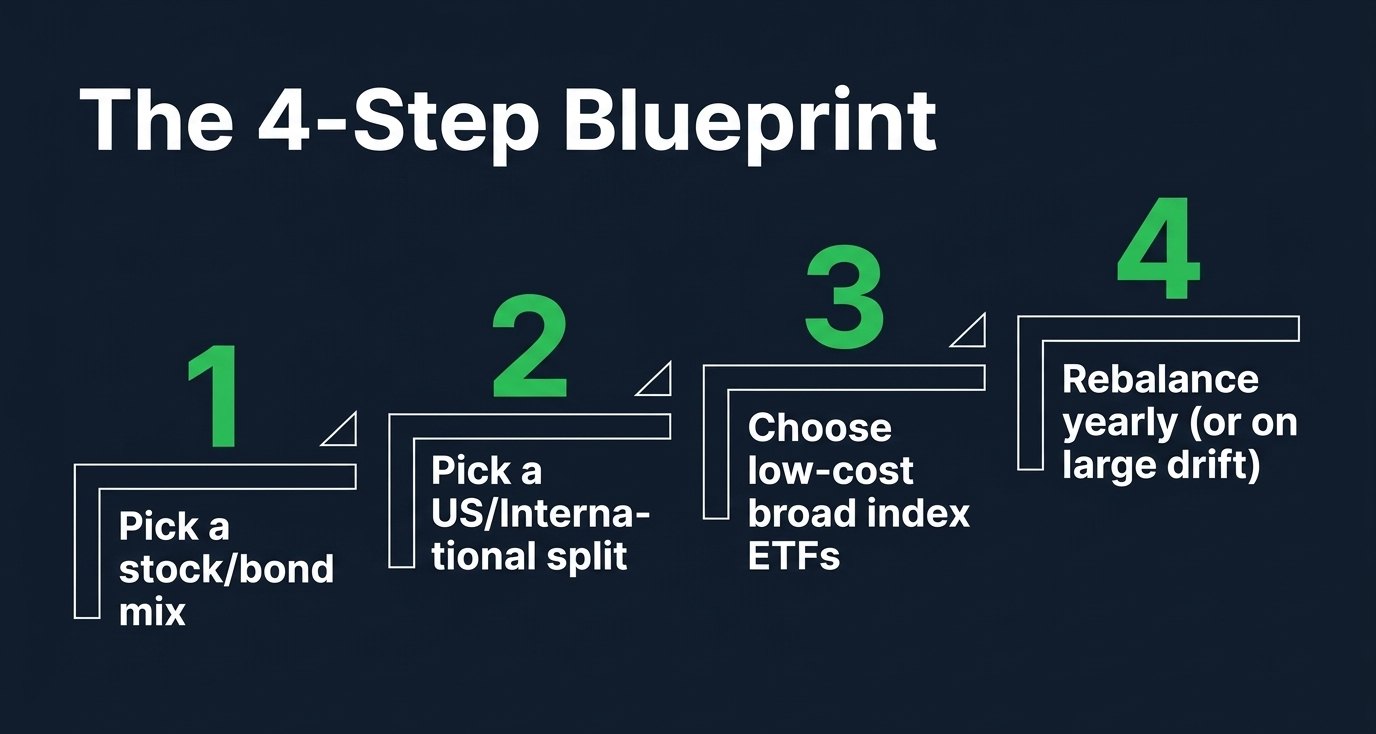
Building a resilient three-fund portfolio follows a simple four-step operational process. According to SwitchWize Boglehead frameworks, automating these four steps creates a low-maintenance long-term investment strategy.
- Select your target stock and bond mix: Set your equity and fixed income percentages based on age and risk tolerance according to FINRA guidelines.
- Determine your US and international equity split: Allocate 20% to 40% of your stock portion to international equities based on Vanguard recommendations.
- Select broad low-cost index ETFs: Choose three liquid index ETFs covering total US equities, international stocks, and US bonds according to Dr Wealth standards.
- Establish a disciplined rebalancing rule: Set a regular calendar schedule or percentage threshold trigger to maintain your target asset allocation according to U.S. Bank rebalancing guides.
How does a 3-ETF portfolio compare with a target-date fund or a one-fund portfolio?
Choosing between a three-fund portfolio, a target-date fund, and an all-in-one asset allocation ETF depends on your desire for customization. According to SwitchWize research, a 3-ETF portfolio allows you to control your exact stock and bond percentages. You can adjust your international equity exposure or fixed income duration whenever your financial goals change.
Conversely, target-date funds automatically adjust your asset allocation over time based on an estimated retirement date. According to Investor.gov documentation, target-date funds shift capital gradually from equities into fixed income as you age. However, target-date funds often charge slightly higher underlying expense ratios than managing three individual index funds.
| Portfolio Structure Type | Level of Allocation Control | Rebalancing Requirement | Primary Advantage |
|---|---|---|---|
| 3-ETF Portfolio | Full control over asset weights | Manual annual or threshold rebalancing | Lowest expense ratios and complete customization |
| Target-Date Fund | Fixed pre-set glide path by target year | Automatic internal rebalancing | Complete hands-off automated management |
| All-In-One Balanced ETF | Fixed static stock and bond ratio | Automatic internal rebalancing | Single-ticker simplicity with fixed risk profile |
How and when should you rebalance a 3-ETF portfolio?
Rebalancing restores your portfolio to its original target asset allocation when market movements cause asset weights to drift. According to U.S. Bank rebalancing research, asset classes grow at different rates during market expansion phases. Rebalancing prevents your portfolio from taking on excess risk when stocks rally strongly.
Investors typically use either calendar-based rebalancing or opportunistic threshold rebalancing strategies. According to YCharts portfolio rebalancing studies, reviewing your portfolio once a year on a fixed date works effectively for retail accounts. Alternatively, threshold rebalancing triggers a trade whenever an asset class drifts by 5 percentage points from its target weight.
You can also rebalance efficiently by directing new cash contributions into your underweighted asset classes. According to Bogleheads rebalancing guides, purchasing underweighted funds with fresh deposit money avoids selling appreciated assets. This approach can avoid capital gains taxes in taxable brokerage accounts while restoring your target asset mix.
What does a $5,000 portfolio rebalancing example look like?
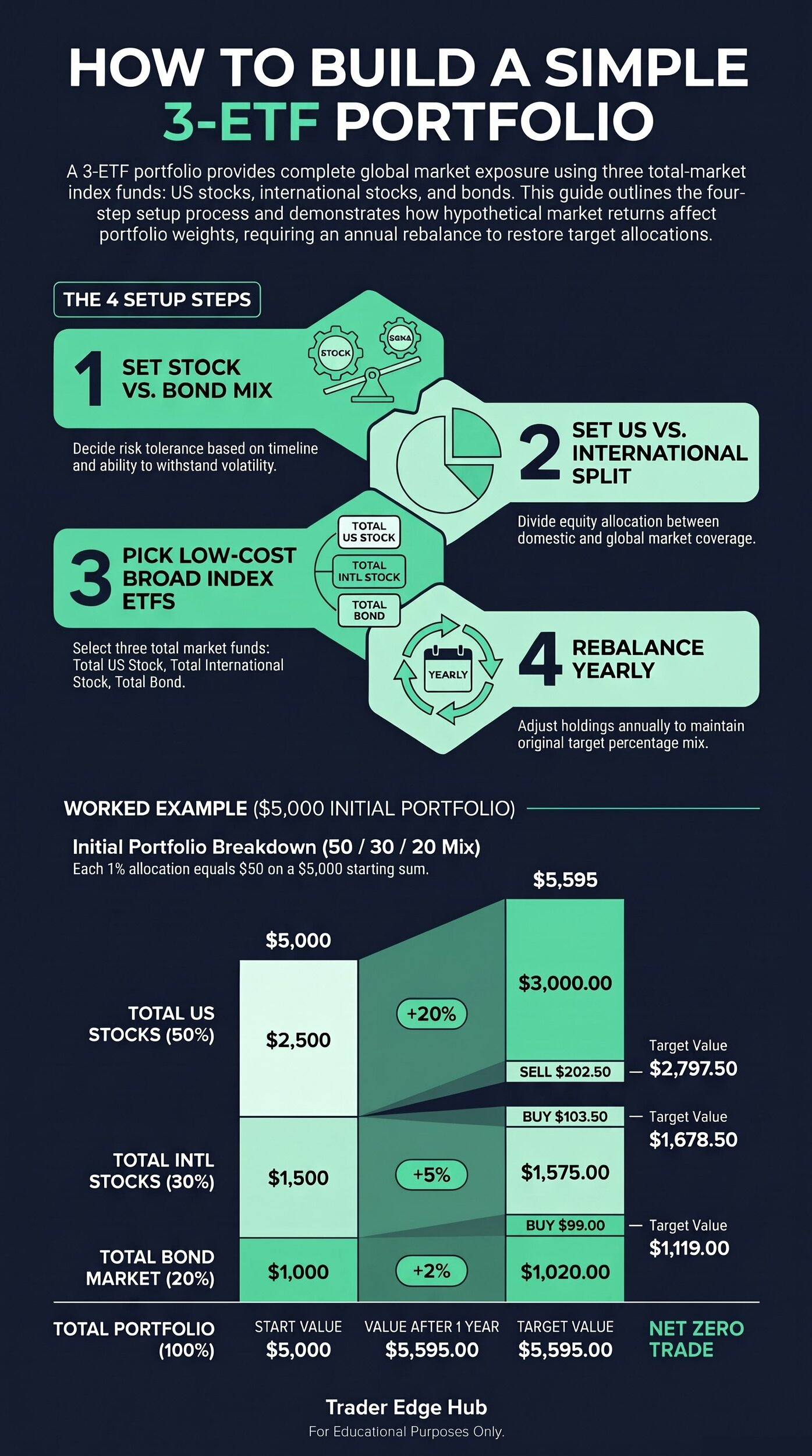
To demonstrate rebalancing mechanics, consider a $5,000 portfolio with a target 50% US stock, 30% international stock, and 20% bond mix. In this allocation, every 1 percentage point equals exactly $50 in cash value. Starting deposits equal $2,500 in US stocks, $1,500 in international stocks, and $1,000 in bonds.
Consider a hypothetical year where US stocks gain 20%, international stocks gain 5%, and bonds gain 2%. Note that these market returns serve as an illustrative model rather than a financial prediction.
| Asset Class Pillar | Initial Value & Weight | Hypothetical Return | Year-End Value & Weight | Target 50/30/20 Value | Required Rebalancing Action |
|---|---|---|---|---|---|
| Total US Stock Market | $2,500.00 [50.0%] | +20.0% gain | $3,000.00 [53.6%] | $2,797.50 [50.0%] | Sell $202.50 of US stocks |
| Total International Stock Market | $1,500.00 [30.0%] | +5.0% gain | $1,575.00 [28.2%] | $1,678.50 [30.0%] | Buy $103.50 of international stocks |
| Total US Bond Market | $1,000.00 [20.0%] | +2.0% gain | $1,020.00 [18.2%] | $1,119.00 [20.0%] | Buy $99.00 of US bonds |
| Total Portfolio Balance | $5,000.00 [100.0%] | +11.9% total gain | $5,595.00 [100.0%] | $5,595.00 [100.0%] | Rebalance back to target 50/30/20 split |
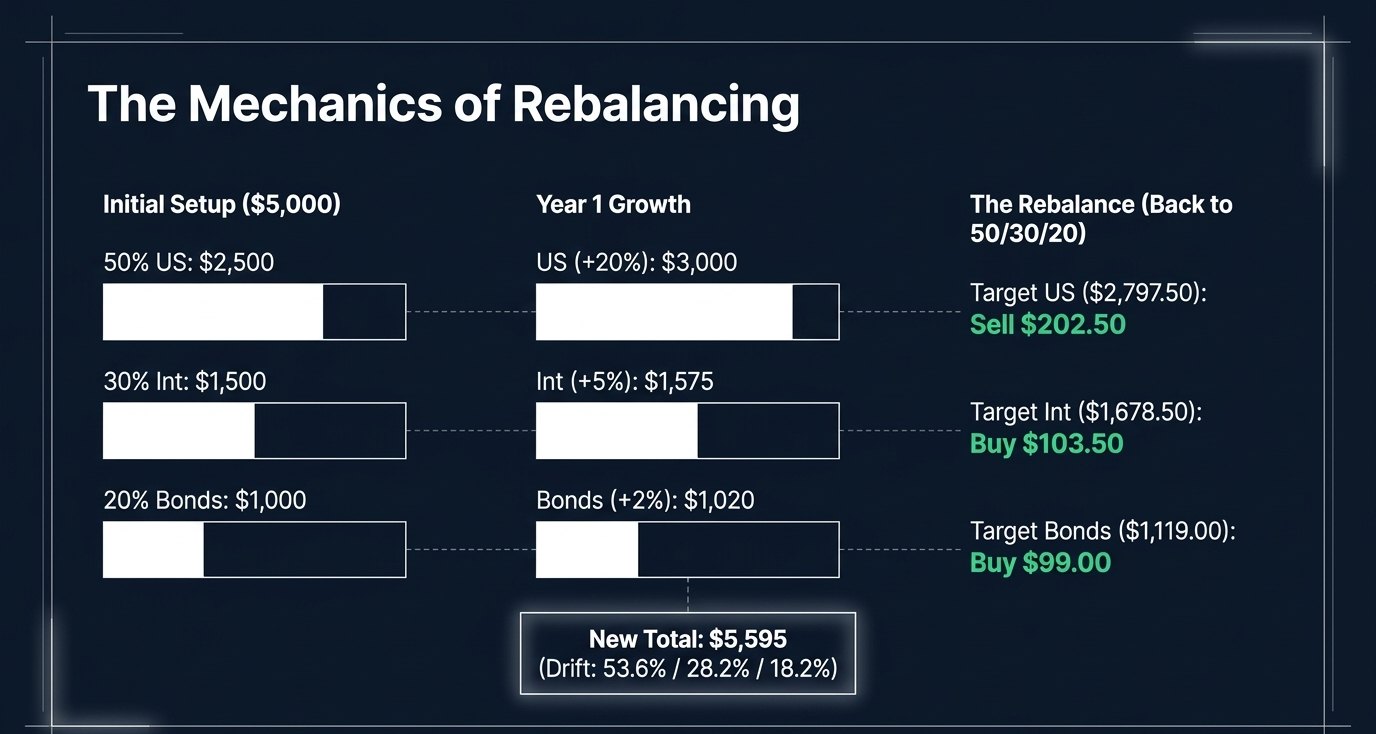
At year end, strong US stock growth expands your portfolio balance to $5,595.00. US stocks grow to 53.6%, while international stocks drop to 28.2% and bonds drop to 18.2%. Rebalancing back to 50/30/20 requires selling $202.50 of US stocks to buy $103.50 of international stocks and $99.00 of bonds.
What are the 6 most common mistakes when building a 3-ETF portfolio?
Avoiding frequent structural errors ensures your three-fund portfolio functions efficiently. At Trader Edge Hub, we identified six common mistakes retail investors make when building core portfolios.
- Adding redundant niche sector ETFs: Buying extra technology or dividend funds creates portfolio overlap. According to QMA Akademie research, sector funds duplicate holdings without adding true asset diversification.
- Rebalancing too frequently: Over-rebalancing creates unnecessary trading friction and capital gains tax liabilities. According to YCharts rebalancing research, annual rebalancing provides optimal risk control with minimal tax drag.
- Ignoring international equity diversification: Eliminating foreign stocks exposes your wealth to single-country economic risk. According to Vanguard research, international equities offer valuable economic growth diversification over extended holding periods.
- Chasing past performance figures: Selecting funds based on recent high returns leads to poor market entry timing. According to State Street Global Advisors due diligence guides, structural expense ratios matter far more than short-term gains.
- Abandoning bond allocations during rate hikes: Selling fixed income when rates rise removes portfolio downside protection. To understand fixed income mechanics during rate cycles, read our guide on Bonds Explained for Stock Investors: Why Prices Fall When Rates Rise.
- Failing to account for fund trading costs: Trading illiquid ETFs with wide bid-ask spreads erodes investment capital upon entry. According to Schwab Asset Management best practices, choosing broad funds with tight execution spreads preserves capital. For pre-purchase metrics, read our breakdown on 10 Things to Check Before You Buy an ETF.
Which tools help you track and manage a 3-ETF portfolio?
Modern investment tools allow you to track asset allocations and execute rebalancing trades easily. You can monitor portfolio drift using digital platforms or simple personal spreadsheets.
To execute commission-free ETF trades and schedule recurring fractional share purchases, consider using Robinhood. To conduct optional AI-powered stock factor research, explore Kavout. Note that factor research is completely optional for managing a basic three-fund portfolio.
In addition to mobile brokerages, a standard offline spreadsheet works for tracking target weights. Simply input your current share quantities and live fund prices to calculate exact rebalancing trade amounts. For dollar-cost averaging steps, explore our guide on What Happens If You Invest $100 a Month? Dollar-Cost Averaging with Real Numbers. For account type comparisons, review Stocks vs Options vs Futures for a Small Account.
Test yourself: can you build a 3-ETF portfolio?
1. What three asset classes form the foundation of a traditional 3-ETF portfolio?
A) High-yield dividend stocks, gold futures, and REITs.
B) Total US stock market, total international stock market, and total US bond market.
C) Tech stocks, energy stocks, and cryptocurrencies.
D) Treasury bills, corporate bonds, and municipal debt.
Answer: B. According to SwitchWize research, three core index funds cover broad global financial markets.
2. Why should investors avoid adding extra sector funds to a 3-ETF portfolio?
A) Extra sector funds are illegal in brokerage accounts.
B) Adding sector funds creates portfolio overlap without adding real diversification.
C) Sector funds pay no interest or dividend distributions.
D) Sector funds carry zero market liquidity.
Answer: B. According to QMA Akademie research, total market index funds already own sector stocks.
3. How does rebalancing with new monthly cash deposits benefit taxable brokerage accounts?
A) It eliminates annual expense ratios charged by fund issuers.
B) It allows you to buy underweighted funds without triggering capital gains taxes.
C) It guarantees higher annual returns across all holdings.
D) It doubles the interest paid by corporate bond holdings.
Answer: B. According to Bogleheads guides, purchasing underweighted funds with fresh cash avoids taxable sales.
4. What percentage of total equity exposure does Vanguard suggest allocating to international stocks?
A) 0% to 5%.
B) 20% to 40%.
C) 75% to 90%.
D) Exactly 100%.
Answer: B. Vanguard research recommends allocating 20% to 40% of stocks to international equities.
5. What is the primary role of the total bond market ETF inside a 3-ETF portfolio?
A) Maximizing aggressive capital appreciation during tech rallies.
B) Providing income yield and dampening overall portfolio volatility.
C) Eliminating inflation risk completely.
D) Generating daily trading profit through arbitrage.
Answer: B. According to FINRA guides, bond funds offer yield and buffer stock price drawdowns.
FAQ
Is a 3-ETF portfolio suitable for beginners?
Yes, a 3-ETF portfolio provides an ideal framework for beginner investors. According to SwitchWize Boglehead analyses, owning three broad index funds offers complete global diversification with minimal management overhead. Automating your purchases helps you stay consistent.
How often should you rebalance a 3-ETF portfolio?
Reviewing your portfolio once a year or when an asset class drifts by 5 percentage points works best. According to YCharts rebalancing studies, annual rebalancing maintains target risk levels without incurring excess trading friction. Rebalancing with fresh cash deposits avoids taxable asset sales.
Can you build a 3-ETF portfolio with $500?
Yes, modern brokerage platforms allowing fractional share trading make building a three-fund portfolio accessible with small balances. According to SoftPak Financial Systems guides, allocating small deposits proportionally across three core ETFs maintains target asset weights effectively.
Do you have to use one fund company for a 3-ETF portfolio?
No, you do not have to buy all three ETFs from a single provider. According to atlasETF guides, investors can freely mix broad index funds from different issuers like Vanguard, iShares, or Schwab based on expense ratios and liquidity. Alternatively, using a single fund family provides administrative simplicity inside one account.
How does a 3-ETF portfolio handle stock market crashes?
Holding a total bond market index fund cushions portfolio drawdowns during major equity market declines. According to Investor.gov asset allocation resources, fixed income holdings provide stable yields when stock prices fall. Market crashes also offer rebalancing opportunities to buy discounted stock funds.
The verdict
Building a 3-ETF portfolio offers a simple, low-cost way to achieve total global diversification and long-term compounding. By automating your contributions and rebalancing once a year, you manage risk effectively without constantly monitoring daily financial markets. Take your next step today by selecting your target stock and bond mix using our four-step checklist.
Sources: SwitchWize Boglehead strategy guide, SoftPak Financial Systems 3-fund overview, AssetRise 3-fund guide, Vanguard international investing research, FINRA asset allocation guide, Investor.gov asset allocation resources, Dr Wealth expense ratio study, State Street Global Advisors due diligence checklist, Schwab Asset Management best practices, U.S. Bank rebalancing guide, YCharts rebalancing study, QMA Akademie 7 metrics study.
Investing involves risk: investments can go down as well as up, and you may get back less than you put in. Past performance does not guarantee future results, and you should check your local tax rules. This article is education, not financial advice.
Further reading: Simple multi-fund portfolios grew out of the index-fund approach John Bogle championed. His The Little Book of Common Sense Investing is a short, plain-English read on why broad, low-cost funds are hard to beat. Check the current price on Amazon.
As an Amazon Associate, Trader Edge Hub earns from qualifying purchases.
