
- What is an investing app and who is it for?
- What are the three types of investing apps?
- What should beginners compare when choosing an investing app?
- How do investing app fees really work?
- Is your money safe in an investing app?
- How do the main investing apps compare?
- Is Robinhood best for active mobile traders?
- Is Fidelity best for all-in-one beginner education?
- Is Charles Schwab best for research and long-term growth?
- Is Vanguard best for long-term index investors?
- Is Public best for learning with context?
- Is Acorns best for automated spare change investing?
- Is Betterment best for goal-based automated investing?
- What does a $5,000 account really pay in fees?
- What are the 6 most common mistakes beginners make with investing apps?
- What tools help beginners research and invest?
- Test yourself: 5 questions on investing apps
- FAQ
- How much money do you need to start using an investing app?
- Are mobile investing apps safe for long-term retirement savings?
- What is the difference between a robo-advisor and a full brokerage app?
- Do you have to pay taxes on earnings inside an investing app?
- Can you transfer your investments from one app to another later?
- The verdict
Investing involves risk, including the loss of the money you put in. Investments can go down as well as up, past performance does not guarantee future results, and you should check your local tax rules. This article is education, not financial advice.
Disclosure: this article contains affiliate links. If you sign up through them, Trader Edge Hub may earn a commission at no extra cost to you. We only mention tools we think fit the topic.
Finding the best investing apps for beginners allows you to build long-term wealth directly from your smartphone. Modern financial platforms eliminate traditional brokerage trade commissions and lower account minimums to as little as $1. Choosing the right platform depends on your fee sensitivity, investment goals, and desired level of automation. At Trader Edge Hub, we examine verified fees, account features, and investor safety rules across leading platforms.
Quick answer: The best investing apps for beginners offer $0 trading commissions, $0 to $5 account minimums, fractional share support, and clear educational tools. Full brokerage apps like Robinhood and Fidelity suit active self-directed traders. Automated robo-advisors like Betterment and Acorns handle portfolio building and rebalancing for hands-off investors.
What is an investing app and who is it for?
An investing app is mobile software that connects retail investors directly to public financial markets. According to Investor.gov glossary definitions, these applications allow you to buy and sell stocks, exchange-traded funds [ETFs], and bonds electronically. Mobile apps allow you to track real-time stock quotes and set up automated deposit schedules. You can manage your entire portfolio from an Android or iOS mobile device.
Investing apps are designed for several distinct investor profiles. According to Motley Fool research as of 2026, mobile platforms suit beginners starting with small balances from $1 to $500. They also serve hands-off savers who prefer automated portfolio management over picking individual stocks.
According to CNBC Select research as of October 27, 2026, digital platforms offer an affordable and secure entry point into equity markets. Whether you want to invest spare change or build a retirement account, mobile apps simplify account setup. You can open and fund a new brokerage account in just a few minutes.
What are the three types of investing apps?
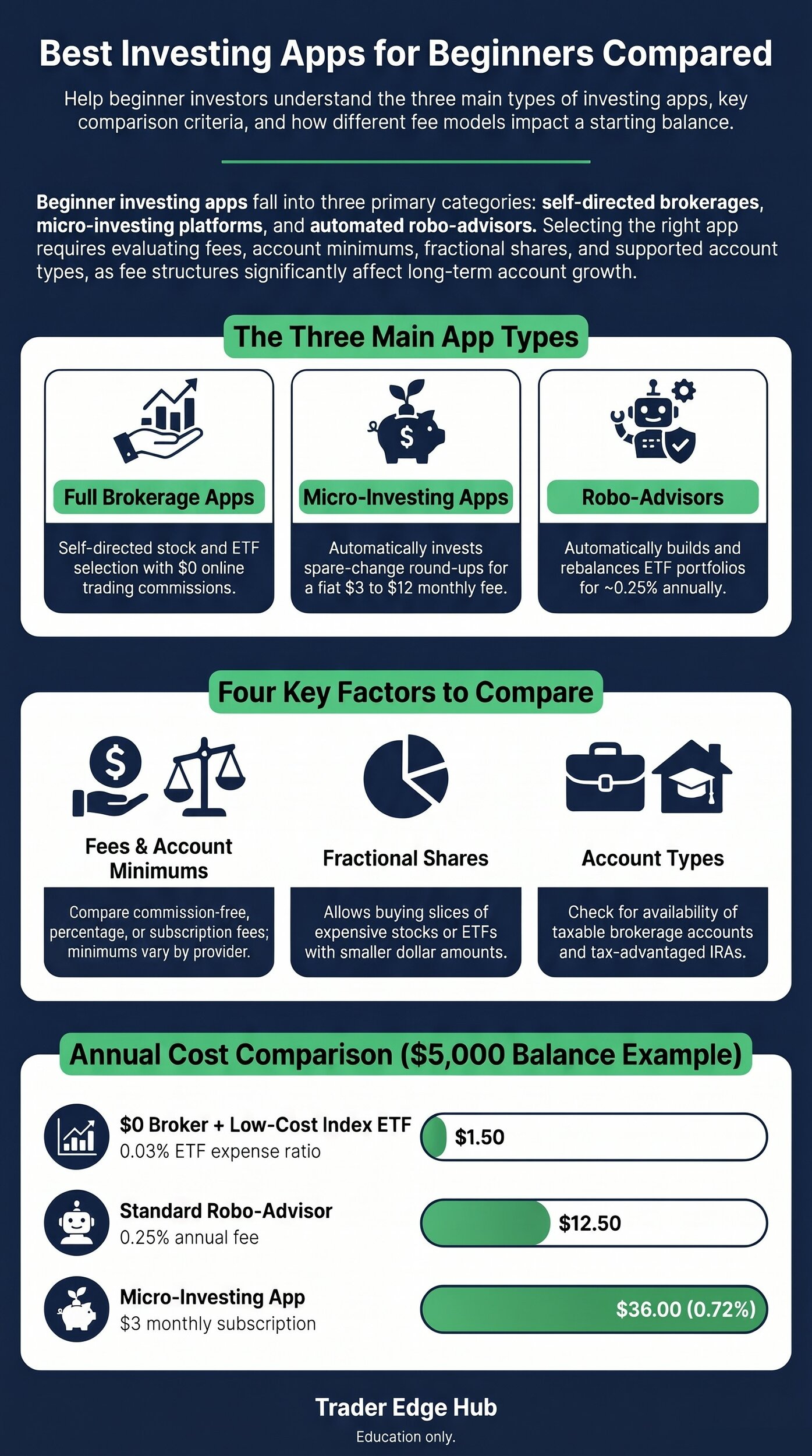
Beginner investing platforms generally fall into three main categories. Understanding how full brokerage apps, micro-investing apps, and robo-advisors operate helps you select the best fit for your financial strategy. Each app type handles portfolio management and trading execution differently.
The first category consists of full brokerage apps designed for self-directed investors. According to Smart Money Picks research as of October 2026, platforms like Fidelity, Charles Schwab, Robinhood, and SoFi Active Investing provide self-directed trading. You choose your own individual stocks, ETFs, and options with $0 trade commissions.
The second category consists of micro-investing apps built around automated spare change deposits. According to CNBC Select research as of October 2026, Acorns connects to your payment cards and rounds up daily purchases to the next dollar. According to Acorns disclosures as of August 26, 2026, users have invested over $7.3 billion in spare change.
The third category consists of robo-advisors that manage your investments using automated software algorithms. According to Investor.gov asset allocation guides, robo-advisors build and rebalance diversified ETF portfolios based on your risk tolerance and goals. According to Chime Invest research as of September 2026, automated advisors manage portfolios for a small annual fee averaging 0.25% of assets.
Pro tip: You do not need to choose exclusively between automated and self-directed investing. According to Chime Invest guidelines, many beginners keep a managed robo-advisor portfolio for core savings while placing small self-directed stock trades.
What should beginners compare when choosing an investing app?
Evaluating a beginner investing app requires reviewing five core account features. According to Chime Invest criteria as of September 2026, you should check trading fees, account minimums, fractional shares, account types, and educational tools. Comparing these metrics ensures your platform aligns with your budget and learning pace.
Trading costs and account minimums represent the most critical starting criteria. According to Motley Fool reviews as of 2026, top beginner platforms charge $0 stock and ETF commissions with $0 account balance minimums. According to Chime Invest disclosures as of April 2026, some platforms allow you to start investing with as little as $1.
Fractional shares allow you to buy small fractions of expensive stocks based on a dollar amount. According to FINRA investor insights, fractional share trading lets beginners invest $5 into major companies whose single share prices exceed hundreds of dollars. This feature enables immediate portfolio diversification on a tight budget.
Account type availability dictates how your investment earnings are taxed over time. According to Investor.gov account guides, platforms offer taxable individual brokerage accounts or tax-advantaged Individual Retirement Accounts [IRAs] like Traditional and Roth IRAs. According to Motley Fool 2026 reviews, Robinhood offers a 1% match on IRA contributions and a 3% match for Gold subscribers.
| App Category | Primary Target User | Average Pricing Structure | Key Standout Feature |
|---|---|---|---|
| Full Brokerage App | Self-directed stock and ETF traders | $0 stock and ETF commissions | Complete control over individual stock selection |
| Micro-Investing App | Hands-off savers investing spare change | $3.00 to $12.00 flat monthly fee | Automatic purchase round-ups on debit cards |
| Robo-Advisor App | Goal-based investors wanting automation | 0.25% annual management fee | Algorithmic portfolio building and rebalancing |
How do investing app fees really work?
Understanding fee structures is essential because unexpected charges quietly reduce your compounding returns over time. According to FINRA ETP guidelines, commission-free trading does not mean an app is completely cost-free. Investors must evaluate trade commissions, fund expense ratios, advisory management fees, and transfer charges.
While most major apps charge $0 online stock and ETF commissions, regulatory trading fees still apply. According to Public fee disclosures as of 2026, regulators assess a tiny SEC transaction fee on stock sell orders. These mandatory pass-through fees are collected by the broker and remitted to regulators.
Common mistake: Ignoring flat monthly subscription fees on small account balances is a costly oversight. According to unbiased.com Acorns reviews as of 2026, paying a $3 monthly fee on a $500 balance equals a 7.2% annual fee rate.
Robo-advisors charge either percentage-based advisory fees or flat monthly subscription pricing. According to Betterment pricing disclosures as of July 27, 2026, automated investing costs $5 per month for balances under $24,000. Once your account reaches $24,000 or includes $200 monthly deposits, the fee switches to 0.25% per year.
In addition to app fees, index ETFs charge underlying operating expense ratios deducted directly from fund returns. According to Dr Wealth research, passive index ETFs average low expense ratios at or below 0.09%. You should also check outgoing transfer fees, as platforms like Public and SoFi charge $100 for outgoing ACAT account transfers.
Is your money safe in an investing app?
Protecting your money in an investing app requires understanding regulatory safeguards and cybersecurity standards. According to Investor.gov bulletins, legitimate brokerage apps operate under strict oversight from federal regulators. You should verify that your chosen platform is registered with regulatory authorities before depositing funds.
Brokerage account cash and securities are protected by the Securities Investor Protection Corporation [SIPC]. According to SIPC disclosures, coverage protects up to $500,000 in customer assets, including up to $250,000 for cash, if a broker fails. However, SIPC coverage protects against broker insolvency, not market price declines.
Uninvested cash held in partner banking accounts receives Federal Deposit Insurance Corporation [FDIC] protection. According to Betterment Cash Reserve disclosures, cash swept into insured partner banks receives FDIC coverage up to $250,000 per bank. This banking insurance covers cash deposits if the partner bank experiences financial failure.
You can independently verify any brokerage or financial professional using online regulatory tools. According to FINRA BrokerCheck guidelines, investors can research the registration history and disciplinary record of broker-dealers for free. Modern apps also secure user accounts using multi-factor authentication [2FA] and data encryption.
How do the main investing apps compare?
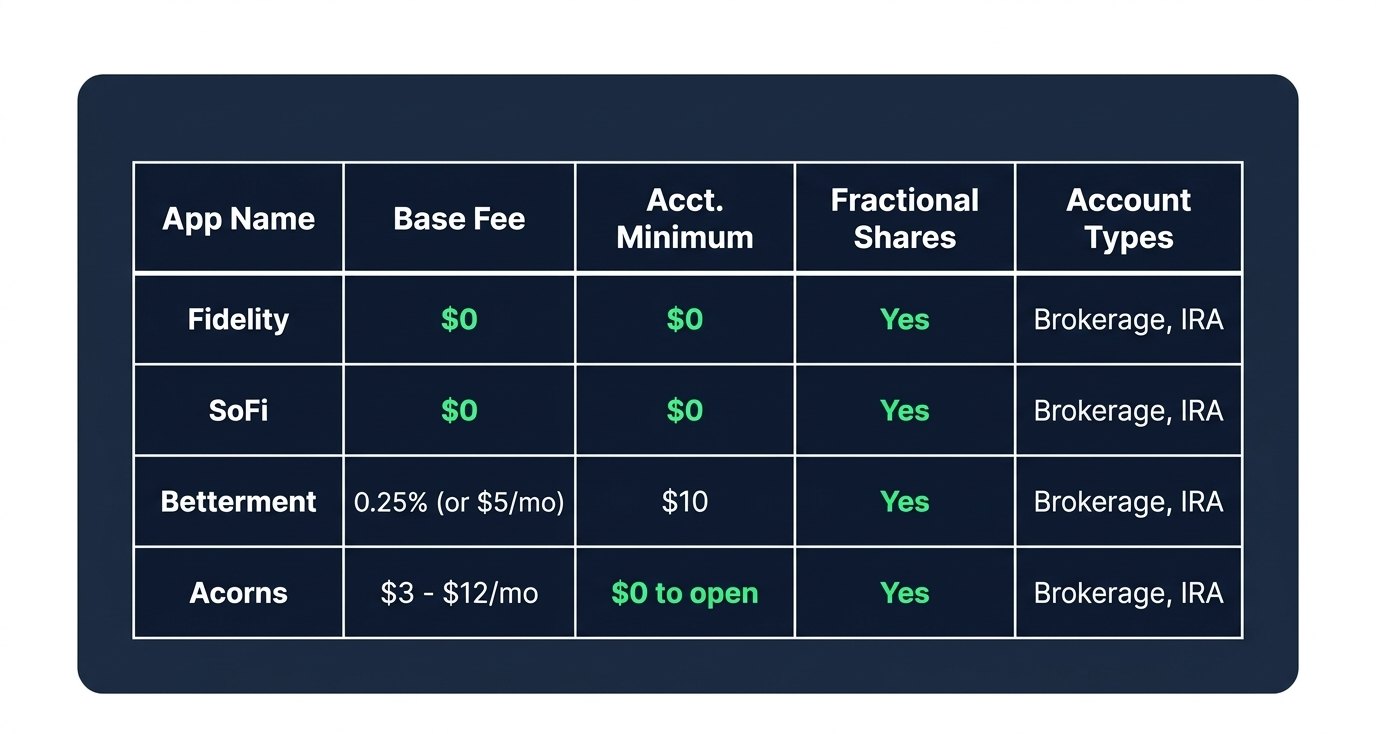
Comparing top beginner platforms helps you identify which app matches your budget and investing style. According to CNBC Select research as of October 2026, platforms differ by account type, minimum deposit rules, and fee structures. The table below outlines how seven major investing apps compare across key metrics.
| Investing App | App Category | Stock/ETF Commission | Account Minimum | Fractional Shares | Main Advisory/Account Fees | IRA Available |
|---|---|---|---|---|---|---|
| Robinhood | Full Brokerage | $0 online stock and ETF trades | $0 account balance minimum | Fractional share trading from $1 | $0 base ($5/mo Gold tier optional) | Traditional & Roth (1%–3% match) |
| Fidelity | Full Brokerage / Robo | $0 online stock and ETF trades | $0 to open ($10 for Fidelity Go) | Stocks and ETFs from $1 | $0 under $25,000; 0.35% over $25,000 | Traditional, Roth, & Rollover IRAs |
| Charles Schwab | Full Brokerage / Robo | $0 online stock and ETF trades | $0 to open ($5,000 for Robo) | Schwab Stock Slices ($5 minimum) | $0 advisory fee on Intelligent Portfolios | Traditional, Roth, & Custodial IRAs |
| Vanguard | Full Brokerage / Robo | $0 online stock and ETF trades | $0 to open ($100 for Robo) | Vanguard ETFs and fractional shares | 0.15% Digital Advisor fee (~$20 paper fee) | Traditional, Roth, & SEP IRAs |
| Public | Full Brokerage | $0 online stock and ETF trades | $1 starting balance minimum | Fractional shares & Treasury bond slices | $0 base ($100 outgoing ACAT transfer fee) | Traditional & Roth IRAs ($150 close fee) |
| Acorns | Micro-Investing / Robo | $0 online stock and ETF trades | $0 to open ($5 to start investing) | Automated fractional ETF portfolios | $3.00 to $12.00 flat monthly subscription | Acorns Later (1%–3% match on Gold) |
| Betterment | Robo-Advisor | $0 online stock and ETF trades | $0 to open ($10 ACH deposit) | Automated fractional ETF shares | $5/month or 0.25% annual management fee | Traditional, Roth, & SEP IRAs |
Is Robinhood best for active mobile traders?
Robinhood suits self-directed investors wanting a clean mobile app. According to Motley Fool 2026 reviews, Robinhood offers $0 commissions and a 1% to 3% IRA match, but StockBrokers.com notes it lacks mutual funds.
Is Fidelity best for all-in-one beginner education?
Fidelity suits first-time investors seeking built-in educational tools. According to Smart Money Picks 2026 reviews, Fidelity provides $0 trades, $0 minimums, and fractional shares, though its app interface feels less modern.
Is Charles Schwab best for research and long-term growth?
Charles Schwab suits beginners planning to grow into advanced market research. According to Motley Fool research, Schwab offers $0 trades and deep research, but its automated robo-advisor requires a $5,000 minimum.
Is Vanguard best for long-term index investors?
Vanguard suits buy-and-hold investors focused on low-cost broad index funds. According to CNBC Select reviews as of October 2026, Vanguard Digital Advisor charges a low 0.15% fee, but requires a $100 minimum.
Is Public best for learning with context?
Public suits investors wanting social community insights and context alongside fractional shares. According to Chime Invest disclosures as of April 2026, Public allows $1 fractional trades, though StockBrokers.com flags a $150 IRA closure fee.
Is Acorns best for automated spare change investing?
Acorns suits hands-off savers who want to automatically invest daily purchase round-ups. According to unbiased.com Acorns reviews as of 2026, Acorns invests spare change effortlessly, though its $3 to $12 monthly fee weighs heavily on small balances.
Is Betterment best for goal-based automated investing?
Betterment suits hands-off investors seeking goal-based portfolio automation. According to Betterment pricing disclosures as of July 27, 2026, automated portfolios cost 0.25% annually with $200 monthly deposits, though core accounts lack individual stock selection.
What does a $5,000 account really pay in fees?
To understand how fee structures impact your real costs, consider a $5,000 investment balance. Annual fees vary significantly between zero-commission brokers, percentage-based robo-advisors, and flat monthly subscriptions. The table below calculates the exact annual cost for each example fee level.
| Fee Model Type | Example Platform Fee Structure | Calculation Math ($5,000 Balance) | Total Yearly Fee Dollars | Effective Annual Fee Rate |
|---|---|---|---|---|
| $0 Broker + Index ETF | $0 commission + 0.03% ETF ratio | $5,000 x 0.03% ETF ratio | $1.50 per year | 0.03% |
| Percentage Robo-Advisor | 0.25% annual advisory fee | $5,000 x 0.25% fee | $12.50 per year | 0.25% |
| Flat Monthly Subscription | $3.00 flat fee per month | $3.00 x 12 months = $36.00 | $36.00 per year | 0.72% |
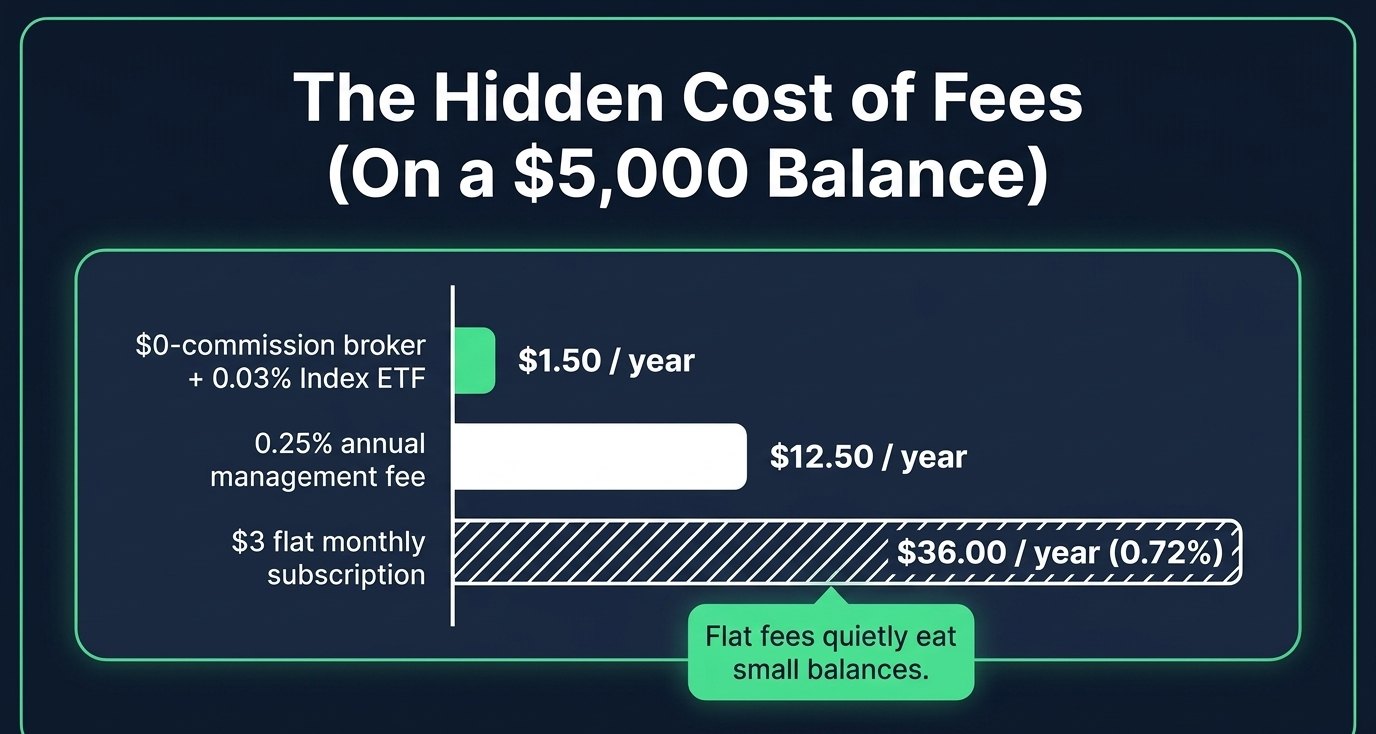
Fee percentages matter significantly more when managing smaller investment balances. According to unbiased.com Acorns reviews as of 2026, paying a flat $3 monthly fee on $500 equals an effective 7.2% annual fee rate. As your balance grows to $5,000, that same $3 monthly fee drops to an effective 0.72% annual fee rate. To evaluate underlying ETF operating costs before investing, read our guide on 10 Things to Check Before You Buy an ETF.
What are the 6 most common mistakes beginners make with investing apps?
Focusing solely on commission-free marketing: Ignoring monthly subscription fees erodes small account balances. According to unbiased.com Acorns reviews as of 2026, a $3 monthly fee on $500 equals a 7.2% annual fee rate.
Over-trading individual stocks impulsively: Easy mobile access leads beginners to trade too frequently. According to FINRA investor guides, frequent trading increases market timing errors and tax drag.
Ignoring account transfer and exit fees: Failing to check outgoing account transfer charges creates unexpected costs. According to Public fee disclosures as of 2026, outgoing account transfers cost $100 per account.
Skipping tax-advantaged retirement options: Investing in taxable accounts misses tax benefits. According to Investor.gov guides, holding index investments inside Roth IRAs shelters earnings from annual dividend taxes.
Misunderstanding SIPC protection limits: Assuming investor protection insurance covers market losses causes confusion. According to SIPC disclosures, coverage protects up to $500,000 against broker failure, not market price drops.
Failing to rebalance diversified portfolios: Letting asset weights drift alters your target risk profile. To learn how rebalancing maintains target allocations, read our guide on How to Build a Simple 3-ETF Portfolio.
What tools help beginners research and invest?
Mobile platforms allow you to trade, evaluate stocks, and chart market trends directly from your phone. Choosing the right tool depends on whether you need execution, AI scoring, or technical charting.
To execute commission-free stock trades and earn retirement match credits, consider using Robinhood. According to Motley Fool 2026 reviews, Robinhood offers $0 commissions, though it lacks mutual funds.
To evaluate institutional factor scores and fund holdings using artificial intelligence, explore Kavout. Kavout provides data-driven stock ranking algorithms, though advanced features require a paid plan.
To analyze technical price charts and set market alerts across global assets, use TradingView. TradingView delivers web-based charting tools, but real-time exchange data feeds require add-on fees.
For dollar-cost averaging strategies, explore What Happens If You Invest $100 a Month?. To compare popular core index funds, read our comparison on SCHD vs VOO.
Test yourself: 5 questions on investing apps
1. What does SIPC coverage protect against?
A) Capital losses from falling stock prices.
B) Loss of cash and securities if a registered broker fails.
C) Corporate dividend cuts.
D) Inflation reducing cash purchasing power.
Answer: B. According to SIPC disclosures, coverage protects up to $500,000 against brokerage insolvency.
2. What effective annual fee rate does a $3 monthly fee equal on $500?
A) 0.25% per year.
B) 1.0% per year.
C) 7.2% per year.
D) 12.0% per year.
Answer: C. A $3 monthly fee equals $36 yearly, representing 7.2% of a $500 balance.
3. How do fractional shares assist beginner investors?
A) They eliminate SEC transaction fees.
B) They allow you to buy pieces of high-priced stocks by dollar amounts.
C) They guarantee dividend payouts.
D) They double margin borrowing limits.
Answer: B. Fractional shares let you invest small dollar amounts into expensive individual stocks.
4. What primary service do automated robo-advisors provide?
A) Executing daily option trades.
B) Building and rebalancing diversified exchange-traded fund [ETF] portfolios.
C) Providing physical bank deposits.
D) Underwriting municipal bonds.
Answer: B. Robo-advisors manage ETF portfolios using automated software.
5. What fee do major full-service brokerage apps charge for online stock trades?
A) $4.95 per trade.
B) $0 online commission.
C) 1.0% of trade value.
D) $10.00 monthly fee.
Answer: B. Major full-service apps offer $0 online stock commissions.
FAQ
How much money do you need to start using an investing app?
You can start investing with $1 to $5 on many mobile platforms. According to Chime Invest disclosures as of 2026, fractional shares eliminate large capital requirements for beginners.
Are mobile investing apps safe for long-term retirement savings?
Yes, legitimate brokerage apps operate under federal regulatory oversight. According to FINRA guidelines, registered brokers provide SIPC protection up to $500,000 if the broker fails.
What is the difference between a robo-advisor and a full brokerage app?
A full brokerage app lets you trade individual stocks independently. A robo-advisor automatically manages a portfolio based on your risk profile, charging small fees averaging 0.25% per year.
Do you have to pay taxes on earnings inside an investing app?
Yes, capital gains and dividend income in taxable accounts incur annual taxes. According to Investor.gov guides, holding investments inside Roth IRAs allows earnings to grow tax-free.
Can you transfer your investments from one app to another later?
Yes, you can transfer holdings between brokerages using Automated Customer Account Transfer [ACAT] services. According to Public fee schedules as of 2026, outgoing transfer fees average $100.
The verdict
Selecting the best investing app depends on whether you prefer self-directed trading or automated portfolio management. Starting with a $0-commission platform and low-cost index funds protects compounding growth from fee drag. Take your next step today by setting up a recurring deposit schedule.
Sources: CNBC Select investing app study, Motley Fool 2026 app reviews, unbiased.com Acorns review, Chime Invest guide, Smart Money Picks research. Official pages: Betterment pricing schedule, Public fee schedule, Investor.gov glossary, FINRA BrokerCheck guide, SIPC protection guidelines. Also: Dr Wealth ETF study.
Investing involves risk, including the loss of the money you put in. Investments can go down as well as up, past performance does not guarantee future results, and you should check your local tax rules. This article is education, not financial advice.
