
- What causes overtrading?
- Emotional triggers
- Structural triggers
- Seven warning signs you are overtrading
- What overtrading costs: the hidden drag
- A worked example of cost drag
- How to measure overtrading in your journal
- Metric 1: average trades per day
- Metric 2: impulse share
- Six rules that stop overtrading
- A sample one-page rule sheet
- What a disciplined day looks like
- A simple weekly review routine
- Common overtrading mistakes
- FAQ
- What is overtrading?
- Can experienced traders overtrade?
- How does overtrading ruin a good strategy?
- What should I do right now if I notice I am overtrading?
- The verdict
Trading involves substantial risk of loss. This article is education, not financial advice.
Disclosure: this article contains affiliate links. If you sign up through them, Trader Edge Hub may earn a commission at no extra cost to you. We only mention tools we think fit the topic.
Most traders do not lose because they cannot read a chart. They lose because they take too many trades they should have skipped. Overtrading (trading far more often, or in larger size, than your plan and the market conditions justify) quietly drains accounts through bad trades and through the costs of every trade, win or lose. This guide explains what causes it, the seven warning signs, what it costs with a worked example, how to measure it in your own journal, and six rules that put a ceiling on it.
Quick answer: Overtrading is trading outside a written plan, driven by emotion rather than a valid setup. Common triggers are revenge after a loss, fear of missing out, overconfidence after wins and boredom. The fix is structure: a daily trade cap, an A+ setup checklist, a daily loss limit, a cooling-off break after losses and a journal that tracks how many of your trades broke the plan.
What causes overtrading?
It is rarely a lack of analysis. It is usually an emotional impulse or a gap in your setup. The sources we reviewed split the causes into two groups.
Emotional triggers
- Revenge trading (taking unplanned trades right after a loss to win the money back). Anger and urgency replace judgment, and drawdowns (the fall from a peak in account value) speed up.
- Fear of missing out, or FOMO. Watching a market run without you creates pressure to jump in late, with no clear entry, stop or target.
- Overconfidence after a winning streak. A run of wins can make marginal setups look good, and tempt you to increase size.
- Boredom. Waiting hours for a valid setup feels unproductive, so some traders take random trades just to feel active. At that point it is closer to gambling than trading.
Structural triggers
- No written trading plan. Without rules for what to trade, when to trade and when to stop, every session is improvised and emotion fills the gap.
- Too much leverage or size. Leverage (borrowed money that increases your buying power) makes small price moves feel huge, which leads to panic and rapid in-and-out trading.
Seven warning signs you are overtrading
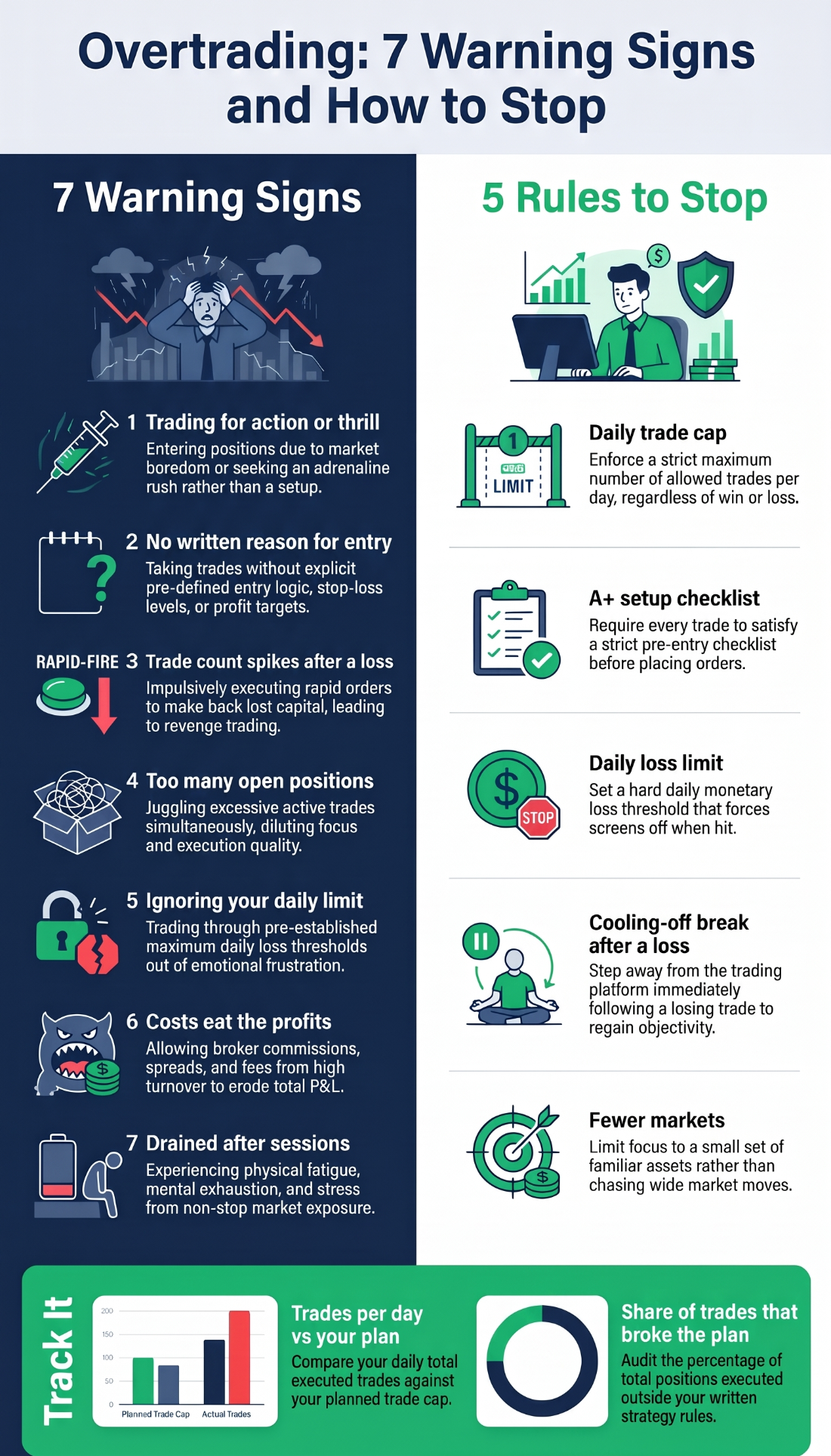
- You trade for action. You feel the urge to open a position just because the market is open.
- You cannot state your reason. You are in a trade but cannot say your entry logic, stop or target.
- Your trade count spikes after a loss. Several quick trades follow a stop-out as you try to recover.
- You hold too many positions to manage. You cannot watch them all, so exits get sloppy.
- You ignore your limits. You trade through your daily loss limit or trade cap, telling yourself the next one will fix the day.
- Costs eat your profits. Your account is flat or down despite a decent win rate, because commissions, spreads and fees absorb the gains.
- You feel drained. You finish sessions stressed, irritable or exhausted because emotions, not rules, ran the day.
What overtrading costs: the hidden drag
Overtrading hurts in two ways. First, the extra trades are usually low quality, so they lose more often. Second, every order has a price. Even with zero commission you pay the bid-ask spread (the gap between the best buy price and the best sell price) and slippage (the difference between the price you expected and the price you got). Small costs repeated many times add up.
A worked example of cost drag
This is a hypothetical, not a quote from any broker. Say you trade a $10,000 account and your all-in cost, including commission, spread and slippage, averages $2 per trade.
| Trades per day | Cost per day | Cost per 20-day month | As % of a $10,000 account |
|---|---|---|---|
| 3 | $6 | $120 | 1.2% |
| 10 | $20 | $400 | 4.0% |
| 25 | $50 | $1,000 | 10.0% |
At 25 trades a day you would need to earn 10% a month before you made a cent. Costs also raise the win rate you need. Imagine a 1:1 strategy that risks $100 to make $100, with $5 of all-in cost per trade. You win $95 or lose $105. Breakeven then sits at 105 ÷ 200 = 52.5% instead of 50%. The more trades you make, the more that gap costs you.
How to measure overtrading in your journal
You cannot fix what you do not measure. Two numbers from your trading journal (a log of each trade, why you took it and how it turned out) tell you most of what you need.
Metric 1: average trades per day
Divide your total trades over the last 30 trading days by 30 and compare the result with your plan. If your plan says three to five trades a day and your journal says fifteen, you have your answer.
Metric 2: impulse share
Tag every trade as either plan-compliant (it met your rules) or impulse (taken out of boredom, FOMO or revenge). Then calculate:
Formula: Impulse share = Impulse trades ÷ Total trades × 100. Example: 12 impulse trades out of 60 total is 12 ÷ 60 = 20%.
There is no official cutoff, but many traders aim to keep it low and treat a rising number as a warning. Filter your profit and loss by the two tags. For many traders, the impulse trades account for a large share of the losses. Our guide on keeping a trading journal shows how to set up these tags.
Six rules that stop overtrading
Willpower fades when you are stressed, so use rules that decide for you before the session starts.
- Set a daily trade cap. Pick a hard maximum, such as three to five trades. When you reach it, you are done for the day, win or lose.
- Use an A+ setup checklist. Before every entry, run a short written list: market conditions, pattern, stop distance, risk-reward. If a trade fails any item, skip it.
- Set a daily loss limit. One common rule is 3 times your risk per trade, which is $300 on a $10,000 account risking 1%. Our guide to daily loss limits and max drawdown covers how to set it. Use automatic locks if your platform offers them.
- Take a cooling-off break after a loss. For example, step away from the screen for 30 minutes. Physical distance helps break the loss-to-revenge-trade reflex.
- Limit your trading hours. Choose a window when your setups usually appear and close the platform outside it. Trading all day invites low-quality trades.
- Trade fewer markets. Watching one to three instruments you know well beats chasing twenty tickers, which creates overload and FOMO.
Rule 2 works best when it ties to your position size. Our position sizing guide shows how to keep risk the same on every trade, and our piece on stop loss placement helps you define the exit before you enter.
A sample one-page rule sheet
Write your limits on one page and keep it next to your screen. Here is a template you can adapt. The numbers are examples, not recommendations.
| Rule | Example setting | Why it helps |
|---|---|---|
| Max trades per day | 4 | Removes the option to chase action all day |
| Max risk per trade | 1% of account | Keeps any single loss small, so one bad trade does not tilt you |
| Daily loss limit | 3 losing trades, or 3R total | Stops a bad day from becoming a bad month |
| Cooling-off after a stop-out | 30 minutes away from the screen | Breaks the revenge-trade reflex |
| Trading window | First 2 hours after your market opens | Concentrates effort when your setups usually appear |
| Markets traded | 1 to 3 | Cuts overload and FOMO |
Notice that every row is a number you can check at the end of the day. A vague rule such as "be more patient" cannot be audited, but "no more than four trades" can. If you break a rule, log it as an impulse trade and move on without punishing yourself with bigger size.
What a disciplined day looks like
Here is a hypothetical walk-through. A trader with a $10,000 account risks $100 per trade, caps the day at four trades and stops at a $300 loss. The first trade hits the stop for a $100 loss. Instead of re-entering at once, the trader takes the planned 30-minute break. After it, a second setup passes the checklist and wins $200. The market then goes quiet for two hours. The old habit would be to force a trade; the plan says to wait. The trader closes the platform with two trades taken out of a possible four and a net gain of $100 before costs. Nothing dramatic happened, and that is the point. A good day under these rules is often a boring one.
Compare that with an impulse-driven day: the first loss triggers three quick revenge entries in the next ten minutes, each larger than the last, and the account is down $450 before lunch. The market was the same on both days. The difference was the rules.
A simple weekly review routine
Spend 15 to 20 minutes each weekend on four checks:
- Count trades. Compare your total for the week with your planned cap.
- Add up costs. Total your commissions, spreads and fees, and subtract them from gross profit to see the net result.
- Compare plan vs impulse. Calculate your impulse share and the net profit or loss of each group.
- Find your triggers. When did the impulse trades happen? After a loss, on a certain day, in the midday lull? Add one rule to your plan to address it next week.
Common overtrading mistakes
Common mistake: Relying on willpower alone. Trying to stay calm in the moment is far less reliable than a trade cap and a platform lock that you set in advance.
Common mistake: Treating the trade cap as a target. If the market offers no valid setups, taking fewer trades than the cap is the right call.
Pro tip: Practice new rules, such as a trade cap and a checklist, on a demo account first, so you are not testing discipline with real money.
Another trap is trading out of financial need. If you are trying to cover bills with trading profits, the pressure pushes you toward forced, low-quality trades. Keep trading capital separate from money you need.
FAQ
What is overtrading?
It is buying and selling far more often, or in much larger size, than your plan and the market conditions call for. It is mostly an emotional and structural problem, not an analysis problem.
Can experienced traders overtrade?
Yes. Overconfidence after a winning streak, revenge after an unexpected loss and boredom during quiet markets can affect anyone.
How does overtrading ruin a good strategy?
A strategy depends on selective setups. Overtrading adds trades with no edge and piles on commissions, spreads and slippage that eat the profits.
What should I do right now if I notice I am overtrading?
Close open positions, log out and step away for the rest of the session. Use the time to review your journal, find the trigger and set a trade cap for the next session.
The verdict
More trades do not mean more profit. Selectivity, small risk and clear rules protect an edge, while overtrading wears it down. Set your trade cap, write your checklist and start tagging impulse trades. Your next step: count your trades from the last five sessions and compare the number with what your plan says you should have taken.
Trading involves substantial risk of loss. This article is education, not financial advice.
Further reading: Overtrading usually comes from trying to win back losses or chase certainty. Mark Douglas's Trading in the Zone is a classic on accepting risk up front so each trade stops feeling personal. Check the current price on Amazon.
As an Amazon Associate, Trader Edge Hub earns from qualifying purchases.
