

- What is an options contract?
- What is a call option?
- What is a put option?
- What is a strike price?
- What is an option premium and what is it made of?
- Call vs put: how do they compare?
- How do call and put buyers and sellers differ?
- What does an options trade calculation look like with a $5,000 account?
- What are the 6 most common mistakes with calls and puts?
- Which tools help you trade call and put options?
- Test yourself: call and put basics
- FAQ
- What is the difference between exercising and selling an option?
- Can an option buyer lose more than the initial premium?
- What is the breakeven price for a put option?
- What does in the money mean for a call option?
- Why do options lose value over time?
- What happens if an option expires out of the money?
- The verdict
Trading involves substantial risk of loss, and most retail traders lose money. This article is education, not financial advice.
Disclosure: this article contains affiliate links. If you sign up through them, Trader Edge Hub may earn a commission at no extra cost to you. We only mention tools we think fit the topic. As an Amazon Associate, Trader Edge Hub earns from qualifying purchases.
Mastering options call and put basics [the core principles governing standardized options contracts] allows traders to hedge risks and build defined risk strategies. At Trader Edge Hub, we break down options mechanics with direct calculations and clear definitions.
Option contracts derive their market value from an underlying financial asset such as a stock or exchange-traded fund. Learning how strike prices, premiums, and expiration dates interact helps you evaluate contract risks before trading.
This beginner guide explains calls, puts, strike mechanics, and premium components step by step. We examine real market rules so you can navigate options markets with complete clarity.
Quick answer: A call option grants the right to buy 100 shares at a fixed strike price. A put option grants the right to sell 100 shares. Buyers pay a non-refundable upfront fee to cap their maximum risk. Sellers collect that fee but take on assignment obligations if exercised.
What is an options contract?
An options contract is a standardized financial derivative that grants specific trading rights to the contract buyer. According to the Options Clearing Corporation [OCC], one standard equity option contract controls exactly 100 shares of underlying stock.
Every contract specifies three core terms: the underlying asset, the strike price, and the expiration date. According to FINRA's educational guide, the buyer pays an upfront premium fee to acquire contractual rights without obligation.
Option contracts follow distinct exercise rules depending on exchange specifications. According to Charles Schwab's options guide, American-style options allow buyers to exercise their rights on any business day prior to expiration.
European-style options permit exercise strictly on the exact expiration date itself. According to Cboe's Options Institute documentation, most equity and ETF options trade as American-style contracts in US markets.
Trading standardized options offers defined flexibility compared to holding direct shares. According to Charles Schwab, understanding these contractual terms helps traders choose appropriate expiration dates and strike levels.
What is a call option?
A call option gives the contract buyer the right to buy 100 shares of stock at a specified strike price. According to Charles Schwab's strategies guide, call buyers express a bullish market view [expecting the stock price to rise].
The call buyer pays an upfront premium fee to the call seller [writer]. According to FINRA's options guide, this premium fee represents the absolute maximum financial loss for the call buyer.
If the stock price rises above the strike price, the call buyer gains value. According to Charles Schwab, the buyer can exercise the option to purchase shares below market value or sell the contract for profit.
If the stock price stays below the strike price through expiration, the call option expires worthless. According to Charles Schwab, the seller retains the collected premium while the buyer loses their fee.
Call options allow investors to participate in upside stock moves with significantly less initial capital. According to StrikeWatch EA's guide published in 2026, leveraging calls requires managing rapid time decay risks.
What is a put option?
A put option gives the contract buyer the right to sell 100 shares of stock at a specified strike price. According to Charles Schwab's guide, put buyers express a bearish market view [expecting the stock price to fall].
Put options also serve as effective portfolio insurance for existing stock holdings. According to Chase's options guide, investors buy put contracts to lock in a minimum sale price against broad market downturns.
The put buyer pays an upfront premium fee to the put seller. According to FINRA's guide, the put seller accepts the contractual obligation to purchase 100 shares if assigned by the buyer.
If the stock price drops below the strike price, the put buyer gains value. According to Charles Schwab, if the stock remains above the strike price at expiration, the put contract expires worthless.
Using puts as protective hedges allows stock investors to limit tail losses during market corrections. According to Charles Schwab, buying protective puts establishes a clear floor on potential stock losses.
What is a strike price?
The strike price [exercise price] is the fixed price at which the option buyer can buy or sell the underlying stock. According to the Options Industry Council [OIC], strike prices are set by exchanges at standardized price intervals.
The relationship between current stock price and strike price determines an option's moneyness state. According to Merrill Edge's pricing guide, options classify into three moneyness categories: in the money, at the money, or out of the money.
For call options, in the money [ITM] means stock price is above strike price. At the money [ATM] means stock price equals strike price, while out of the money [OTM] means stock price is below strike.
For put options, in the money means stock price is below strike price. At the money means stock price equals strike price, while out of the money means stock price is above strike.
Moneyness directly influences how sensitive an option's price is to underlying stock movements. According to Merrill Edge, in-the-money options contain real intrinsic cash value while out-of-the-money options contain zero intrinsic value.
Pro tip: Always convert per-share option premiums into total contract costs by multiplying by 100. A call quoted at $2.50 costs $250.00 total plus broker commissions.
What is an option premium and what is it made of?
The option premium is the total cash price paid by the buyer to the seller for the contract. According to Merrill Edge's pricing guide, option premium consists of two distinct components: intrinsic value and time value.
Intrinsic value [the real monetary value if exercised immediately] applies only to in-the-money options. According to Merrill Edge, out-of-the-money and at-the-money options contain zero intrinsic value.
Time value [extrinsic value] represents the premium portion above intrinsic value. According to Fidelity Investments' pricing guide, time value reflects remaining calendar time until expiration and implied volatility levels.
Three main market factors drive changes in option premiums over time. According to Fidelity Investments, premium prices shift based on underlying stock movements, time decay [theta], and implied volatility changes.
Time decay accelerates rapidly as the option approaches its expiration date. According to the CFA Institute's tutorial, options lose time value faster during their final 30 calendar days before expiration.
Implied volatility measures market expectations of future stock price fluctuations. According to Option Greeks Demystified, higher implied volatility increases extrinsic time value for both call and put options.
Common mistake: Buying short-dated out-of-the-money options expecting fast profits. Rapid time decay can erode 100% of an option's time value even if the stock price moves slightly in your favor.
Call vs put: how do they compare?
Comparing call and put options highlights how buyers and sellers manage opposing risk profiles. According to FINRA's options guide, understanding contract mechanics helps traders match options strategies to market expectations.
Option buyers take on limited risk capped at the premium paid upfront. Option sellers collect income but assume assignment risks if the market moves against their positions.
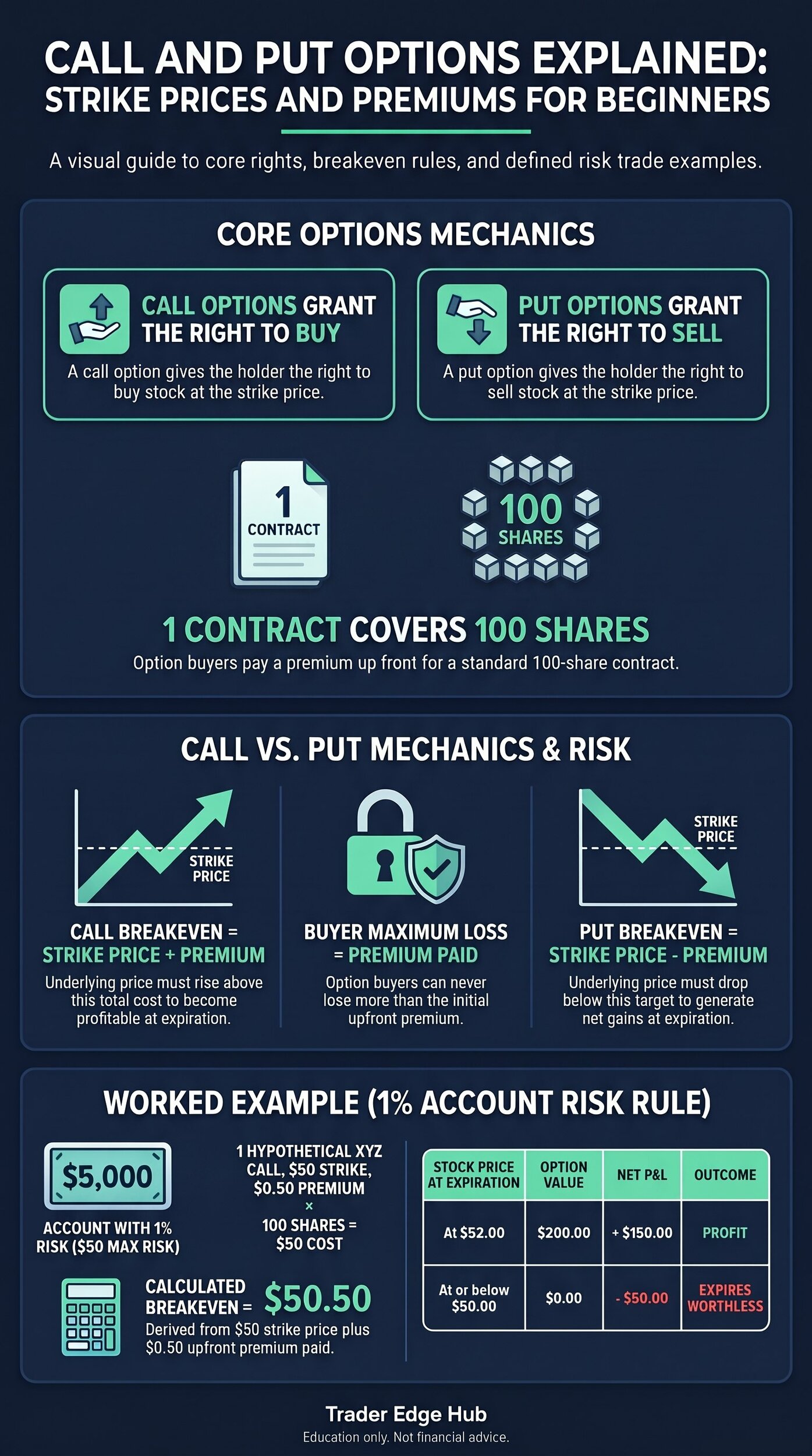
Calculating breakeven prices ensures you evaluate required stock moves before opening positions. According to MetroTrade's guide, call breakeven equals strike price plus premium, while put breakeven equals strike price minus premium.
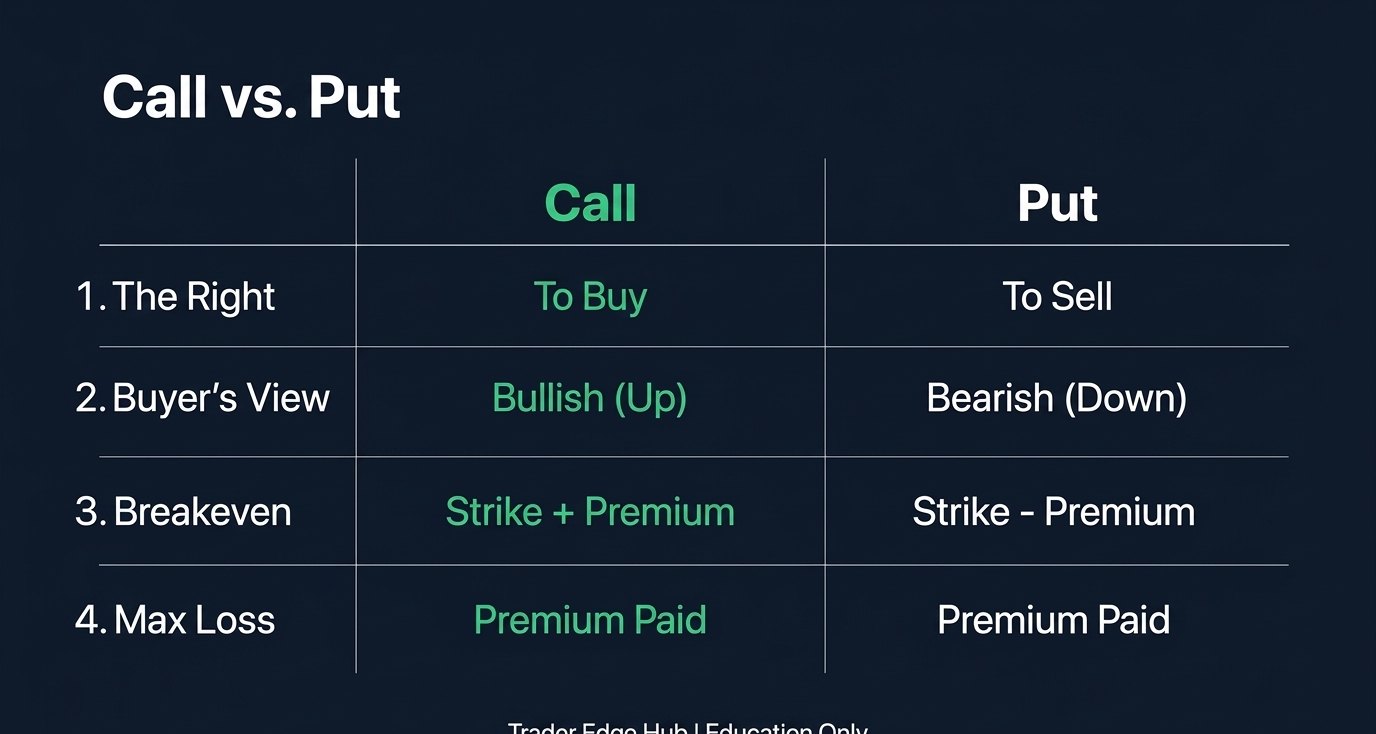
Evaluating these structural differences helps traders select the right contract for their portfolio goals. The table below compares call and put options across key operational parameters using verified exchange standards.
| Option Parameter | Call Option (Buyer) | Put Option (Buyer) | Call Option (Seller) | Put Option (Seller) |
|---|---|---|---|---|
| Contractual Right / Obligation | Right to buy 100 shares | Right to sell 100 shares | Obligation to sell 100 shares | Obligation to buy 100 shares |
| Market Direction View | Bullish [stock price rises] | Bearish [stock price falls] | Neutral to Bearish | Neutral to Bullish |
| Breakeven Stock Price | Strike Price + Premium | Strike Price – Premium | Strike Price + Premium | Strike Price – Premium |
| Maximum Financial Risk | Limited to Premium Paid | Limited to Premium Paid | Substantial (Uncovered) | Substantial (Strike – Premium) |
| Maximum Potential Profit | Uncapped as stock rises | Strike Price – Premium | Limited to Premium Received | Limited to Premium Received |
How do call and put buyers and sellers differ?
Every options trade involves a contract buyer and a contract seller [writer]. According to FINRA's options guide, buyers and sellers hold opposite rights, obligations, and financial risk profiles.
Option buyers pay an upfront premium fee to acquire contractual rights without obligation. According to Charles Schwab's options guide, buyer risk is limited strictly to the upfront premium paid.
Option sellers collect the upfront premium but accept binding assignment obligations. According to Charles Schwab, sellers must deliver or buy shares if the option holder exercises their right.
Selling uncovered call options carries substantial risk because stock prices can rise without limit. According to FINRA's guide, selling cash-secured puts limits loss to the strike price minus premium received.
Understanding these opposing roles helps traders decide whether to buy defined-risk contracts or collect option income. Reviewing rules in Stocks vs Options vs Futures for a Small Account clarifies capital requirements across asset classes.
What does an options trade calculation look like with a $5,000 account?
Walking through numerical examples shows how position sizing protects account equity. Following Position Sizing: The 1% Rule keeps maximum loss capped on every trade setup.
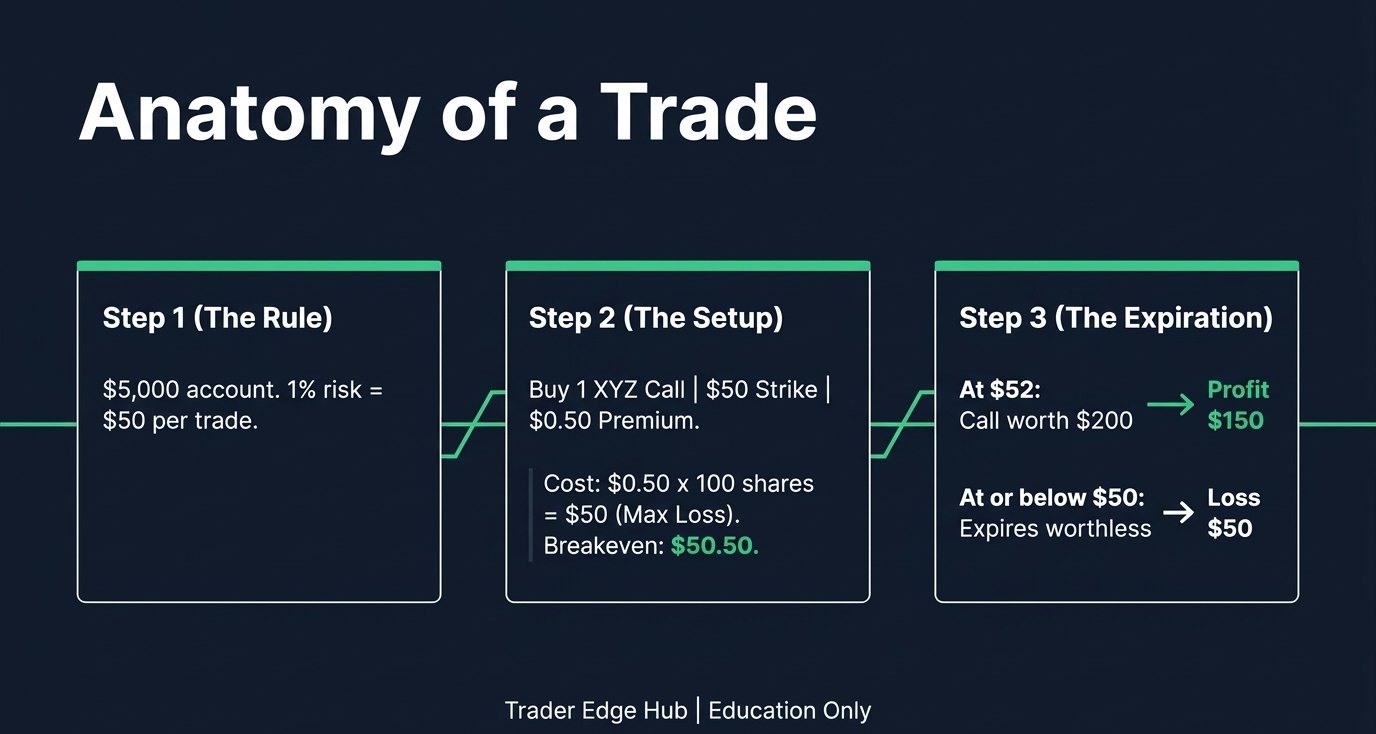
Consider a $5,000 trading account risking 1% ($50.00) on a single options contract. According to Charles Schwab's guide, buying one contract quoted at $0.50 premium costs $50.00 total ($0.50 multiplied by 100 shares).
First, analyze a hypothetical XYZ call option with a $50.00 strike price and $0.50 premium. The call breakeven price equals $50.50 ($50.00 strike plus $0.50 premium). At $52.00 expiration, the call is worth $2.00 per share ($200.00 total), yielding a $150.00 net profit.
At $50.50, the contract is worth $0.50 per share ($50.00 total), resulting in $0.00 profit. At or below $50.00, the call expires worthless, resulting in a $50.00 loss.
Now consider a matching XYZ put option with a $50.00 strike price and $0.50 premium. Total contract cost equals $50.00, setting maximum risk at 1% of account capital. The put breakeven price equals $49.50 ($50.00 strike minus $0.50 premium).
At $48.00 expiration, the put is worth $2.00 per share ($200.00 total), yielding a $150.00 net profit. At or above $50.00, the put expires worthless, capping maximum loss at $50.00. The table below details these call and put trade metrics side by side.
| Trade Metric / Option Parameter | XYZ $50 Call Option ($0.50 Premium) | XYZ $50 Put Option ($0.50 Premium) |
|---|---|---|
| Account Capital & Risk Limit (1%) | $5,000 balance x 1% = $50.00 risk limit | $5,000 balance x 1% = $50.00 risk limit |
| Option Premium & Total Cost | $0.50 x 100 shares = $50.00 total cost | $0.50 x 100 shares = $50.00 total cost |
| Expiration Breakeven Stock Price | $50.00 strike + $0.50 premium = $50.50 | $50.00 strike – $0.50 premium = $49.50 |
| Outcome at Favorable Stock Price | At $52.00: worth $200 ($150 profit) | At $48.00: worth $200 ($150 profit) |
| Outcome at Breakeven Stock Price | At $50.50: worth $50 ($0 profit) | At $49.50: worth $50 ($0 profit) |
| Outcome at Unfavorable Stock Price | At or below $50.00: expires worthless ($50 loss) | At or above $50.00: expires worthless ($50 loss) |
What are the 6 most common mistakes with calls and puts?
Avoiding frequent operational errors protects options trading capital from rapid decay. Most of these errors come from skipping the basic maths before the order goes in.
1. Buying short-dated out-of-the-money options expecting rapid stock moves. Accelerating time decay erodes extrinsic value quickly during final days before expiration.
2. Forgetting to multiply quoted option premiums by 100 shares. Miscalculating total contract cost leads to accidental over-leveraging across account positions.
3. Ignoring expiration breakeven prices when opening directional trades. Stock prices must move past the strike plus premium to generate profit at expiration.
4. Holding expiring long options into market close without sufficient exercise capital. Brokers may auto-exercise in-the-money contracts, creating unexpected share positions.
5. Selling uncovered call options without underlying stock or margin buffers. Uncovered call selling exposes traders to substantial losses if stock prices surge.
6. Over-risking capital on high implied volatility events like earnings announcements. Volatility crush causes option premiums to drop sharply immediately after earnings releases. Managing risk through Daily Loss Limits and Max Drawdown prevents sudden capital depletion.
Which tools help you trade call and put options?
Utilizing proper software platforms simplifies options analysis and order execution. Tracking underlying price trends ensures structured trade planning.
Using TradingView provides advanced charting tools for analyzing underlying stock trends. Monitoring support and resistance levels helps you evaluate entry timing before buying options.
Executing options trades requires an approved broker account like Robinhood. According to FINRA rules, brokers require traders to complete an options agreement and assign trading approval levels before opening contract orders.
For deeper mathematical insights into option pricing models and volatility, read Option Volatility and Pricing by Sheldon Natenberg, a classic deeper read for readers ready to go past the basics. Check the current price on Amazon. Evaluating probability models with Trading Expectancy builds long-term consistency.
Test yourself: call and put basics
Test your understanding of call options, put options, strike prices, and premiums with this five-question quiz.
1. How many shares of underlying stock are controlled by one standard equity option contract?
A) 10 shares
B) 50 shares
C) 100 shares
D) 500 shares
Answer: C. One standard equity option contract controls exactly 100 shares of underlying stock.
2. What is the maximum financial risk for a buyer of a call or put option?
A) Unlimited risk if the stock moves against you.
B) Capped strictly at the upfront premium paid for the contract.
C) The strike price multiplied by 100 shares.
D) Half of the total account balance.
Answer: B. Option buyers cap their maximum loss strictly at the total premium fee paid upfront.
3. On a $50 call option purchased for a $2.00 premium, what is the expiration breakeven stock price?
A) $48.00
B) $50.00
C) $52.00
D) $54.00
Answer: C. Call breakeven price equals the strike price plus premium paid ($50.00 plus $2.00 equals $52.00).
4. What happens to an option's time value as expiration approaches?
A) Time value increases exponentially.
B) Time value remains permanently fixed.
C) Time value decays, losing value faster during the final 30 days.
D) Time value converts directly into shares.
Answer: C. Option time value decays continuously over time, accelerating rapidly in the final 30 calendar days.
5. What is the market view of a put option buyer?
A) Bullish, expecting the stock price to rise.
B) Bearish, expecting the stock price to fall.
C) Neutral, expecting zero price movement.
D) Volatility neutral, expecting stable prices.
Answer: B. Put option buyers take a bearish market view, profiting when the underlying stock drops below strike minus premium.
FAQ
What is the difference between exercising and selling an option?
Exercising executes your contractual right to buy or sell underlying shares. Selling closes out your option contract in the secondary market for cash profit or loss.
Can an option buyer lose more than the initial premium?
No, option buyers can lose no more than the total upfront premium paid for the contract. Your maximum financial risk remains strictly capped at purchase.
What is the breakeven price for a put option?
Put breakeven price equals the strike price minus the per-share option premium paid. The underlying stock must drop below this price for the put buyer to profit at expiration.
What does in the money mean for a call option?
A call option is in the money when the current stock price sits above the contract strike price. In-the-money options contain positive intrinsic cash value.
Why do options lose value over time?
Options lose time value because fewer calendar days remain for the stock to make a favorable price move before expiration. Time decay accelerates during the final 30 days.
What happens if an option expires out of the money?
An out-of-the-money option expires worthless at expiration, and the buyer loses their paid premium. Comparing probability setups through Risk-Reward Ratio Explained improves overall trade selection.
The verdict
Understanding call and put options allows traders to execute defined-risk positions and hedge existing stock portfolios effectively. Mastering strike price selection, premium pricing, and expiration decay transforms basic stock trading into structured risk management.
Your immediate next step is to paper trade one call option and one put option on a demo account. Record exact strike prices, premiums, and breakeven levels before risking real capital.
Sources: OCC Characteristics and Risks of Standardized Options, FINRA Options Guide, Charles Schwab Options Strategies, Merrill Edge Option Pricing, Cboe Options Institute, Fidelity Options Pricing, CFA Institute Options Tutorial.
Trading involves substantial risk of loss, and most retail traders lose money. This article is education, not financial advice.
